

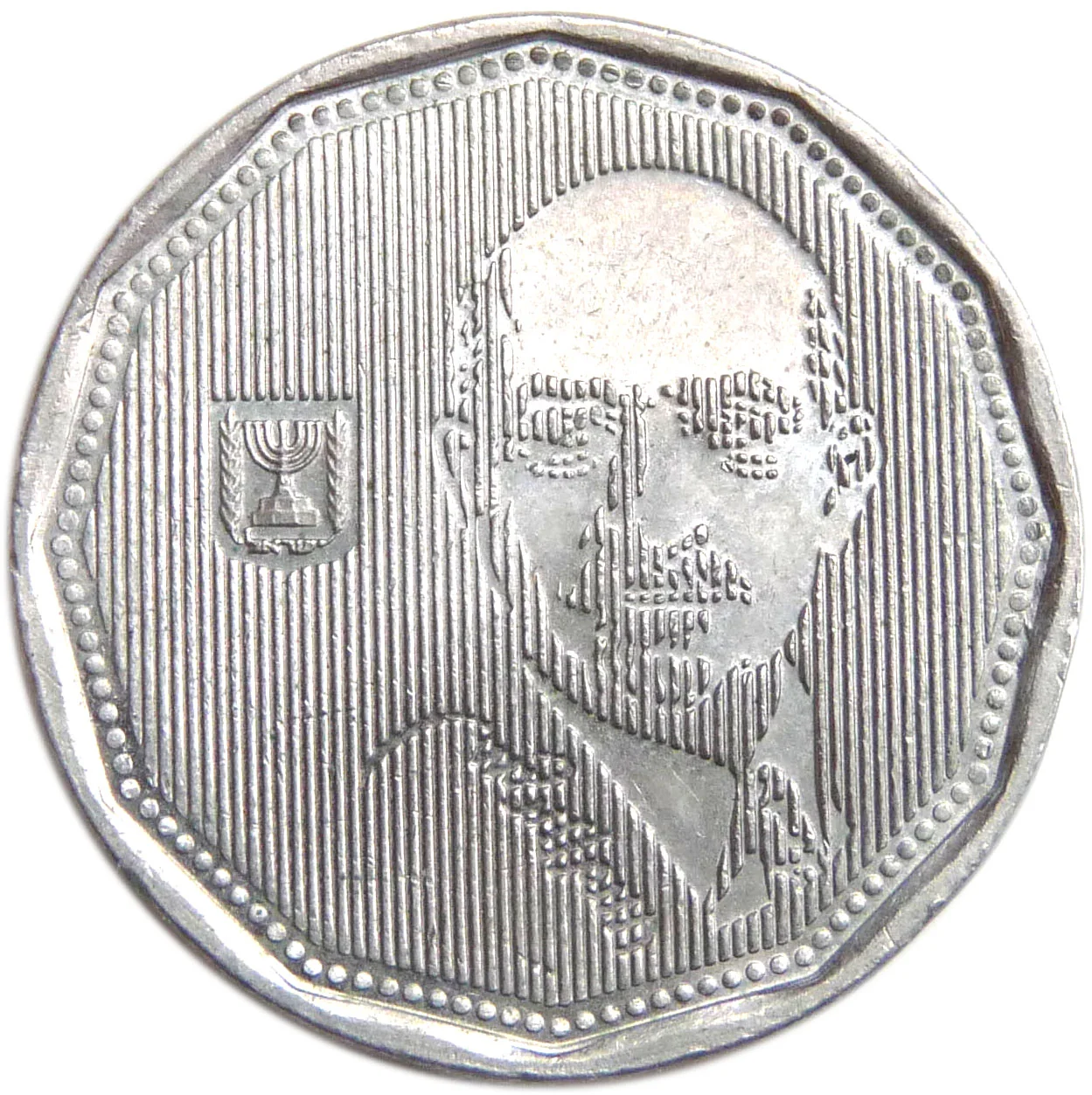
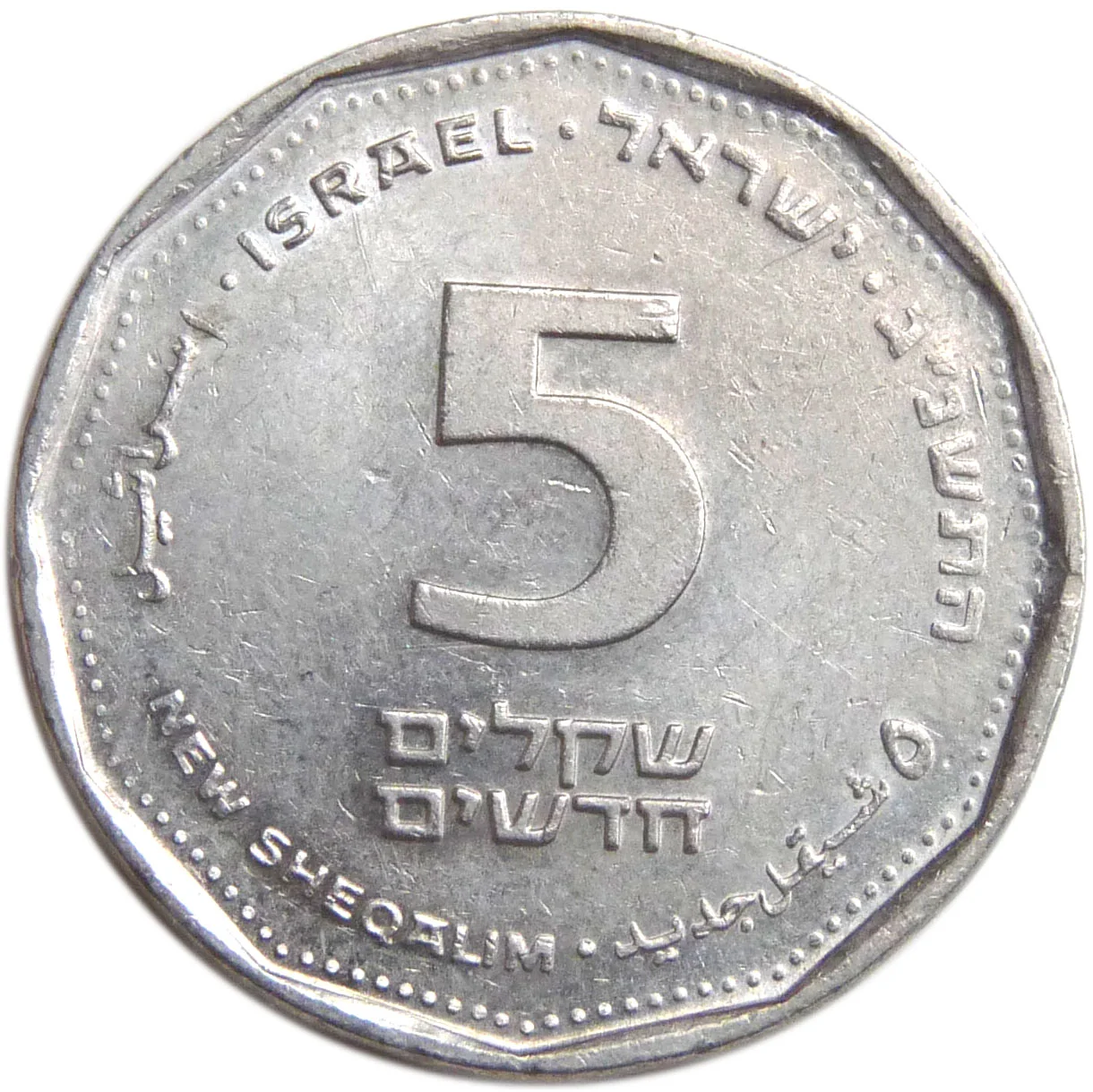
5 New Sheqalim – Israel
Circulating commemorative coins
Commemoration: Chaim Weizmann
Israel
Context
Material
Diameter: 24 mm
Weight: 8.2 g
Thickness: 2.45 mm
Shape: Dodecagonal
Technique: Milled
Alignment: Medal alignment
flip
References
KM: #Click to copy to clipboard237
Numista: #15972
Value
Exchange value: 5 ILS = $1.61
Inflation-adjusted value: 14.21 ILS
Obverse
Reverse
Description:
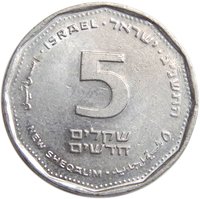
"5 New Sheqalim" in Hebrew, Arabic, English; Hebrew date; "Israel" in Hebrew, Arabic, English; surrounded by pearls.
Inscription:
ISRAEL · ישראל · اسرائيل · התשנ״ג
5 שקלים חדשים
NEW SHEQALIM · ٥ شيقل جديد
5 שקלים חדשים
NEW SHEQALIM · ٥ شيقل جديد
Translation:
Five New Sheqalim
NEW SHEQALIM · Five New Sheqalim
NEW SHEQALIM · Five New Sheqalim
Edge
Mints
| Name | Mark |
|---|---|
| Jerusalem | — |
Mintings
| Year | Mint Mark | Mintage | Quality | Collection |
|---|---|---|---|---|
| 1993 | — | 1,500,000 |
Historical background
In 1993, Israel's currency situation was characterized by a managed float of the New Israeli Shekel (NIS), which had replaced the hyper-inflated old shekel in 1985 as part of a comprehensive stabilization plan. The Bank of Israel actively intervened in foreign exchange markets to control volatility and maintain a stable and competitive exchange rate, primarily against the US dollar. This stability was a hard-won achievement, as the economy was still in a transitional phase from the triple-digit inflation of the early 1980s, with price increases now subdued to an annual rate of roughly 10-11%. The shekel's value was thus a critical anchor for economic confidence and growth.
The period was also defined by the ongoing process of economic liberalization, including the gradual removal of foreign exchange controls. Just two years prior, in 1991, a major step was taken with the introduction of the "Pazak" (Foreign Currency Account) system, allowing Israeli citizens and companies to hold and transact in foreign currency freely for the first time in decades. By 1993, this increased convertibility was integrating Israel more fully into the global financial system, facilitating foreign investment and trade, which were seen as vital for the expanding economy.
Furthermore, the currency environment in 1993 was indirectly influenced by the geopolitical optimism following the signing of the Oslo Accords in September of that year. The prospect of peace spurred significant inflows of foreign capital and boosted economic projections, placing upward pressure on the shekel. The Bank of Israel faced the dual challenge of preventing excessive appreciation that could harm exports while maintaining the anti-inflationary discipline that was the cornerstone of the post-1985 economic policy. This delicate balancing act defined the monetary landscape as Israel navigated both economic modernization and a changing political reality.
The period was also defined by the ongoing process of economic liberalization, including the gradual removal of foreign exchange controls. Just two years prior, in 1991, a major step was taken with the introduction of the "Pazak" (Foreign Currency Account) system, allowing Israeli citizens and companies to hold and transact in foreign currency freely for the first time in decades. By 1993, this increased convertibility was integrating Israel more fully into the global financial system, facilitating foreign investment and trade, which were seen as vital for the expanding economy.
Furthermore, the currency environment in 1993 was indirectly influenced by the geopolitical optimism following the signing of the Oslo Accords in September of that year. The prospect of peace spurred significant inflows of foreign capital and boosted economic projections, placing upward pressure on the shekel. The Bank of Israel faced the dual challenge of preventing excessive appreciation that could harm exports while maintaining the anti-inflationary discipline that was the cornerstone of the post-1985 economic policy. This delicate balancing act defined the monetary landscape as Israel navigated both economic modernization and a changing political reality.
🌱 Common