

50 centavos (General San Martin's Death) – Argentina
Add to wishlist
Circulating commemorative coins
Commemoration: 150th Anniversary of General San Martin's Death
Argentina
Context
Material
Diameter: 25.2 mm
Weight: 5.8 g
Thickness: 1.8 mm
Shape: Round
Composition: Aluminium bronze
Magnetic: No
Technique: Milled
Alignment: Medal alignment
flip
References
KM: #
Numista: #15957
Value
Exchange value: 0.50 ARS
Obverse
Description:
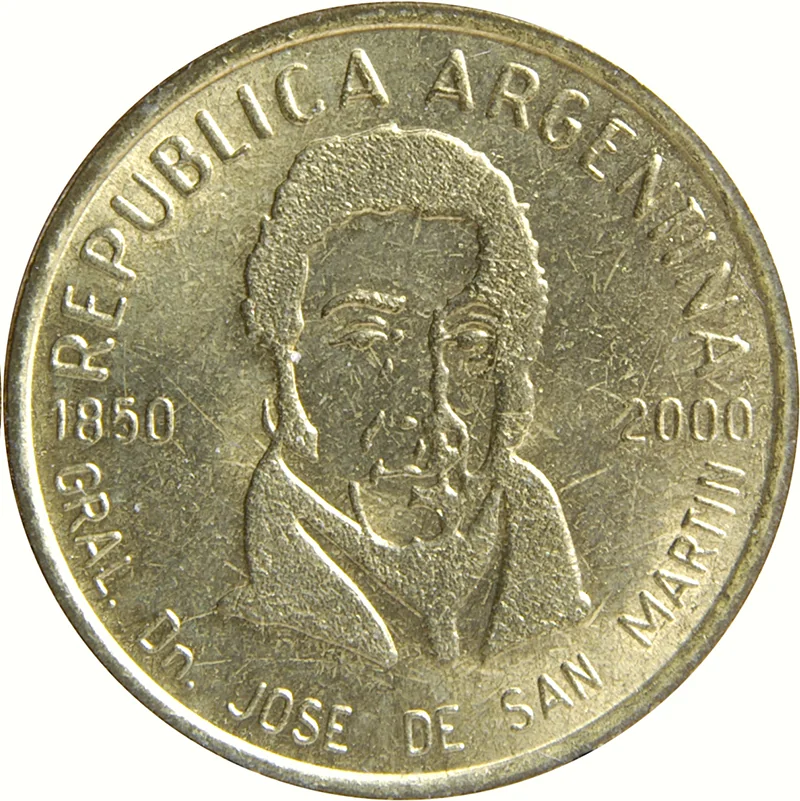
Bust of General San Martín, front view.
Inscription:
REPUBLICA ARGENTINA
1850 2000
GRAL. Dn. JOSE DE SAN MARTIN
1850 2000
GRAL. Dn. JOSE DE SAN MARTIN
Translation:
Argentine Republic
1850 2000
General Don Jose de San Martin
1850 2000
General Don Jose de San Martin
Script: Latin
Language: Spanish
Engraver: Carlos Pedro Rodríguez Dufour
Reverse
Description:
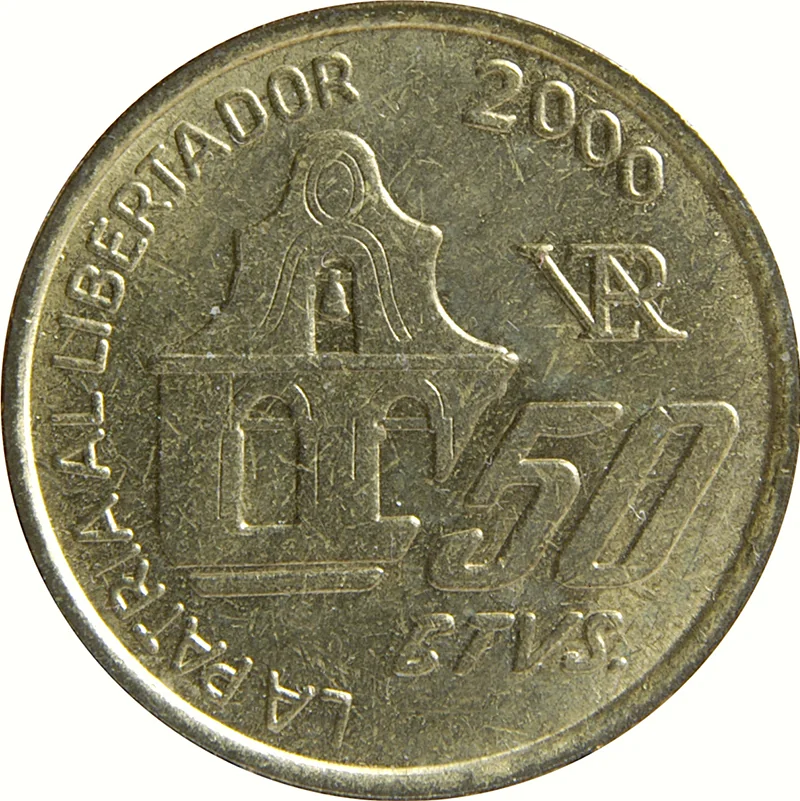
San Carlos Convent's bell gable, with the monogram "VIVA LA PATRIA" beside the bell. Date and face value.
Inscription:
LA PATRIA AL LIBERTADOR 2000
50
CTVS.
50
CTVS.
Translation:
The Homeland to the Liberator 2000
50
Centavos.
50
Centavos.
Script: Latin
Language: Spanish
Engraver: Carlos Pedro Rodríguez Dufour
Edge
Reeded
Categories
| Person> Military leader |
| Person> Politician |
| Event> Death anniversary |
Mintings
| Year | Mint Mark | Mintage | Quality | Collection |
|---|---|---|---|---|
| 2000 | — | 995,000 |
Historical background
Argentina entered the year 2000 trapped in the rigid constraints of its Convertibility Plan, established in 1991 to halt hyperinflation. This law pegged the Argentine peso at a one-to-one parity with the U.S. dollar, making the Central Bank effectively a currency board that could only issue new pesos if backed by an equal amount of dollar reserves. Initially successful in stabilizing prices and attracting foreign investment, the system created a profound loss of monetary sovereignty. The government could no longer print money to finance deficits, and the peso's value was entirely dependent on the maintenance of full foreign exchange reserves.
However, by 2000, the structural flaws of convertibility had become critical. A series of external shocks, including the 1997 Asian Financial Crisis and the 1999 Brazilian devaluation, severely damaged Argentina's export competitiveness. Stuck with an overvalued peso, the economy sank into a deep and prolonged recession beginning in 1998. Tax revenues plummeted while public debt, much of it denominated in dollars, ballooned. The government resorted to severe austerity and borrowed heavily from the International Monetary Fund (IMF), but confidence evaporated. A growing perception that the dollar peg was unsustainable led to capital flight, steadily draining the very reserves that backed the currency.
Thus, the currency situation in 2000 was one of acute vulnerability and impending crisis. The fixed exchange rate, once a pillar of stability, had become a straitjacket that prevented economic adjustment and fueled a vicious cycle of recession, deflation, and rising debt burdens. Despite massive IMF bailouts, the drain on reserves continued unabated, setting the stage for the catastrophic collapse of convertibility that would occur at the end of 2001.
However, by 2000, the structural flaws of convertibility had become critical. A series of external shocks, including the 1997 Asian Financial Crisis and the 1999 Brazilian devaluation, severely damaged Argentina's export competitiveness. Stuck with an overvalued peso, the economy sank into a deep and prolonged recession beginning in 1998. Tax revenues plummeted while public debt, much of it denominated in dollars, ballooned. The government resorted to severe austerity and borrowed heavily from the International Monetary Fund (IMF), but confidence evaporated. A growing perception that the dollar peg was unsustainable led to capital flight, steadily draining the very reserves that backed the currency.
Thus, the currency situation in 2000 was one of acute vulnerability and impending crisis. The fixed exchange rate, once a pillar of stability, had become a straitjacket that prevented economic adjustment and fueled a vicious cycle of recession, deflation, and rising debt burdens. Despite massive IMF bailouts, the drain on reserves continued unabated, setting the stage for the catastrophic collapse of convertibility that would occur at the end of 2001.


🌱 Common