

Obverse
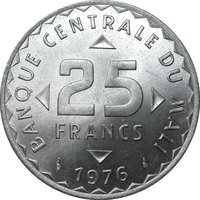
Description:
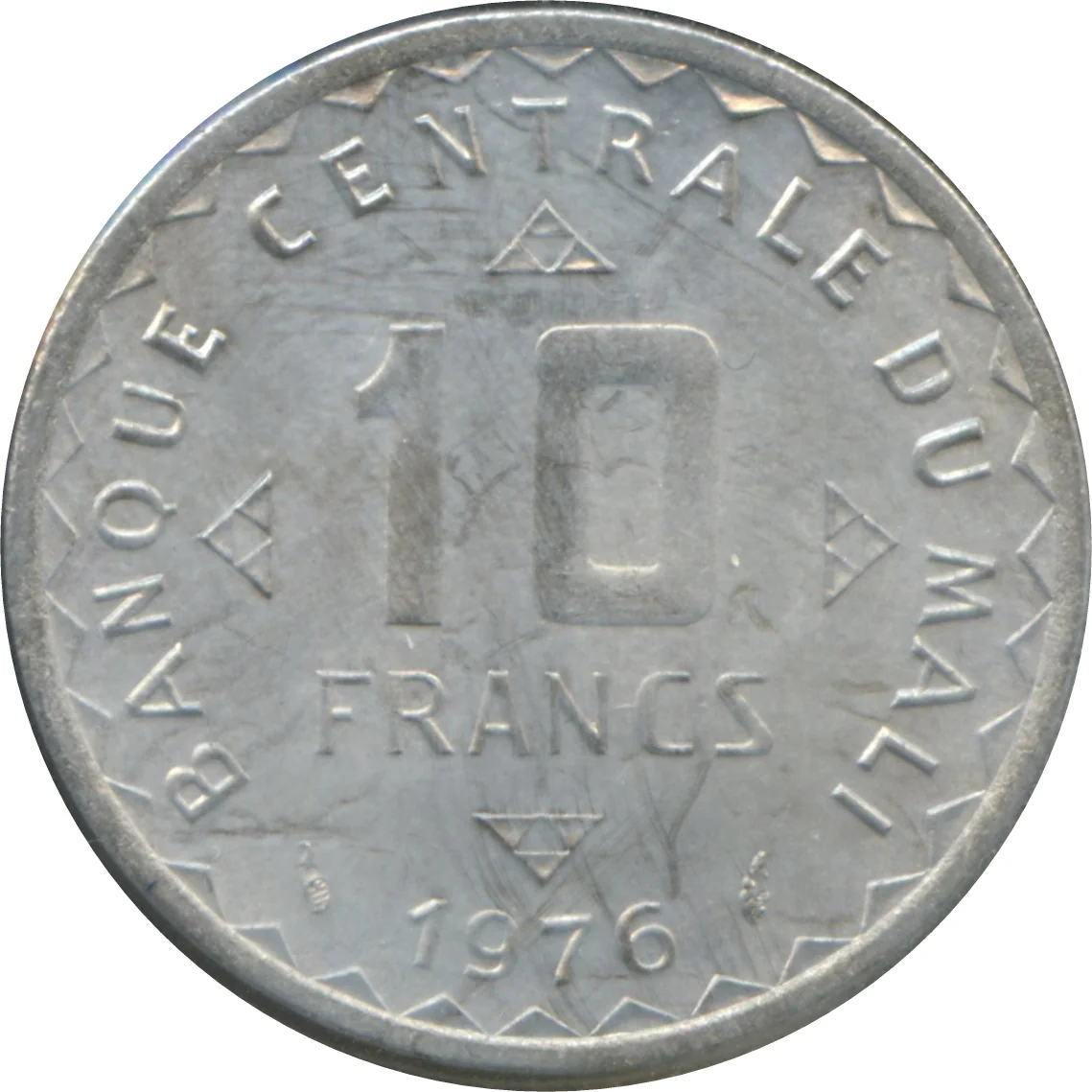
Denomination and date below.
Inscription:
BANQUE CENTRALE DU MALI
▲
◀ 10 ▶
FRANCS
▼
1976
▲
◀ 10 ▶
FRANCS
▼
1976
Translation:
CENTRAL BANK OF MALI
▲
◀ 10 ▶
FRANCS
▼
1976
▲
◀ 10 ▶
FRANCS
▼
1976
Script: Latin
Language: French
Engraver: Raymond Joly
Reverse
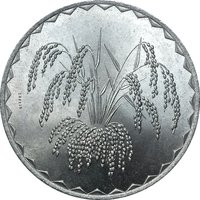
Description:
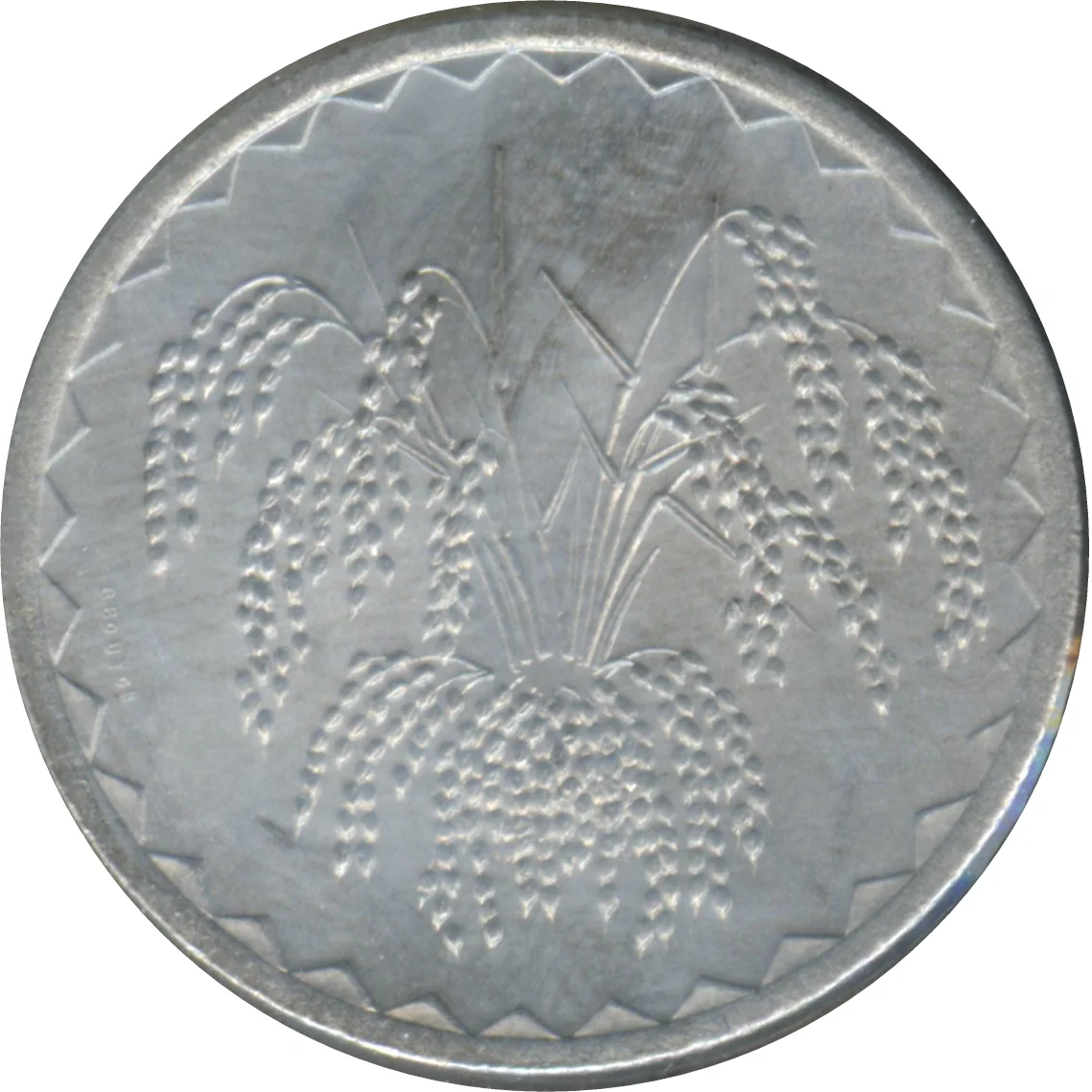
Sorghum.
Engraver: Raymond Joly
Edge
Plain
Mints
| Name | Mark |
|---|---|
| Monnaie de Paris | — |
Mintings
| Year | Mint Mark | Mintage | Quality | Collection |
|---|---|---|---|---|
| 1976 | — | 5,000,000 |
Historical background
In 1976, Mali's currency situation was defined by its membership in the West African Monetary Union (UMOA) and its use of the CFA franc. The CFA franc, created in 1945, was (and remains) a currency pegged to the French franc with a guaranteed fixed exchange rate and convertibility, backed by operations accounts held at the French Treasury. For Mali, this arrangement provided monetary stability and facilitated trade with France and other UMOA members, but it also meant ceding significant control over its monetary policy to the regional central bank, the BCEAO, and maintaining a strong financial link to the former colonial power.
This period followed a significant historical divergence. Mali had initially left the CFA zone in 1962 under President Modibo Keïta, introducing its own independent franc in an effort to pursue economic self-determination. However, this experiment led to economic isolation, fiscal difficulties, and currency devaluation. Following a coup in 1968, the new military government of Moussa Traoré sought to reintegrate with regional partners. Consequently, Mali rejoined the UMOA and the CFA franc zone in 1967, a process that was fully consolidated by the early 1970s. Thus, by 1976, Mali was in a phase of relative monetary stability under the CFA system, having deliberately chosen regional integration and guaranteed convertibility over autonomous monetary sovereignty.
The broader economic context in 1976 was challenging, marked by the lasting effects of the catastrophic Sahel droughts of the early 1970s, which devastated Mali's agrarian economy. While the fixed CFA franc provided stability, it also limited the government's ability to use currency devaluation as a tool to boost export competitiveness for key commodities like cotton and livestock. Therefore, Mali's currency situation in 1976 was one of institutional stability within a neo-colonial framework, but this stability existed alongside profound structural economic vulnerabilities and a recent history that underscored the political tensions between monetary independence and regional integration.
This period followed a significant historical divergence. Mali had initially left the CFA zone in 1962 under President Modibo Keïta, introducing its own independent franc in an effort to pursue economic self-determination. However, this experiment led to economic isolation, fiscal difficulties, and currency devaluation. Following a coup in 1968, the new military government of Moussa Traoré sought to reintegrate with regional partners. Consequently, Mali rejoined the UMOA and the CFA franc zone in 1967, a process that was fully consolidated by the early 1970s. Thus, by 1976, Mali was in a phase of relative monetary stability under the CFA system, having deliberately chosen regional integration and guaranteed convertibility over autonomous monetary sovereignty.
The broader economic context in 1976 was challenging, marked by the lasting effects of the catastrophic Sahel droughts of the early 1970s, which devastated Mali's agrarian economy. While the fixed CFA franc provided stability, it also limited the government's ability to use currency devaluation as a tool to boost export competitiveness for key commodities like cotton and livestock. Therefore, Mali's currency situation in 1976 was one of institutional stability within a neo-colonial framework, but this stability existed alongside profound structural economic vulnerabilities and a recent history that underscored the political tensions between monetary independence and regional integration.
🌱 Fairly Common