


Obverse
Description:
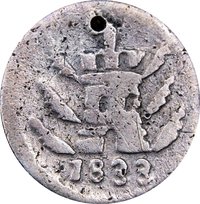
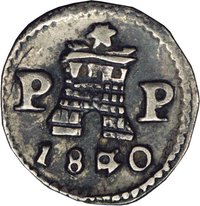
Wide Castle, undated
Reverse
Description:
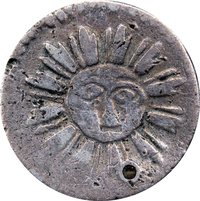
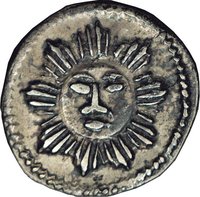
Smiling sun.
Edge
Plain
Categories
| Building> Castle or fortification |
| Symbol> Sun |
Mintings
| Year | Mint Mark | Mintage | Quality | Collection |
|---|---|---|---|---|
| 1833 | — | — |
Historical background
In 1833, the province of Córdoba, Argentina, was navigating the severe economic turmoil that characterized the early decades of the nation's independence. The collapse of the central authority and the rise of provincial caudillos led to the fragmentation of the national economy. The Buenos Aires-controlled Banco Nacional had ceased issuing a national currency, and the subsequent scarcity of precious metals forced provinces like Córdoba to issue their own, largely unbacked paper money to finance their governments and militias. This resulted in a chaotic monetary landscape where each province's notes traded at wildly different discounts.
Governor José Vicente Reinafé, in power since 1831, continued the practice of issuing provincial paper money, known as billetes de Córdoba. These notes were not backed by gold or silver but by the promise of future provincial tax revenues, leading to rapid depreciation and deep public distrust. The currency's value was highly unstable, fluctuating with the province's political fortunes and military expenditures, which were significant due to Córdoba's involvement in the ongoing civil wars between Unitarians and Federalists.
The monetary situation severely disrupted commerce, both within the province and with neighboring regions. Merchants and the public had to contend with a confusing array of devalued paper from various provinces alongside a limited supply of hard currency. This environment fostered barter, exacerbated inflation for basic goods, and weakened Córdoba's economic integration. Ultimately, the currency crisis of 1833 was a direct symptom of the broader political instability and fiscal weakness of the Argentine Confederation, reflecting a period where monetary policy was a tool of wartime finance rather than economic stability.
Governor José Vicente Reinafé, in power since 1831, continued the practice of issuing provincial paper money, known as billetes de Córdoba. These notes were not backed by gold or silver but by the promise of future provincial tax revenues, leading to rapid depreciation and deep public distrust. The currency's value was highly unstable, fluctuating with the province's political fortunes and military expenditures, which were significant due to Córdoba's involvement in the ongoing civil wars between Unitarians and Federalists.
The monetary situation severely disrupted commerce, both within the province and with neighboring regions. Merchants and the public had to contend with a confusing array of devalued paper from various provinces alongside a limited supply of hard currency. This environment fostered barter, exacerbated inflation for basic goods, and weakened Córdoba's economic integration. Ultimately, the currency crisis of 1833 was a direct symptom of the broader political instability and fiscal weakness of the Argentine Confederation, reflecting a period where monetary policy was a tool of wartime finance rather than economic stability.
✨ Legendary