

1 New Sheqel (FAO) – Israel
Non-circulating coins
Commemoration: FAO 50th Anniversary
Israel
Context
Year: 1995
Hebrew Year: 5755
Issuer: Israel 
Issuing organization: Israel Government Coins and medals Corp.
Period:
(since 1948)
Currency:
(since 1986)
Total mintage: 3,945
Material
References
KM: #Click to copy to clipboard271
Numista: #159264
Value
Exchange value: 1 ILS = $0.32
Bullion value: $37.34
Inflation-adjusted value: 2.28 ILS
Obverse
Description:
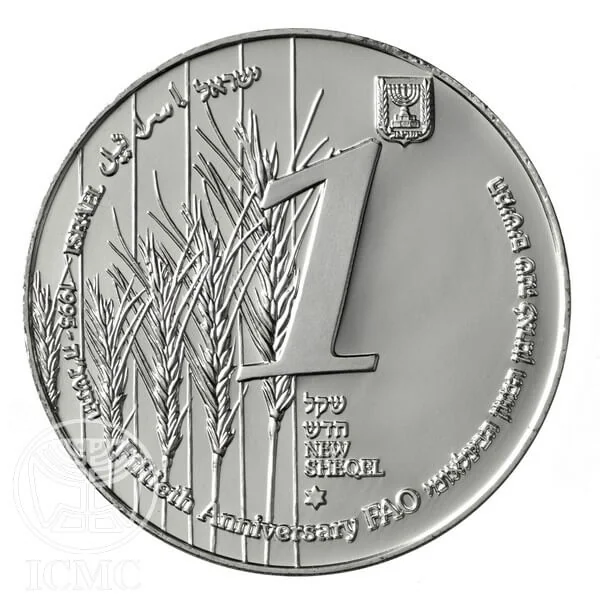
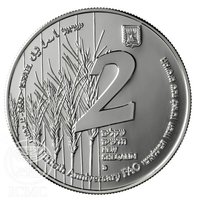
Silver 1 New Sheqel coin. Obverse: Face value in Hebrew and English, State Emblem. Reverse: Ears of grain with inscriptions "Fiftieth Anniversary FAO" in Hebrew and English, "ISRAEL" in Hebrew, Arabic, and English, and the dual date 1995/5755.
Inscription:
1
שקל חדש NEW SHEQEL
✡
ישראל
ISRAEL اسرائيل
התשנ"ה 1995
חמשים שנה לארגון המזון הבינלאומי
Fiftieth Anniversary FAO
שקל חדש NEW SHEQEL
✡
ישראל
ISRAEL اسرائيل
התשנ"ה 1995
חמשים שנה לארגון המזון הבינלאומי
Fiftieth Anniversary FAO
Translation:
New Sheqel
Israel
1995
Fifty Years to the International Food Organization
Israel
1995
Fifty Years to the International Food Organization
Engravers: Ruben Nutels, Tidhar Dagan
Reverse
Description:
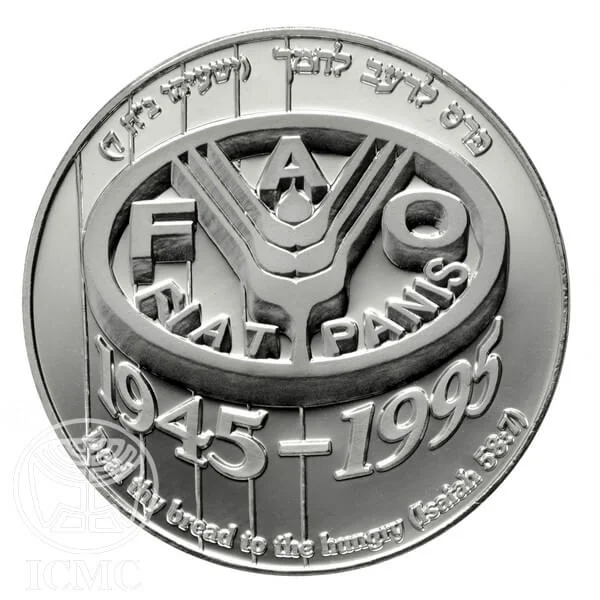
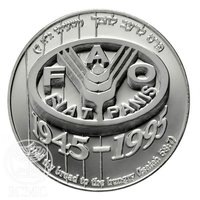
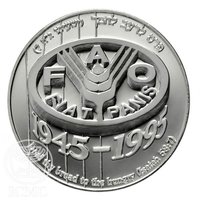
FAO emblem with "1945-1995," the inscription "Deal thy bread to the hungry," and Isaiah 58:7 in Hebrew and English.
Inscription:
FAO
1945-1995
פרס לרעב לחמך
(ישעיהו נ"ח 8)
Deal thy bread to the hungry
(Isaiah 58:7)
1945-1995
פרס לרעב לחמך
(ישעיהו נ"ח 8)
Deal thy bread to the hungry
(Isaiah 58:7)
Translation:
FAO
1945-1995
Deal thy bread to the hungry
(Isaiah 58:7)
Deal thy bread to the hungry
(Isaiah 58:7)
1945-1995
Deal thy bread to the hungry
(Isaiah 58:7)
Deal thy bread to the hungry
(Isaiah 58:7)
Engravers: Ruben Nutels, Tidhar Dagan
Edge
Plain
Categories
| Organization> FAO |
Mints
| Name | Mark |
|---|---|
| Mint of Finland | — |
Mintings
| Year | Mint Mark | Mintage | Quality | Collection |
|---|---|---|---|---|
| 1995 | — | 3,945 |
Historical background
In 1995, Israel's currency situation was characterized by a period of relative stability and successful economic management under the framework of the New Israeli Shekel (NIS), which had been introduced in 1986 to replace the hyper-inflated old shekel. The primary focus of the Bank of Israel was maintaining price stability, having successfully tamed the triple-digit inflation of the early 1980s. Inflation in 1995 was a manageable 8.1%, a significant achievement, though policymakers continued to aim for lower single-digit rates comparable to developed nations. This stability was underpinned by a managed float exchange rate regime, where the shekel's value was allowed to fluctuate within a secret band ("the crawling band") against a basket of currencies, primarily the US Dollar and German Deutsche Mark, to maintain export competitiveness.
The economic context was one of optimism driven by the Oslo Peace Process, which spurred foreign investment and growth. The shekel experienced appreciation pressure during the year, partly due to substantial capital inflows from privatization initiatives and optimism about the region's economic future. This presented a challenge for the Bank of Israel, which had to balance allowing some appreciation to curb inflation against intervening to prevent excessive strength from hurting the crucial export sector. Consequently, the Bank actively purchased foreign currency to build reserves and moderate the shekel's rise, a policy that expanded the country's foreign exchange reserves significantly.
Overall, 1995 represented a consolidation phase for Israeli monetary policy. The traumas of past hyperinflation were receding, and the institutional framework was proving effective. However, the situation remained delicate, with the economy navigating the dual objectives of sustained growth and further disinflation. This period of calm would soon be tested, as the currency market faced volatility following the assassination of Prime Minister Yitzhak Rabin in November 1995, which triggered a brief but sharp sell-off of the shekel due to political uncertainty, highlighting the underlying geopolitical sensitivities always present in Israel's economic landscape.
The economic context was one of optimism driven by the Oslo Peace Process, which spurred foreign investment and growth. The shekel experienced appreciation pressure during the year, partly due to substantial capital inflows from privatization initiatives and optimism about the region's economic future. This presented a challenge for the Bank of Israel, which had to balance allowing some appreciation to curb inflation against intervening to prevent excessive strength from hurting the crucial export sector. Consequently, the Bank actively purchased foreign currency to build reserves and moderate the shekel's rise, a policy that expanded the country's foreign exchange reserves significantly.
Overall, 1995 represented a consolidation phase for Israeli monetary policy. The traumas of past hyperinflation were receding, and the institutional framework was proving effective. However, the situation remained delicate, with the economy navigating the dual objectives of sustained growth and further disinflation. This period of calm would soon be tested, as the currency market faced volatility following the assassination of Prime Minister Yitzhak Rabin in November 1995, which triggered a brief but sharp sell-off of the shekel due to political uncertainty, highlighting the underlying geopolitical sensitivities always present in Israel's economic landscape.
💎 Very Rare