

2000 forint – Hungary
Add to wishlist
Non-circulating coins
Commemoration: Hungarian Saints of the House of Arpad
Hungary
Context
Year: 2019
Issuer: Hungary
Issuing organization: Magyar Pénzverő
Period:
(since 1989)
Currency:
(since 1946)
Total mintage: 5,000
Material
Diameter: 22 mm
Weight: 4.2 g
Shape: Round
Composition: Nickel silver
Technique: Milled
Alignment: Medal alignment
flip
References
Numista: #159040
Value
Exchange value: 2000 HUF
Inflation-adjusted value: 3216.20 HUF
Obverse
Description:
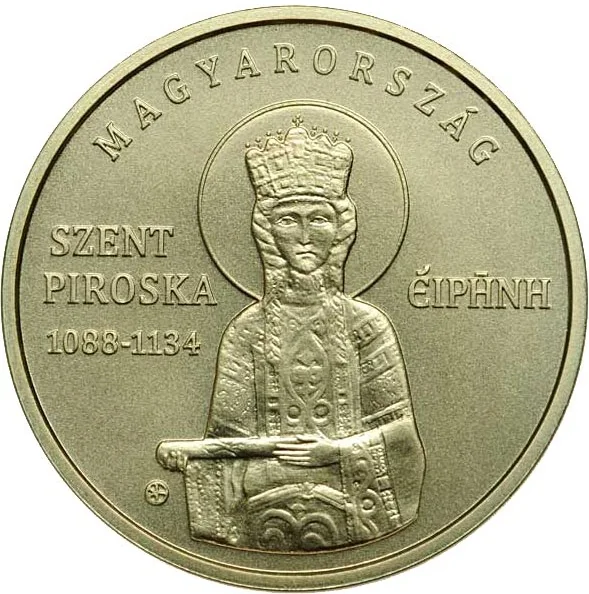
Saint Piroshka (Greek: Eirini) facing forward.
Inscription:
MAGYARORSZÁG
SZENT
PIROSKA
1088-1134
ÉIPHNH
SZENT
PIROSKA
1088-1134
ÉIPHNH
Translation:
HUNGARY
SAINT
PIROSKA
1088-1134
REST IN PEACE
SAINT
PIROSKA
1088-1134
REST IN PEACE
Script: Latin
Language: Hungarian
Designer: Fanni Király
Reverse
Description:
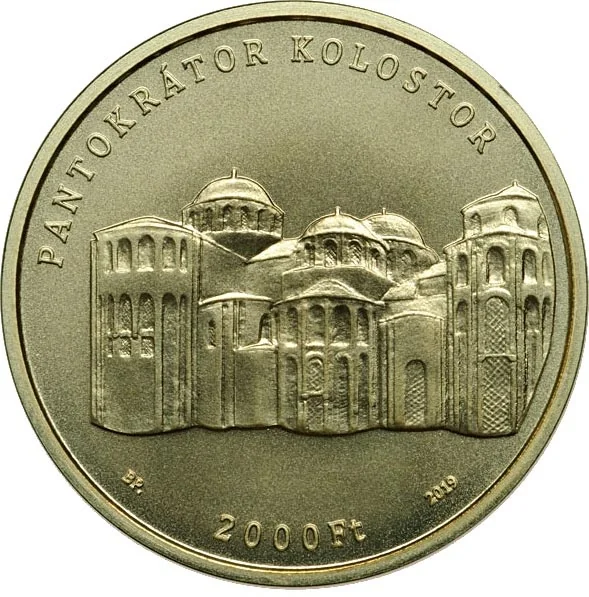
Monastery photograph
Inscription:
PANTOKRÁTOR KOLOSTOR
BP.
2000 Ft
2019
BP.
2000 Ft
2019
Translation:
Pantocrator Monastery
Budapest
2000 Forint
2019
Budapest
2000 Forint
2019
Script: Latin
Designer: Fanni Király
Edge
Plain
Categories
| Building> Religious building |
Mints
| Name | Mark |
|---|---|
| Hungarian mint | BP. |
Mintings
| Year | Mint Mark | Mintage | Quality | Collection |
|---|---|---|---|---|
| 2019 | BP. | 5,000 | BU |
Historical background
In 2019, Hungary's currency situation was characterized by a period of relative stability for the Hungarian Forint (HUF) following years of significant volatility, though it remained under the influence of both domestic monetary policy and external global factors. The National Bank of Hungary (MNB), led by Governor György Matolcsy, maintained a consistently accommodative stance, keeping its key base rate at a historic low of 0.90% throughout the year. This policy aimed to stimulate economic growth and maintain favorable financing conditions, but it also contributed to the forint being a popular target for carry trades, where investors borrowed in low-yield currencies like the euro to invest in higher-yielding Hungarian assets, creating sensitivity to shifts in global risk appetite.
The forint's value was primarily measured against the euro (EUR/HUF), with the exchange rate fluctuating within a managed but unofficial band. Throughout 2019, the EUR/HUF rate traded mostly between 315 and 330, showing less dramatic movement than in previous years. However, the currency faced periodic downward pressure due to a slowing European economy, particularly in Germany, which is Hungary's largest trading partner, and broader concerns about global trade tensions. The MNB occasionally used verbal interventions to signal its comfort zone for the exchange rate, aiming to prevent excessive weakening that could fuel inflation or strengthening that could hurt export competitiveness.
Overall, 2019 represented a year of cautious equilibrium. The MNB successfully navigated the dual objectives of supporting economic growth through loose monetary policy while containing inflationary pressures, which remained moderate. The forint's stability, however, was perceived as fragile and highly dependent on sustained global liquidity and investor sentiment. This set the stage for the significant challenges that would emerge in 2020, when the COVID-19 pandemic triggered a global market shock, causing the forint to plummet to record lows above 360 against the euro and testing the central bank's policy framework.
The forint's value was primarily measured against the euro (EUR/HUF), with the exchange rate fluctuating within a managed but unofficial band. Throughout 2019, the EUR/HUF rate traded mostly between 315 and 330, showing less dramatic movement than in previous years. However, the currency faced periodic downward pressure due to a slowing European economy, particularly in Germany, which is Hungary's largest trading partner, and broader concerns about global trade tensions. The MNB occasionally used verbal interventions to signal its comfort zone for the exchange rate, aiming to prevent excessive weakening that could fuel inflation or strengthening that could hurt export competitiveness.
Overall, 2019 represented a year of cautious equilibrium. The MNB successfully navigated the dual objectives of supporting economic growth through loose monetary policy while containing inflationary pressures, which remained moderate. The forint's stability, however, was perceived as fragile and highly dependent on sustained global liquidity and investor sentiment. This set the stage for the significant challenges that would emerge in 2020, when the COVID-19 pandemic triggered a global market shock, causing the forint to plummet to record lows above 360 against the euro and testing the central bank's policy framework.
💎 Very Rare