

3 marks – Germany
Add to wishlist
Circulating commemorative coins
Commemoration: 1000th Year of the Rhineland
Germany
Obverse
Description:
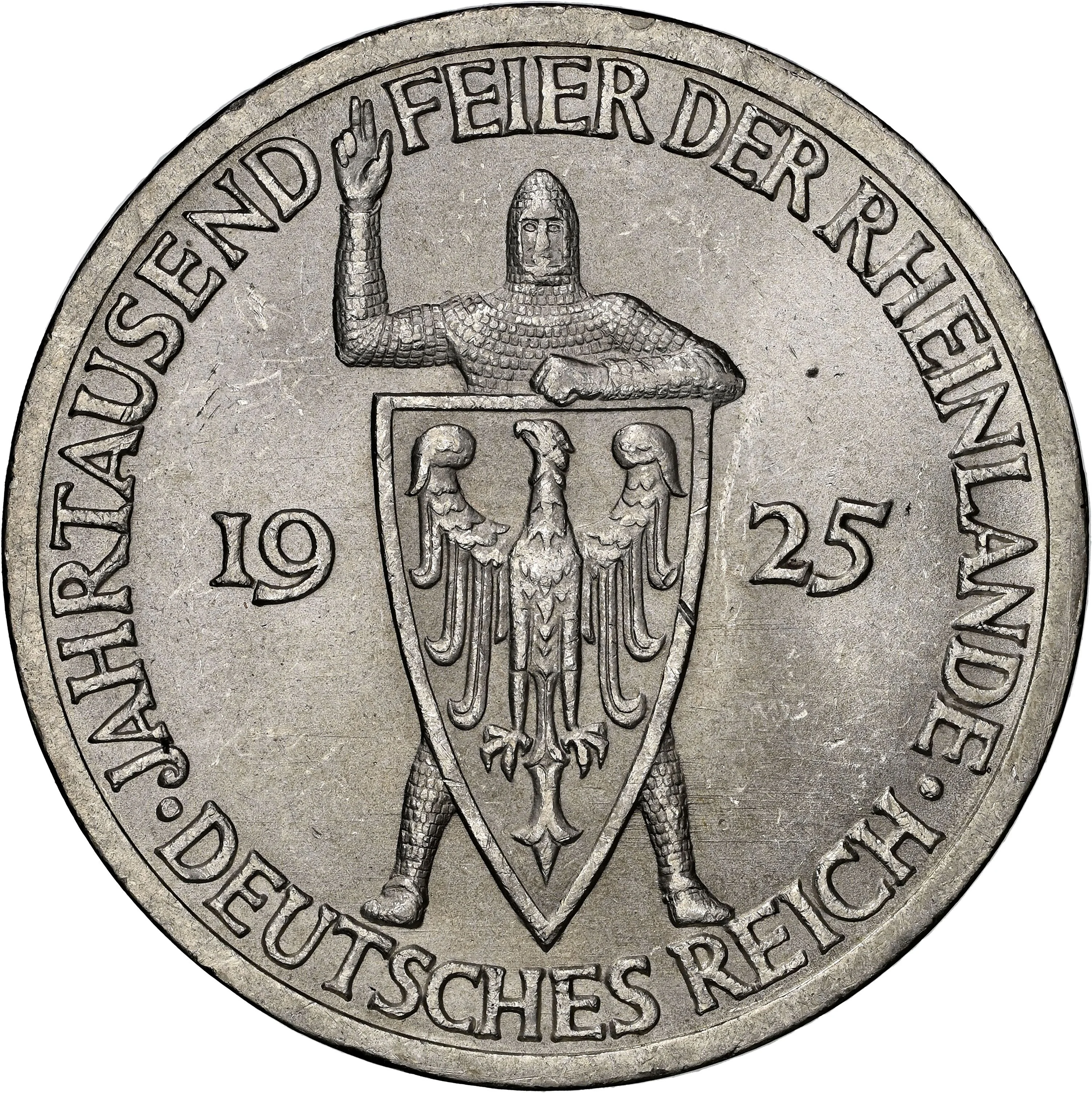
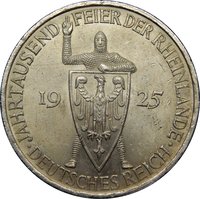
Armored soldier, right hand raised in oath, arm resting on a shield with an imperial eagle. Vintage on both sides, surrounded by legend.
Inscription:
JAHRTAUSEND FEIER DER RHEINLANDE * DEUTSCHES REICH *
19 25
19 25
Translation:
Millennium Celebration of the Rhineland * German Empire *
19 25
19 25
Script: Latin
Language: German
Engraver: Renée Weiss Sintenis
Reverse
Description:
Workshop name and letter
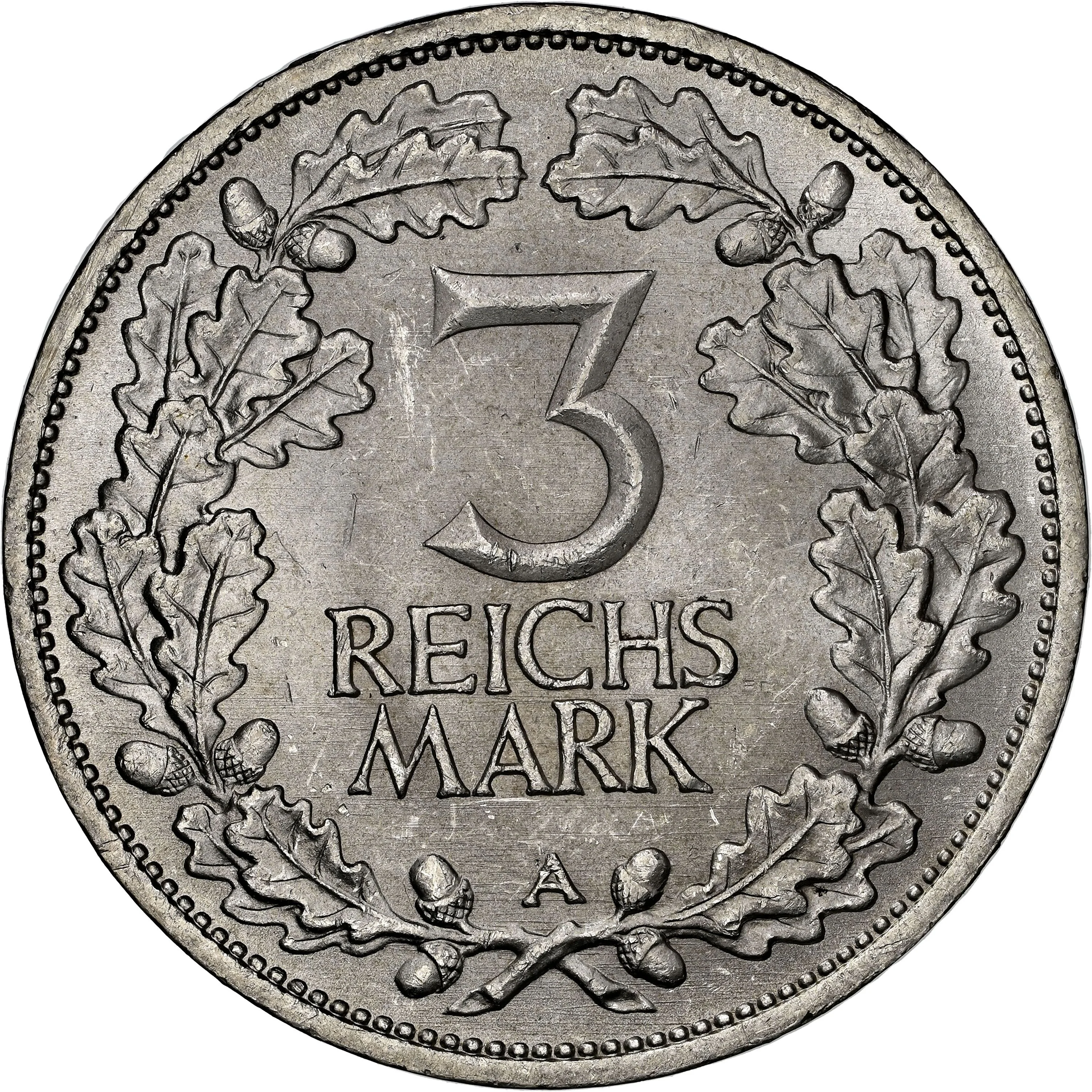
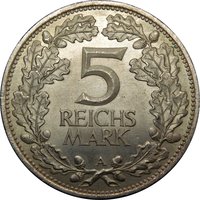
in four lines, framed by
oak branches and grenetis.
in four lines, framed by
oak branches and grenetis.
Inscription:
3
REICHS
MARK
A (Mint Mark)
REICHS
MARK
A (Mint Mark)
Translation:
REICHS
MARK
A
MARK
A
Script: Latin
Language: German
Engraver: Renée Weiss Sintenis
Edge
Inscripted
Legend:
EINIGKEIT UND RECHT UND FREIHEIT
Translation:
Unity and Justice and Freedom
Language: German
Mints
| Name | Mark |
|---|---|
| Berlin | A |
| Munich | D |
| Muldenhütten | E |
| Staatliche Münze Baden-Württemberg | F |
| Staatliche Münze Baden-Württemberg | G |
| Hamburgische Münze | J |
Mintings
Historical background
By 1925, Germany was in a fragile period of stabilization following the catastrophic hyperinflation of 1923. The old Reichsmark, rendered worthless, had been replaced in late 1923 by the Rentenmark, a currency backed by a theoretical mortgage on German land and industry. This stopgap measure, based on psychological confidence rather than tangible reserves, successfully halted the inflation. In 1924, the Dawes Plan restructured Germany's reparations payments and provided foreign loans, primarily from the United States, which allowed for the introduction of a new, permanent currency.
On October 11, 1924, the Reichsmark was formally established, replacing the Rentenmark at a 1:1 ratio. It was intended to be backed by gold and foreign exchange, re-linking Germany to the international gold standard. By 1925, this new currency was bedded in, and the economy was experiencing a period of relative calm and growth known as the "Golden Twenties." This stability, however, was fundamentally dependent on continuous inflows of American capital under the Dawes Plan to pay reparations and fuel industrial expansion.
Consequently, the currency situation in 1925 was one of surface normality masking profound underlying vulnerability. The stability of the Reichsmark was not organically achieved but was propped up by foreign debt and international political agreements. The economy and the currency were therefore acutely sensitive to any withdrawal of foreign loans or shifts in the geopolitical landscape, planting the seeds for future crisis when the Great Depression began and those capital flows abruptly reversed.
On October 11, 1924, the Reichsmark was formally established, replacing the Rentenmark at a 1:1 ratio. It was intended to be backed by gold and foreign exchange, re-linking Germany to the international gold standard. By 1925, this new currency was bedded in, and the economy was experiencing a period of relative calm and growth known as the "Golden Twenties." This stability, however, was fundamentally dependent on continuous inflows of American capital under the Dawes Plan to pay reparations and fuel industrial expansion.
Consequently, the currency situation in 1925 was one of surface normality masking profound underlying vulnerability. The stability of the Reichsmark was not organically achieved but was propped up by foreign debt and international political agreements. The economy and the currency were therefore acutely sensitive to any withdrawal of foreign loans or shifts in the geopolitical landscape, planting the seeds for future crisis when the Great Depression began and those capital flows abruptly reversed.
🌱 Fairly Common