

1 crown (Cecil Rhodes) – Southern Rhodesia
Add to wishlist
Circulating commemorative coins
Commemoration: 100th Birthday of Cecil Rhodes
Zimbabwe
Context
Year: 1953
Country: Zimbabwe
Issuer: Southern Rhodesia
Ruler: Elizabeth II
Currency:
(1932—1955)
Demonetization: 1 June 1965
Total mintage: 123,500
Material
References
KM: #
Numista: #15875
Value
Bullion value: $36.13
Obverse
Description:
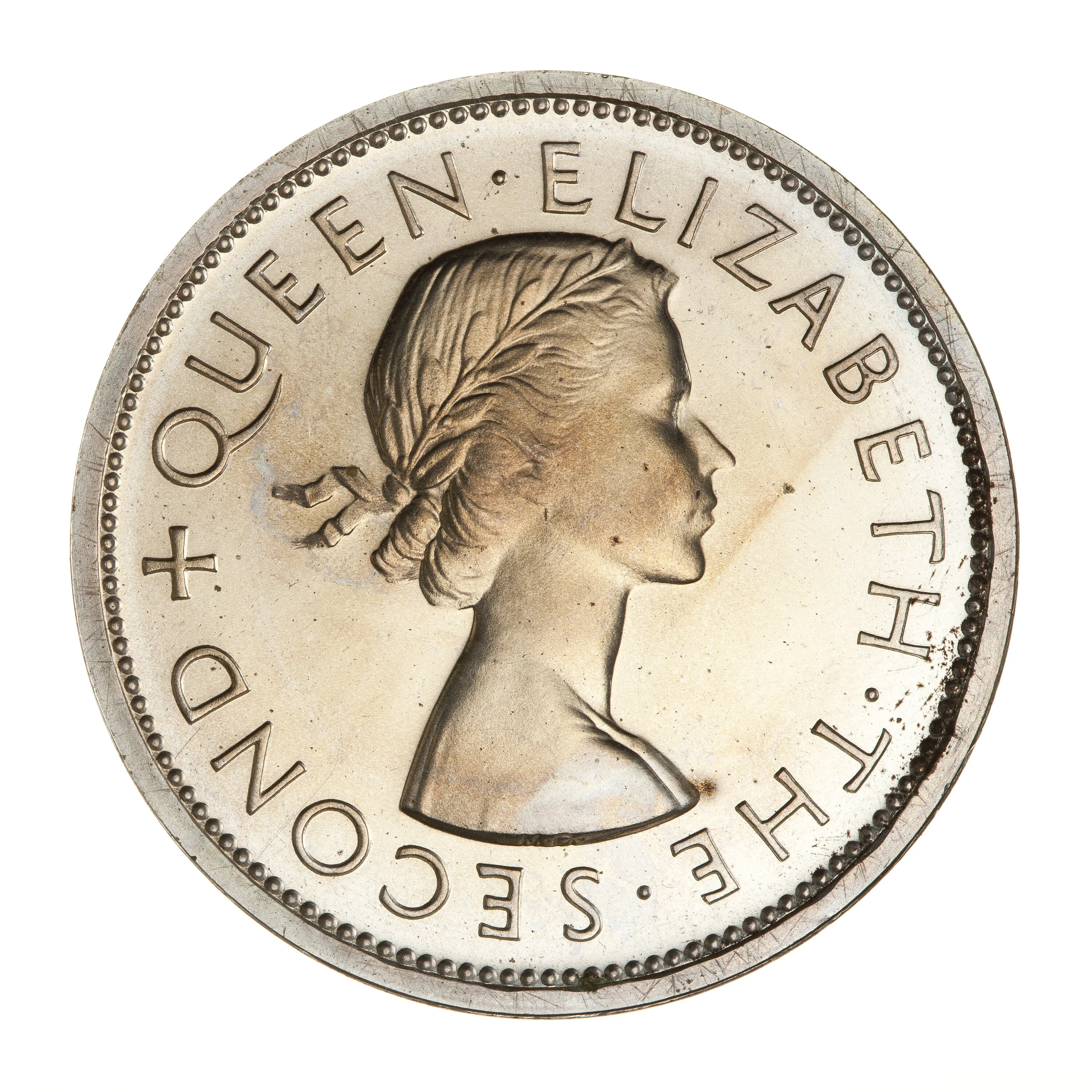
Young laureate bust of Elizabeth II right, surrounded by legend.
Inscription:
+ QUEEN·ELIZABETH·THE·SECOND
M.G.
M.G.
Script: Latin
Engraver: Mary Gillick
Reverse
Description:
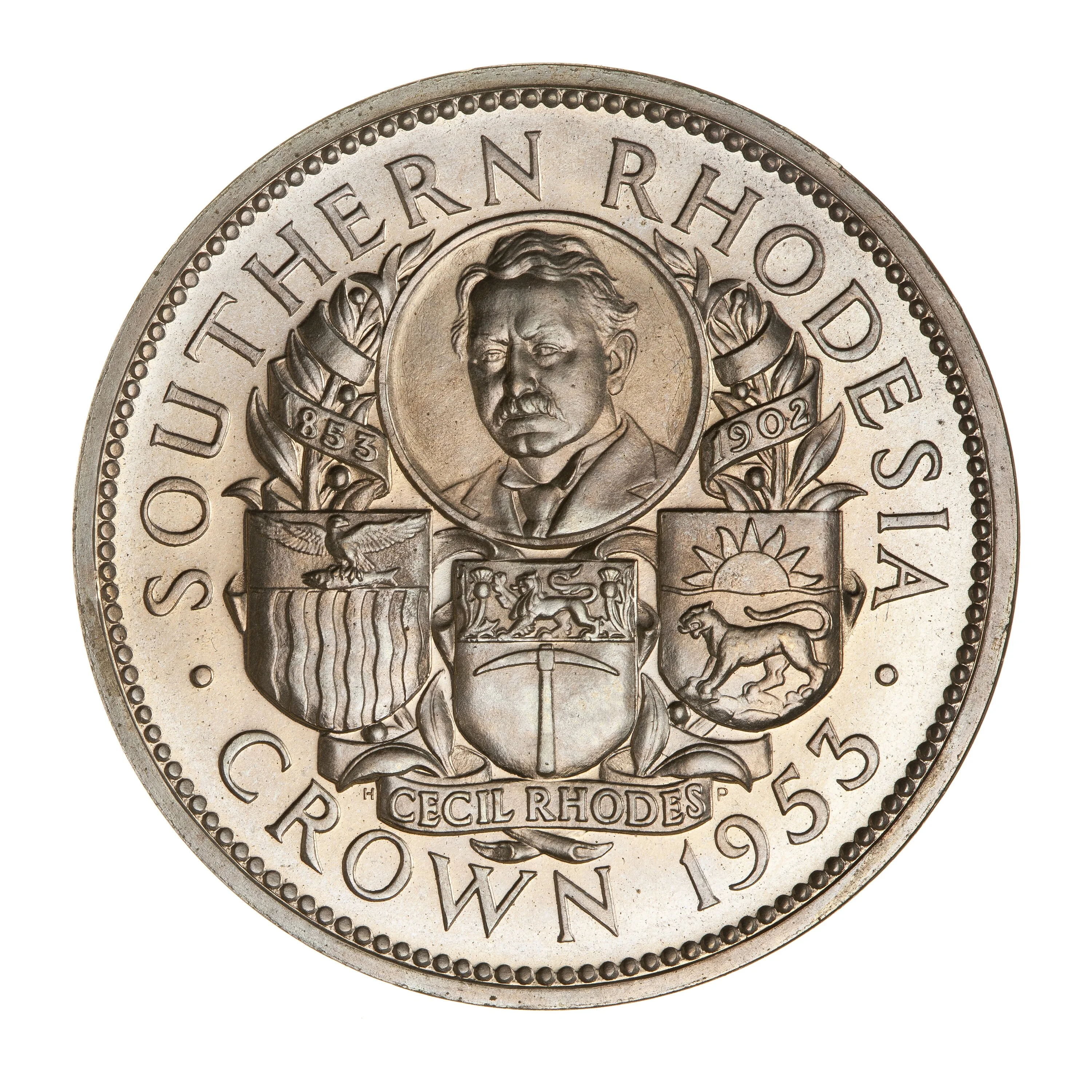
Cecil Rhodes bust encircled, flanked by wreaths, with shields of Northern Rhodesia, Southern Rhodesia, and Nyasaland below.
Inscription:
SOUTHERN RHODESIA
1853 1902
CECIL RHODES
HP
· CROWN 1953 ·
1853 1902
CECIL RHODES
HP
· CROWN 1953 ·
Script: Latin
Engraver: Thomas Humphrey Paget
Edge
Plain with incuse lettering
Legend:
★ 1853 1953 ★ OUT OF VISION CAME REALITY
Categories
| Event> Birth anniversary |
| Person> Monarch |
| Person> Politician |
| Symbol> Wreath |
| Symbols> Coat of Arms |
Mints
| Name | Mark |
|---|---|
| Royal Mint (Tower Hill) | — |
Mintings
| Year | Mint Mark | Mintage | Quality | Collection |
|---|---|---|---|---|
| 1953 | — | — | Proof | |
| 1953 | — | — | Matte | |
| 1953 | — | 123,500 |
Historical background
In 1953, Southern Rhodesia was in a period of significant political and economic transition, having just entered the Federation of Rhodesia and Nyasaland in August of that year. This new political entity, also known as the Central African Federation, brought together Southern Rhodesia, Northern Rhodesia, and Nyasaland. Consequently, the currency situation was directly tied to this federal structure. The official currency was the Rhodesia and Nyasaland pound (R&N£), which was created to serve as a unified currency across the three territories, replacing the Southern Rhodesian pound at par.
The R&N£ was pegged at par with the British pound sterling, maintaining the direct link to the sterling area that Southern Rhodesia had long observed. This peg provided monetary stability and facilitated trade and investment, particularly with Britain, which was crucial for the Federation's export-driven economy based on tobacco, copper, and other commodities. The currency was issued by the Central Africa Currency Board, headquartered in Salisbury, Southern Rhodesia, which managed the note and coin supply backed by sterling reserves held in London.
Despite this formal federal arrangement, Southern Rhodesia, as the most industrialized and financially dominant territory, effectively functioned as the Federation's economic hub. The currency union was administratively centered in Salisbury, reinforcing Southern Rhodesia's de facto financial leadership. However, this system also sowed the seeds for future monetary tensions, as the economic interests of the three territories were not fully aligned, a disparity that would contribute to the Federation's dissolution a decade later.
The R&N£ was pegged at par with the British pound sterling, maintaining the direct link to the sterling area that Southern Rhodesia had long observed. This peg provided monetary stability and facilitated trade and investment, particularly with Britain, which was crucial for the Federation's export-driven economy based on tobacco, copper, and other commodities. The currency was issued by the Central Africa Currency Board, headquartered in Salisbury, Southern Rhodesia, which managed the note and coin supply backed by sterling reserves held in London.
Despite this formal federal arrangement, Southern Rhodesia, as the most industrialized and financially dominant territory, effectively functioned as the Federation's economic hub. The currency union was administratively centered in Salisbury, reinforcing Southern Rhodesia's de facto financial leadership. However, this system also sowed the seeds for future monetary tensions, as the economic interests of the three territories were not fully aligned, a disparity that would contribute to the Federation's dissolution a decade later.
🌱 Common