



10 yuan (China's Reform and Opening Up) – People's Republic of China
Add to wishlist
Circulating commemorative coins
Commemoration: 40th Anniversary of China's Reform and Opening Up
China
Context
Year: 2018
Country: China
Issuer: People's Republic of China
Period:
(since 1949)
Currency:
(since 1955)
Total mintage: 180,000,000
Material


References
KM: #
Numista: #158146
Value
Exchange value: 10 CNY
Inflation-adjusted value: 11.06 CNY
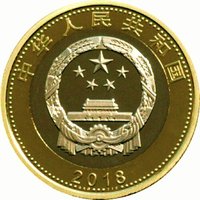
Obverse
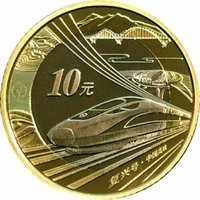
Reverse
Edge
Slanted reeding; every second reed only spreads over 40% of the width
Legend:
\` \` \` \` \` \` \` \` \` \` \` \` \` \` \` \` \` \` \` \`
Mintings
| Year | Mint Mark | Mintage | Quality | Collection |
|---|---|---|---|---|
| 2018 | — | 180,000,000 |
Historical background
In 2018, the People's Republic of China faced a complex currency environment marked by external pressures and strategic domestic management. The year began with the Chinese yuan (CNY), or renminbi (RMB), continuing a strengthening trend from 2017, bolstered by capital inflow controls and a relatively weak US dollar. However, this trajectory reversed sharply by mid-year as escalating trade tensions with the United States, culminating in successive rounds of tariffs, intensified downward pressure on the currency. Concurrently, a tightening monetary policy in the US led to a strengthening dollar, further exacerbating the CNY's decline. By the end of the third quarter, the onshore yuan (CNY) had depreciated by over 5% against the dollar for the year, breaching the psychologically significant 6.9 level and approaching the 7.0 threshold not seen since the 2008 financial crisis.
The Chinese government and the People's Bank of China (PBOC) employed a multi-faceted toolkit to manage the depreciation in a controlled manner, aiming to balance market forces with stability. Key measures included setting a stronger-than-expected daily central parity rate to guide market expectations and reintroducing the "counter-cyclical factor" in August to mitigate pro-cyclical sentiment in the forex market. Authorities also utilized foreign exchange reserves, which saw moderate declines, to smooth volatility. Crucially, policymakers maintained strict capital controls to prevent destabilizing outflows, while publicly committing to a market-oriented exchange rate regime and avoiding a competitive devaluation, despite accusations from the US administration.
The 2018 currency dynamics had significant implications. Internally, the depreciation helped partially offset the impact of US tariffs on Chinese exports but raised concerns about capital flight and imported inflation. Externally, it became a focal point in the trade war, with US officials accusing China of currency manipulation—a designation China vehemently denied. By year's end, the situation underscored the delicate balancing act facing Chinese authorities: allowing greater market influence on the yuan's value as part of financial liberalization, while retaining enough control to ensure macroeconomic and financial stability amidst unprecedented trade conflict and global monetary policy shifts.
The Chinese government and the People's Bank of China (PBOC) employed a multi-faceted toolkit to manage the depreciation in a controlled manner, aiming to balance market forces with stability. Key measures included setting a stronger-than-expected daily central parity rate to guide market expectations and reintroducing the "counter-cyclical factor" in August to mitigate pro-cyclical sentiment in the forex market. Authorities also utilized foreign exchange reserves, which saw moderate declines, to smooth volatility. Crucially, policymakers maintained strict capital controls to prevent destabilizing outflows, while publicly committing to a market-oriented exchange rate regime and avoiding a competitive devaluation, despite accusations from the US administration.
The 2018 currency dynamics had significant implications. Internally, the depreciation helped partially offset the impact of US tariffs on Chinese exports but raised concerns about capital flight and imported inflation. Externally, it became a focal point in the trade war, with US officials accusing China of currency manipulation—a designation China vehemently denied. By year's end, the situation underscored the delicate balancing act facing Chinese authorities: allowing greater market influence on the yuan's value as part of financial liberalization, while retaining enough control to ensure macroeconomic and financial stability amidst unprecedented trade conflict and global monetary policy shifts.

🌱 Fairly Common