

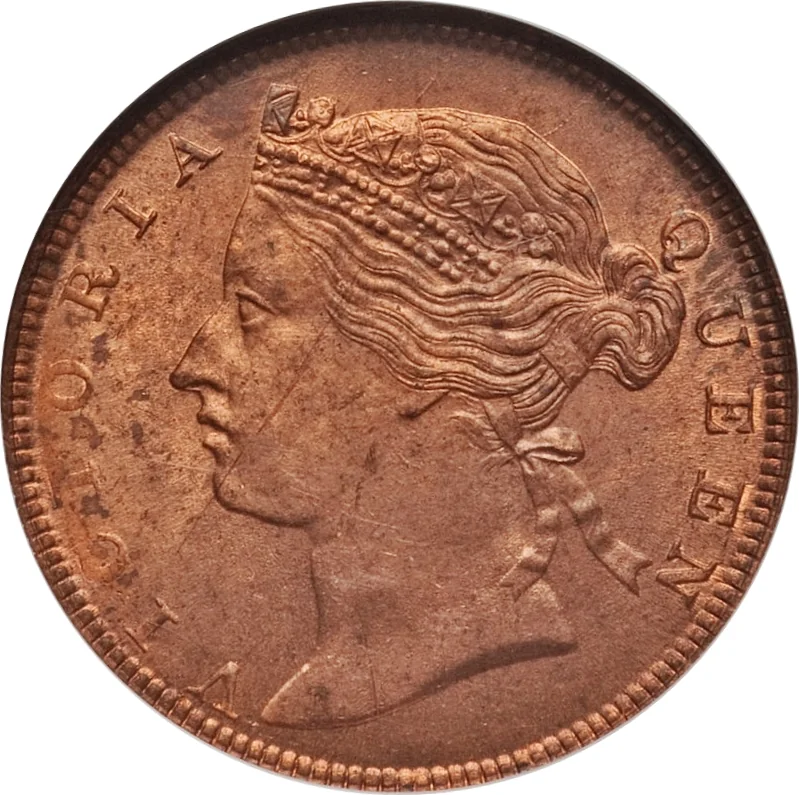
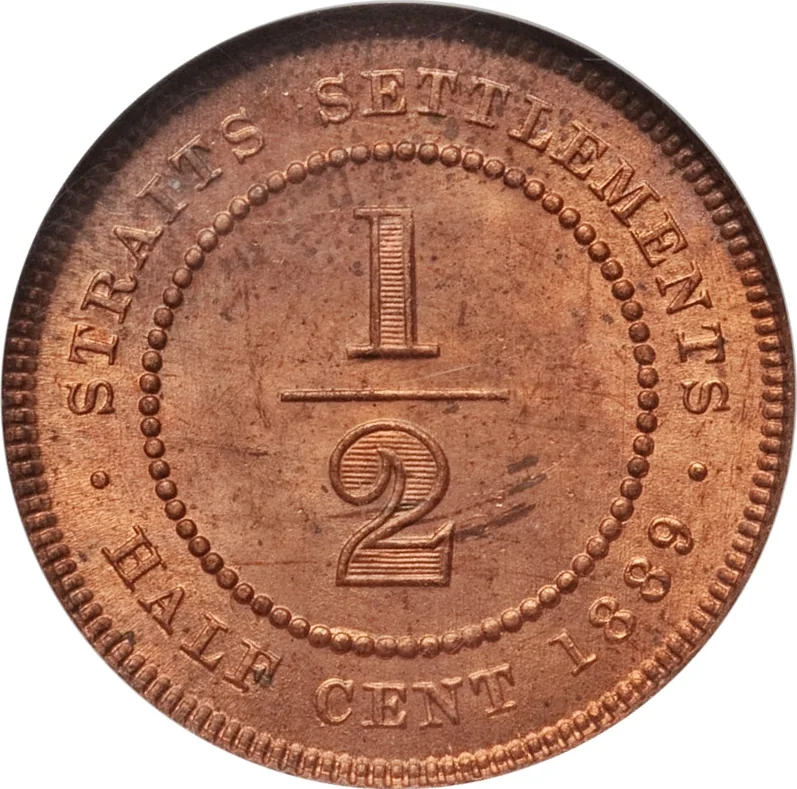
½ Cent – Straits Settlements
Malaysia
Context
Years: 1889–1891
Country: Malaysia 
Issuer: Straits Settlements
Ruler: Victoria
Currency:
(1845—1939)
Demonetized: Yes
Total mintage: 2,000,096
Material
References
KM: #Click to copy to clipboard15
Numista: #15788
Obverse
Description:
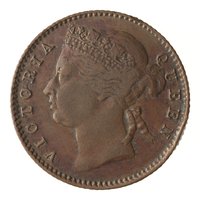
Crowned left-facing bust.
Inscription:
VICTORIA QUEEN
Script: Latin
Engraver: Leonard Charles Wyon
Reverse
Description:
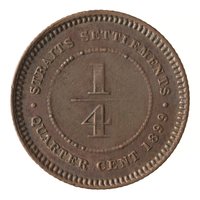
Denomination in beaded circle, date at lower right.
Inscription:
STRAITS SETTLEMENTS
1/2
· HALF CENT 1889 ·
1/2
· HALF CENT 1889 ·
Script: Latin
Edge
Reeded
Mintings
| Year | Mint Mark | Mintage | Quality | Collection |
|---|---|---|---|---|
| 1889 | — | 2,000,096 | ||
| 1890 | — | — | Proof | |
| 1891 | — | — | Proof |
Historical background
In 1889, the currency situation in the Straits Settlements (comprising Singapore, Penang, and Malacca) was one of transition and complexity, dominated by the practical use of the Mexican silver dollar and its various trade counterparts. Despite being a British colony, the official currency, the British silver dollar and its fractional parts, had failed to gain public confidence since its introduction in the 1860s. The mercantile community, deeply entrenched in the regional trade of Southeast Asia and China, overwhelmingly preferred the familiar and consistent silver content of the Mexican dollar, which circulated alongside other silver coins like the Hong Kong dollar and the Spanish Carolus dollar. This created a de facto silver standard centred on foreign coinage.
The colonial government faced significant challenges due to this monetary fragmentation, including exchange rate fluctuations and the costly practice of repeatedly recoining worn Spanish and Mexican dollars at the Bombay Mint. To address this, 1889 fell within a critical period of planning that would lead to the landmark Currency Ordinance of 1890. This ordinance aimed to assert financial control by establishing a Board of Commissioners of Currency and authorising the minting of a new Straits dollar. The new coin was to be a sterling-backed silver dollar, with its value fixed at 2 shillings and 4 pence, explicitly designed to replace the plethora of existing silver dollars in circulation.
Thus, the background of 1889 is best understood as the final year of a problematic monetary free-for-all, immediately preceding a decisive colonial intervention. The stage was set for a government-issued currency that would not only unify the Settlements' monetary system but also firmly tether it to the sterling exchange standard, moving away from the purely intrinsic value of silver. This reform was a crucial step in aligning the Straits Settlements' economy with imperial financial networks while stabilising local commerce.
The colonial government faced significant challenges due to this monetary fragmentation, including exchange rate fluctuations and the costly practice of repeatedly recoining worn Spanish and Mexican dollars at the Bombay Mint. To address this, 1889 fell within a critical period of planning that would lead to the landmark Currency Ordinance of 1890. This ordinance aimed to assert financial control by establishing a Board of Commissioners of Currency and authorising the minting of a new Straits dollar. The new coin was to be a sterling-backed silver dollar, with its value fixed at 2 shillings and 4 pence, explicitly designed to replace the plethora of existing silver dollars in circulation.
Thus, the background of 1889 is best understood as the final year of a problematic monetary free-for-all, immediately preceding a decisive colonial intervention. The stage was set for a government-issued currency that would not only unify the Settlements' monetary system but also firmly tether it to the sterling exchange standard, moving away from the purely intrinsic value of silver. This reform was a crucial step in aligning the Straits Settlements' economy with imperial financial networks while stabilising local commerce.
⭐ Somewhat Rare