

5 Rupees – Sri Lanka
Sri Lanka
Context
Years: 1984–2004
Issuer: Sri Lanka 
Period:
(since 1978)
Currency:
(since 1972)
Total mintage: 241,000,000
Material
Diameter: 23.4 mm
Weight: 9.5 g
Thickness: 2.9 mm
Shape: Round
Composition: Nickel brass
Magnetic: No
Technique: Milled
Alignment: Medal alignment
flip
References
KM: #Click to copy to clipboard148
Numista: #15760
Value
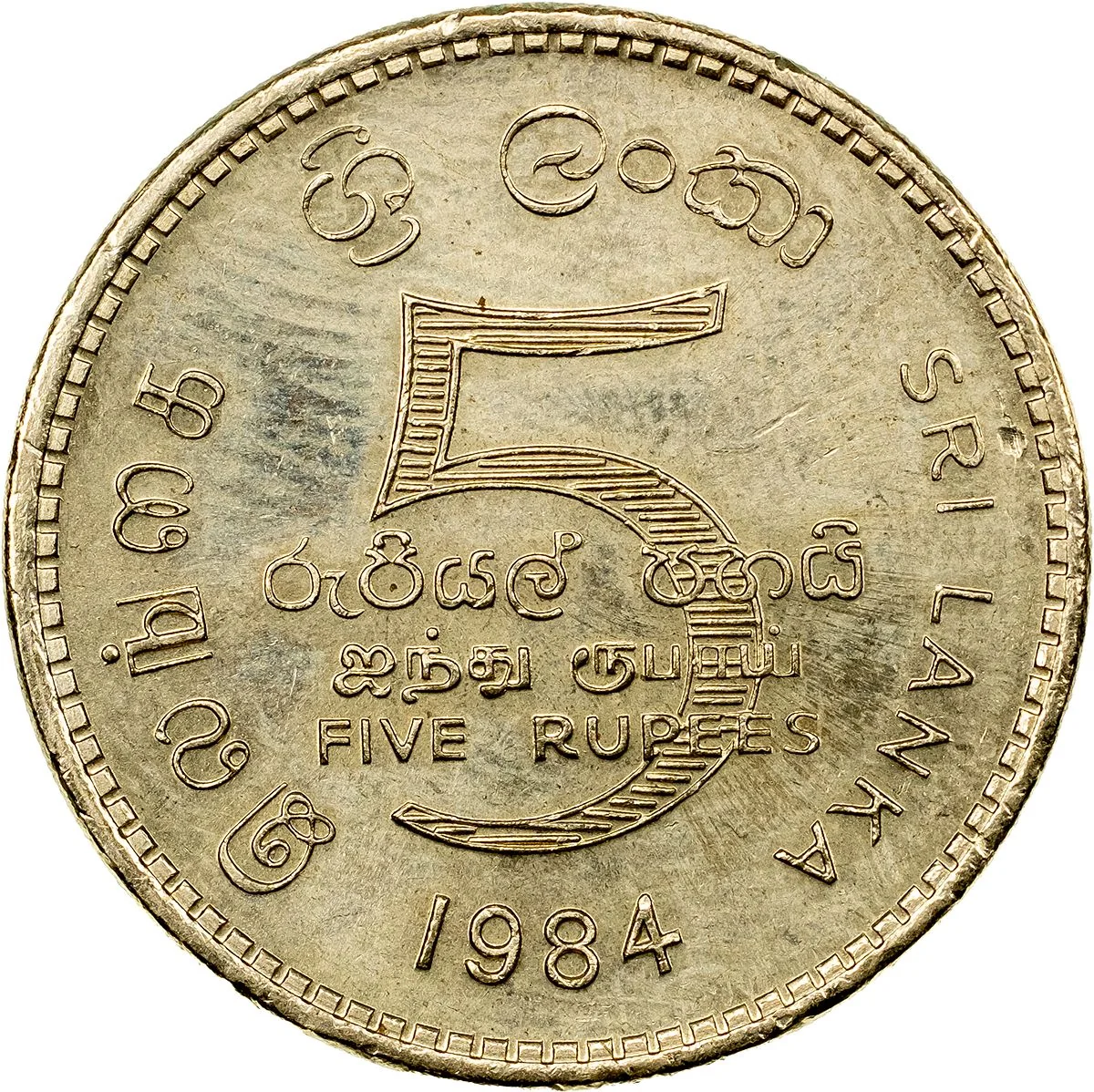
Exchange value: 5 LKR
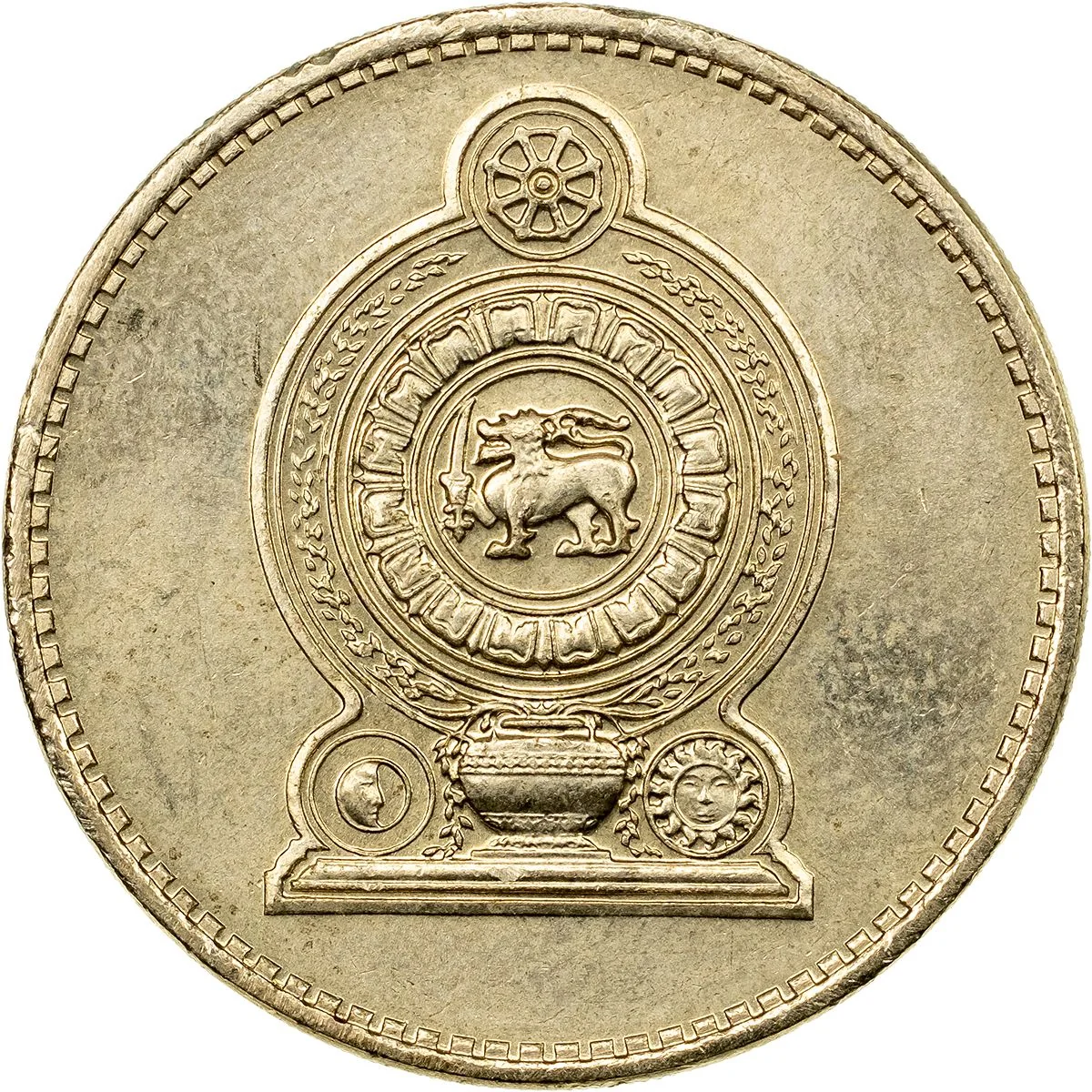
Obverse
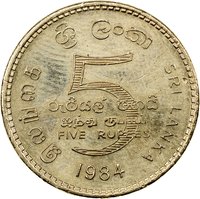
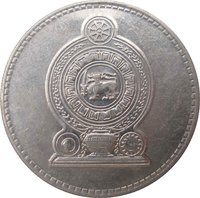
Description:
National coat of arms
Reverse
Mints
| Name | Mark |
|---|---|
| Royal Mint | — |
Mintings
| Year | Mint Mark | Mintage | Quality | Collection |
|---|---|---|---|---|
| 1984 | — | 25,000,000 | ||
| 1986 | — | 60,000,000 | ||
| 1991 | — | 40,000,000 | ||
| 1994 | — | 50,000,000 | ||
| 2002 | — | 32,000,000 | ||
| 2004 | — | 34,000,000 |
Historical background
In 1984, Sri Lanka's currency situation was characterized by a tightly controlled and overvalued exchange rate under a dual system. The official exchange rate was fixed at approximately 16 Sri Lankan Rupees (LKR) to 1 US Dollar, a rate maintained by the Central Bank of Ceylon since 1978. However, this official rate was largely reserved for government transactions and essential imports, creating a significant disparity with the real market value. Alongside this, a more flexible "secondary rate" existed for non-essential imports and some private transactions, which traded at a depreciated level, though still managed by the central bank. This structure created distortions, encouraging black-market currency trading where the rupee traded at a much weaker value.
The overvaluation was a legacy of the open economic policies adopted in 1977, which, while initially boosting growth, led to persistent trade and budget deficits. By the mid-1980s, the costs of these imbalances were mounting. The overvalued rupee made imports artificially cheap, hurting domestic industries and exacerbating the trade deficit, while making Sri Lanka's key agricultural exports like tea less competitive on the global market. Furthermore, the country was grappling with the early stages of a costly civil war, which began in 1983, placing additional strain on public finances and foreign exchange reserves through increased military spending and dampened investor confidence.
Consequently, 1984 fell within a period of mounting pressure that would eventually force a major devaluation. The rigid exchange regime struggled to reflect economic realities, draining foreign reserves to defend the unsustainable peg. While a full-scale crisis was still a few years away, the structural weaknesses were evident. The government's reliance on foreign borrowing to finance deficits and support the currency was becoming increasingly untenable, setting the stage for the more severe economic adjustments and liberalization measures that would follow in the late 1980s and early 1990s.
The overvaluation was a legacy of the open economic policies adopted in 1977, which, while initially boosting growth, led to persistent trade and budget deficits. By the mid-1980s, the costs of these imbalances were mounting. The overvalued rupee made imports artificially cheap, hurting domestic industries and exacerbating the trade deficit, while making Sri Lanka's key agricultural exports like tea less competitive on the global market. Furthermore, the country was grappling with the early stages of a costly civil war, which began in 1983, placing additional strain on public finances and foreign exchange reserves through increased military spending and dampened investor confidence.
Consequently, 1984 fell within a period of mounting pressure that would eventually force a major devaluation. The rigid exchange regime struggled to reflect economic realities, draining foreign reserves to defend the unsustainable peg. While a full-scale crisis was still a few years away, the structural weaknesses were evident. The government's reliance on foreign borrowing to finance deficits and support the currency was becoming increasingly untenable, setting the stage for the more severe economic adjustments and liberalization measures that would follow in the late 1980s and early 1990s.
🌱 Very Common