

5 crowns (Coronation of Franz Joseph I as King of Hungary) – Hungary
Add to wishlist
Circulating commemorative coins
Commemoration: 40th Anniversary of the Coronation of Franz Joseph I as King of Hungary
Hungary
Context
Year: 1907
Issuer: Hungary
Ruler: Francis Joseph I
Currency:
(1892—1918)
Demonetized: Yes
Total mintage: 300,032
Material
References
KM: #
Numista: #15759
Value
Bullion value: $55.14
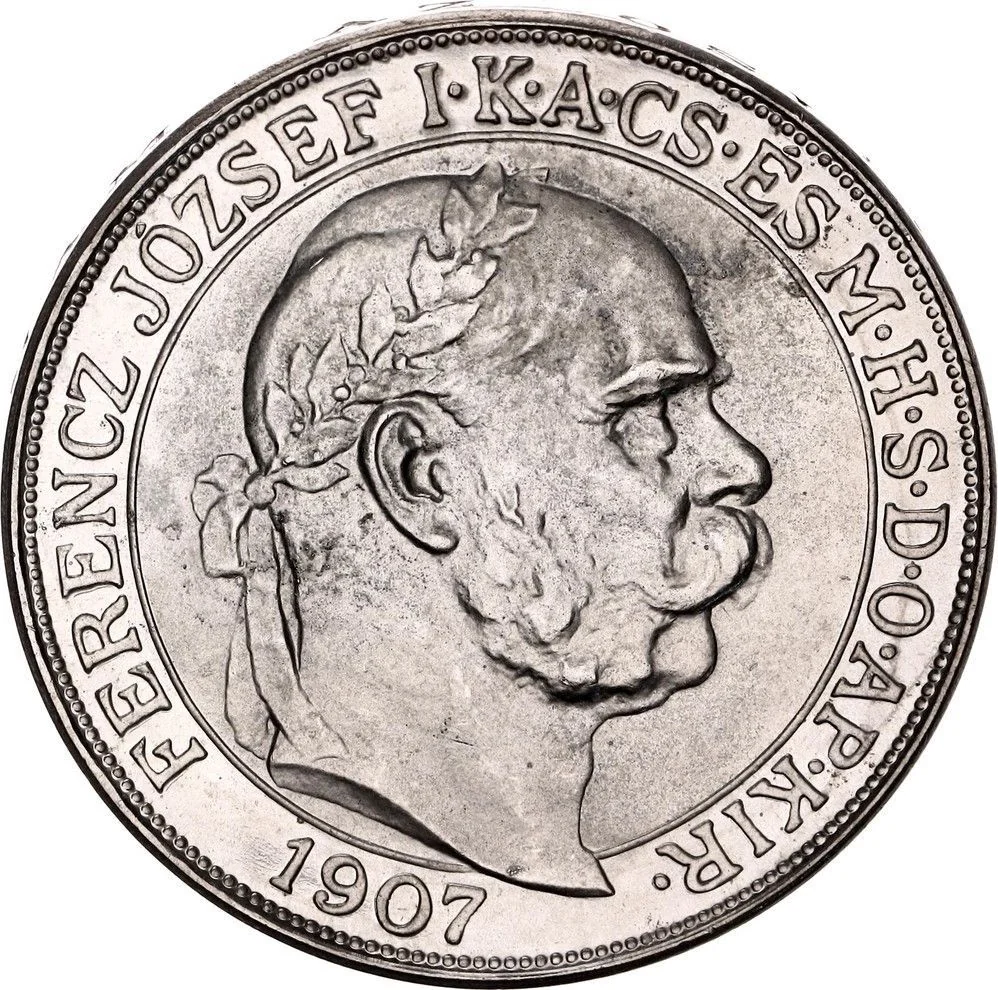
Obverse
Description:
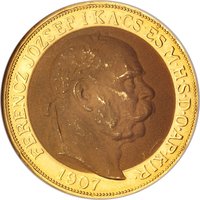
Francis I laureate head right, with legend.
Inscription:
FERENCZ JÓZSEF I.K.A.CS.ÉS M.H.S.D.O.AP.KIR
1907
1907
Translation:
Francis Joseph I, Emperor of Austria, Apostolic King of Hungary, Croatia, Slavonia, and Dalmatia.
Script: Latin
Engravers: Rudolf Marschall, Rudolf Neuberger
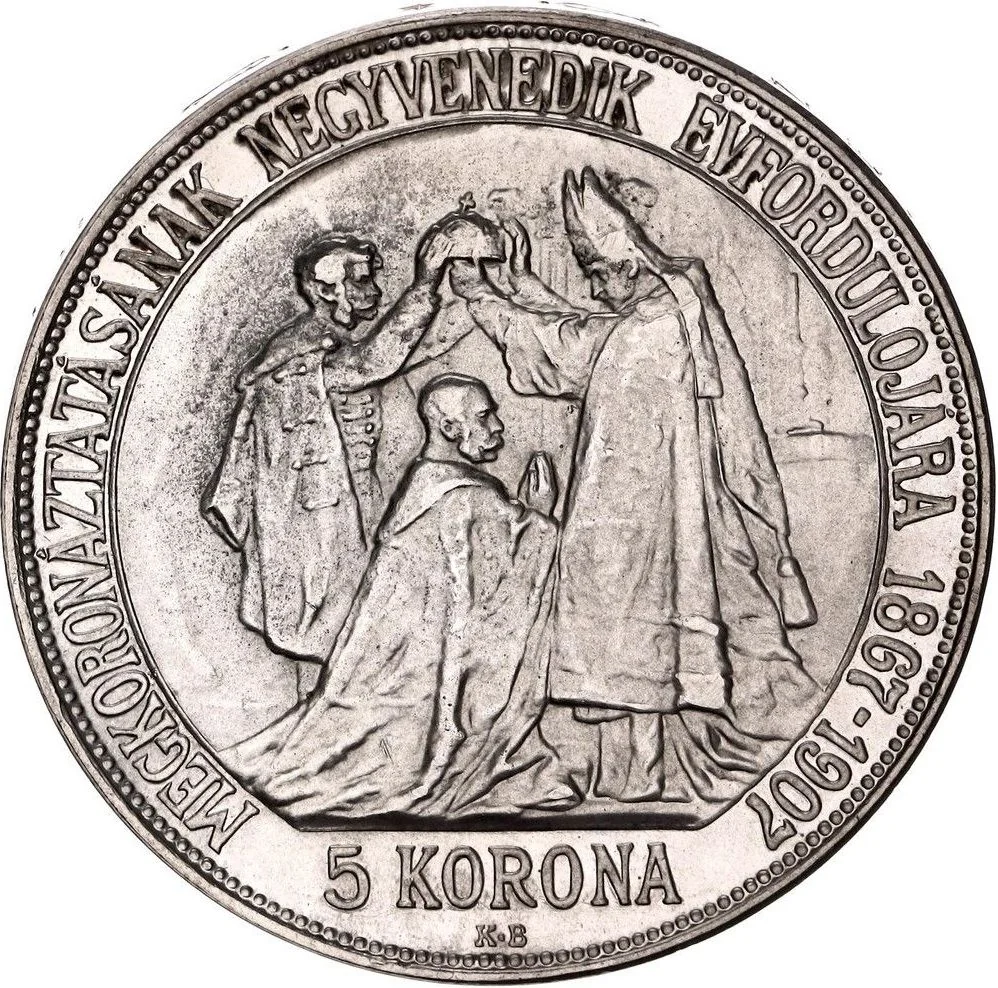
Reverse
Description:
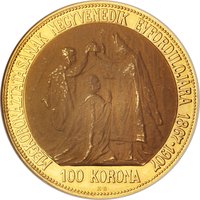
Crowning ceremony
Inscription:
MECKORONÁZTATÁSÁNAK NEGYVENEDIK EVFORDULOJÁRA 1867 - 1907
5 KORONA
K B
5 KORONA
K B
Translation:
On the fortieth anniversary of his coronation 1867 - 1907
5 Korona
K B
5 Korona
K B
Script: Latin
Language: Hungarian
Engraver: Stefan Schwartz
Edge
Incuse text
Legend:
BIZALMAM AZ ŐSI ERÉNYBEN
Translation:
My trust is in ancient virtue.
Language: Hungarian
Categories
| Event> Coronation |
| Person> Military leader |
| Mustache/Beard |
Mints
| Name | Mark |
|---|---|
| Kremnica | KB |
Historical background
In 1907, Hungary operated within the complex monetary framework of the Austro-Hungarian Empire, sharing a common currency but engaged in a persistent political struggle for greater financial autonomy. The legal tender was the Austro-Hungarian gulden (or florin), managed by the Austro-Hungarian Bank, a joint institution with its headquarters in Vienna. This arrangement often fueled Hungarian nationalist sentiment, as Budapest sought equal status and influence over monetary policy, viewing control over currency as a key pillar of national sovereignty within the Dual Monarchy.
Economically, the period was one of relative stability and growth, part of the so-called "Silver Age" following the 1892 transition from a silver standard to a gold standard. The currency was effectively backed by gold, which facilitated international trade and investment. However, this very stability was underpinned by the empire's centralized financial structure, a point of contention for Hungarian political leaders. They argued that the common bank and currency policy primarily served Austrian industrial interests, sometimes to the detriment of Hungary's agrarian economy.
The year 1907 itself did not see a dramatic monetary shift, but it existed within the protracted "bank war" negotiations over renewing the charter of the Austro-Hungarian Bank. Hungarian demands for a separate central bank or a truly bi-national institution with a Budapest headquarters were consistently blocked by Vienna. This ongoing dispute highlighted the fundamental tension within the empire: Hungary's desire for economic self-determination against the practical necessities of a unified monetary system. The stalemate would continue until the empire's collapse in 1918, after which Hungary rapidly established its own independent currency.
Economically, the period was one of relative stability and growth, part of the so-called "Silver Age" following the 1892 transition from a silver standard to a gold standard. The currency was effectively backed by gold, which facilitated international trade and investment. However, this very stability was underpinned by the empire's centralized financial structure, a point of contention for Hungarian political leaders. They argued that the common bank and currency policy primarily served Austrian industrial interests, sometimes to the detriment of Hungary's agrarian economy.
The year 1907 itself did not see a dramatic monetary shift, but it existed within the protracted "bank war" negotiations over renewing the charter of the Austro-Hungarian Bank. Hungarian demands for a separate central bank or a truly bi-national institution with a Budapest headquarters were consistently blocked by Vienna. This ongoing dispute highlighted the fundamental tension within the empire: Hungary's desire for economic self-determination against the practical necessities of a unified monetary system. The stalemate would continue until the empire's collapse in 1918, after which Hungary rapidly established its own independent currency.
🌱 Fairly Common