

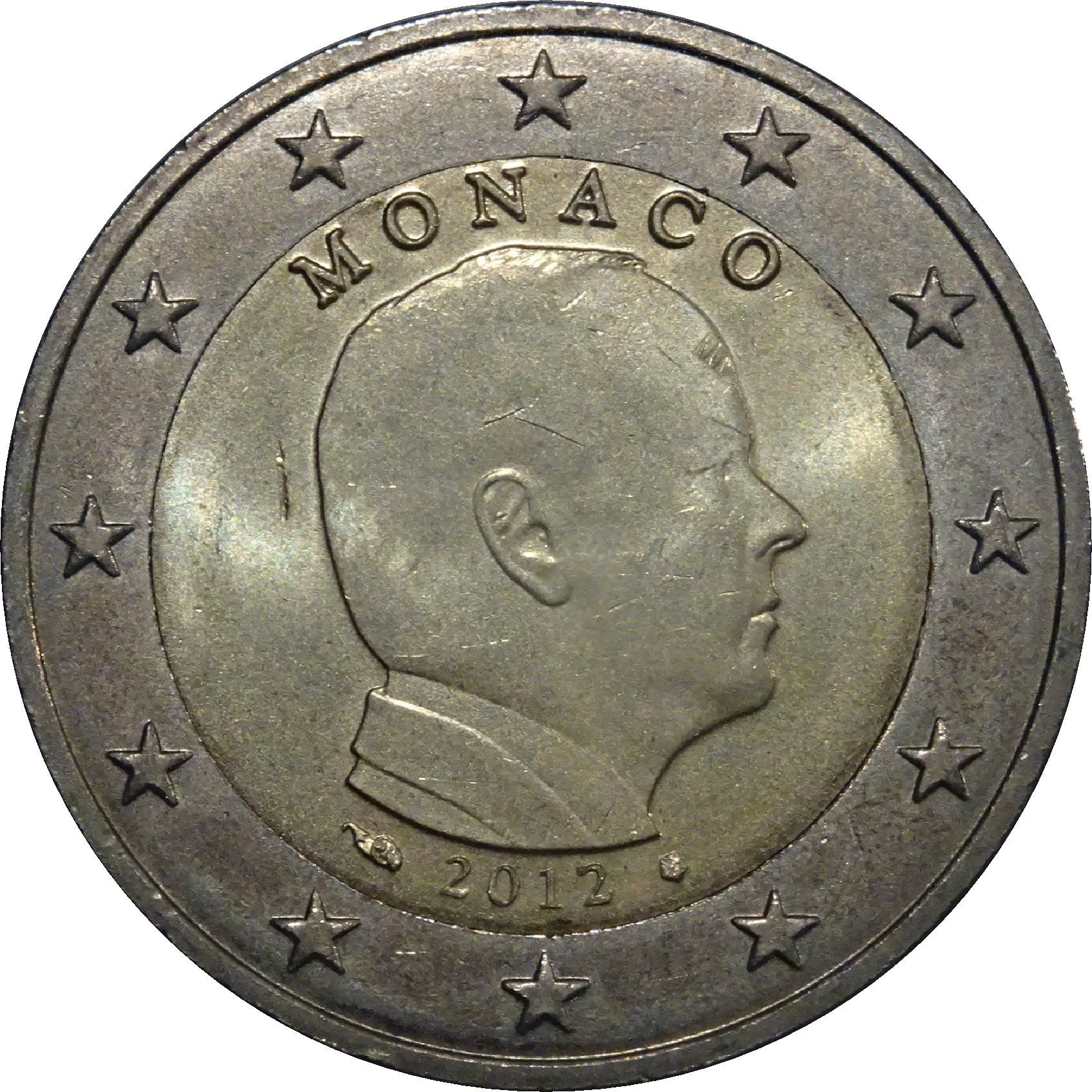
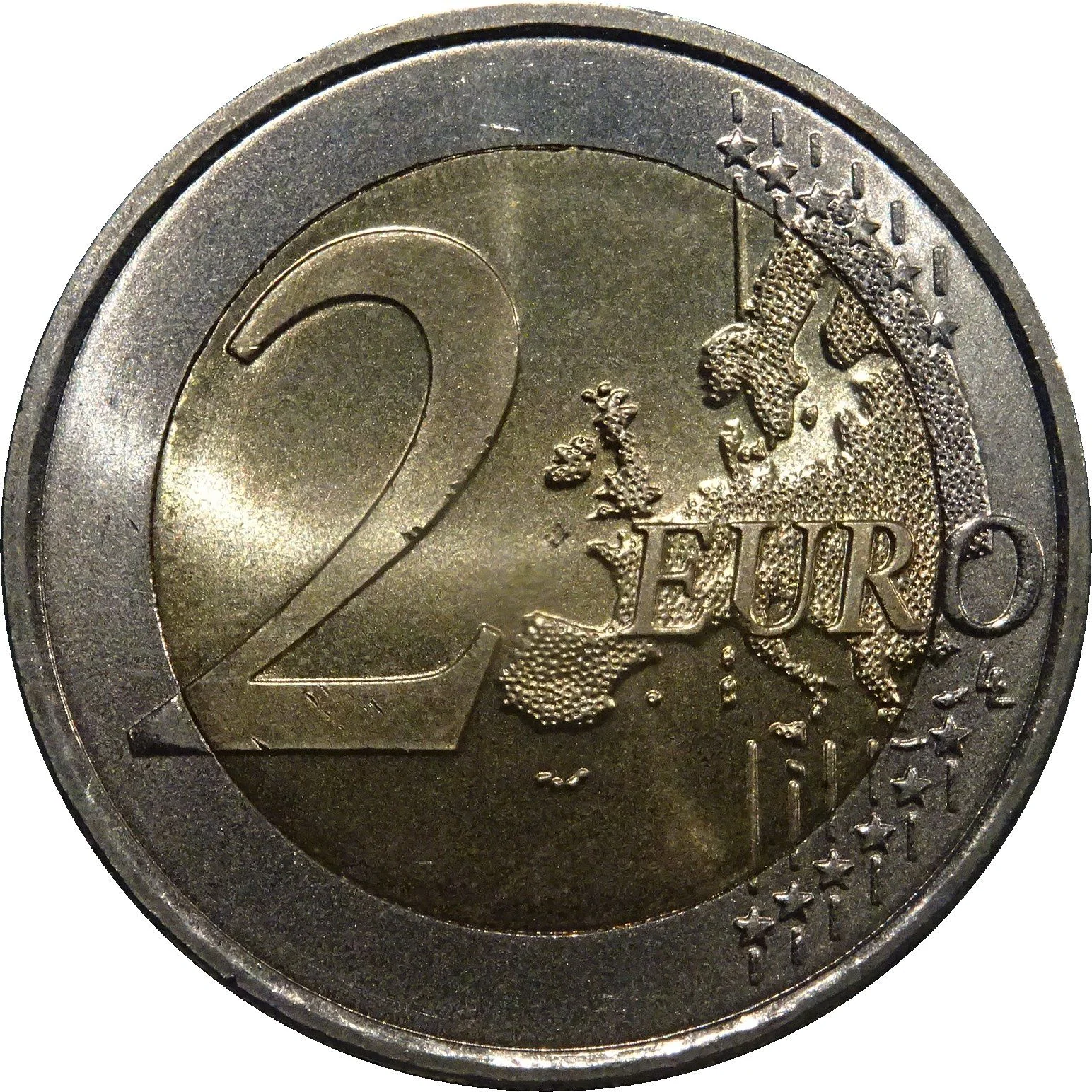
Obverse
Description:
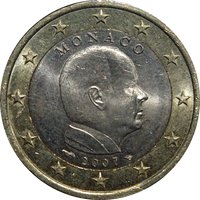
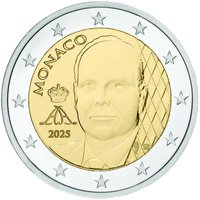
Albert II facing right, country above, date below.
Inscription:
MONACO 2012
Script: Latin
Engraver: Pierre Jauvaudin
Reverse
Edge
Reeded with 2's
Legend:
2 ** 2 ** 2 ** 2 ** 2 ** 2 **
Mints
| Name | Mark |
|---|---|
| Monnaie de Paris | — |
Mintings
| Year | Mint Mark | Mintage | Quality | Collection |
|---|---|---|---|---|
| 2009 | — | 250,000 | ||
| 2009 | — | 8,000 | BU | |
| 2010 | — | 25,000 | Proof | |
| 2011 | — | 1,032,052 | ||
| 2011 | — | 7,000 | BU | |
| 2012 | — | 1,082,373 | ||
| 2013 | — | 10,000 | BU | |
| 2014 | — | 772,000 | ||
| 2014 | — | 8,000 | BU | |
| 2015 | — | 1,306,782 | ||
| 2016 | — | 864,645 | ||
| 2017 | — | 1,383,528 | ||
| 2017 | — | 8,000 | BU | |
| 2018 | — | 934,771 | ||
| 2019 | — | 1,195,119 | ||
| 2020 | — | 1,000,000 | ||
| 2020 | — | 7,000 | BU | |
| 2021 | — | 1,035,000 | ||
| 2022 | — | 1,050,000 | ||
| 2023 | — | 1,000,000 | ||
| 2024 | — | 1,100,000 |
Historical background
In 2009, Monaco, like all members of the Eurozone, used the euro (€) as its sole official currency. This situation was the result of a formal monetary agreement signed with the European Community in 2002, which granted Monaco the unique right to use the euro and mint its own limited-edition Monegasque euro coins. These coins, featuring the image of Prince Albert II, were legal tender throughout the Eurozone but were primarily collected as numismatic items rather than used in everyday circulation. The principality's financial system was fully integrated with that of France and the broader Eurozone, with its central bank functions effectively delegated to the Banque de France.
The global financial crisis of 2008-2009 profoundly impacted Monaco's economy, which is heavily reliant on tourism, luxury goods, and banking. While the currency itself was stable as a shared European instrument, the economic downturn led to decreased revenue from key sectors, putting pressure on the state budget. The crisis highlighted both the advantages and constraints of sharing a currency; Monaco benefited from the euro's stability and lacked exchange rate risk with its main partners, but it also had no independent monetary policy (like interest rate control) to stimulate its economy, relying instead on fiscal policy and its close ties with France.
Therefore, the 2009 "currency situation" was one of institutional stability within a context of economic vulnerability. The euro's framework was firmly entrenched and uncontested within the principality, providing a solid monetary foundation. However, the macroeconomic shockwaves from the crisis tested the resilience of Monaco's euro-pegged economy, emphasizing its deep interdependence with European financial fortunes and the limitations of being a microstate within a large currency union during a period of severe recession.
The global financial crisis of 2008-2009 profoundly impacted Monaco's economy, which is heavily reliant on tourism, luxury goods, and banking. While the currency itself was stable as a shared European instrument, the economic downturn led to decreased revenue from key sectors, putting pressure on the state budget. The crisis highlighted both the advantages and constraints of sharing a currency; Monaco benefited from the euro's stability and lacked exchange rate risk with its main partners, but it also had no independent monetary policy (like interest rate control) to stimulate its economy, relying instead on fiscal policy and its close ties with France.
Therefore, the 2009 "currency situation" was one of institutional stability within a context of economic vulnerability. The euro's framework was firmly entrenched and uncontested within the principality, providing a solid monetary foundation. However, the macroeconomic shockwaves from the crisis tested the resilience of Monaco's euro-pegged economy, emphasizing its deep interdependence with European financial fortunes and the limitations of being a microstate within a large currency union during a period of severe recession.
🌱 Very Common