

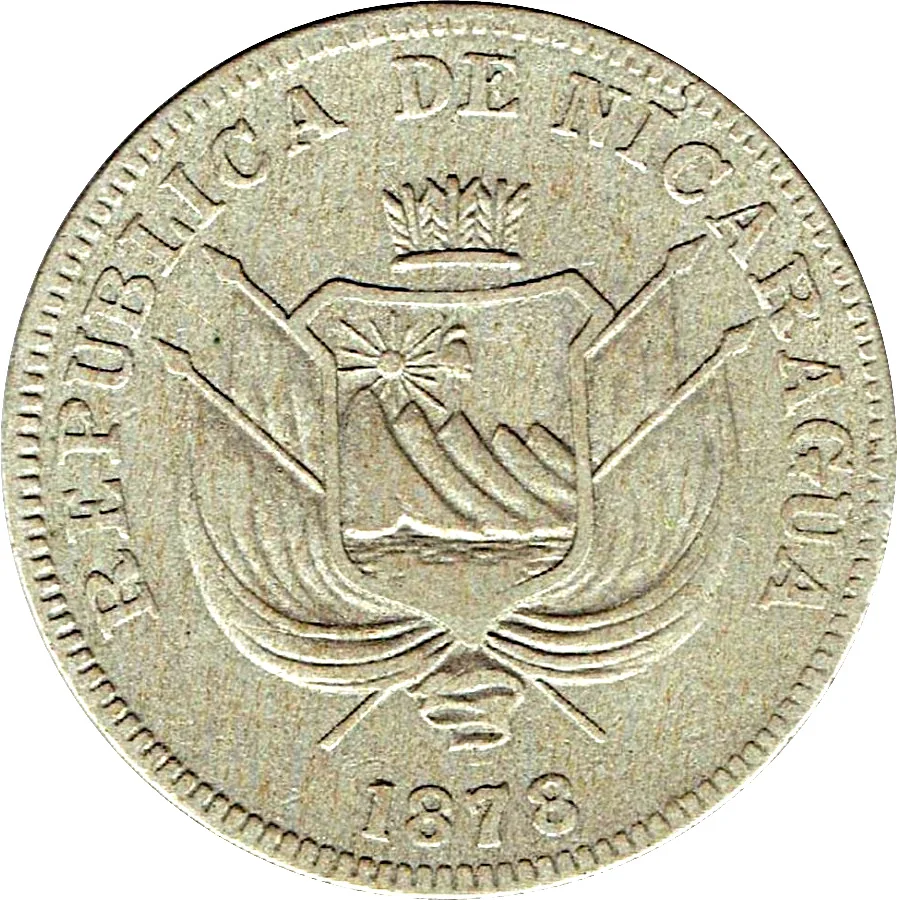
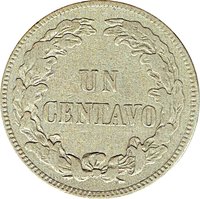
Obverse
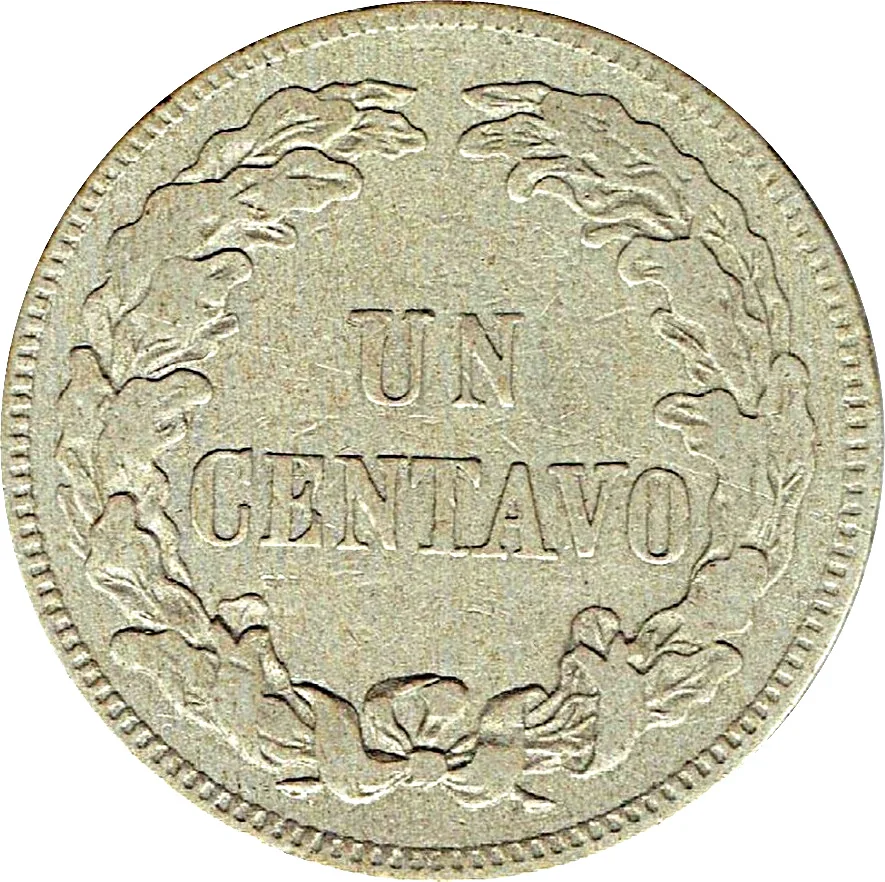
Reverse
Edge
Plain
Categories
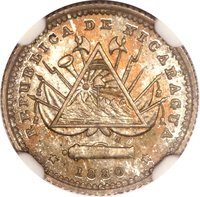
| Symbols> Coat of Arms |
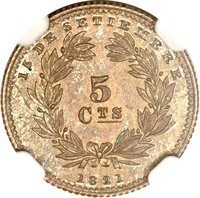
| Symbol> Wreath |
Mints
| Name | Mark |
|---|---|
| Scovill Manufacturing Company | — |
Mintings
| Year | Mint Mark | Mintage | Quality | Collection |
|---|---|---|---|---|
| 1878 | — | 500,000 | ||
| 1878 | — | — | Proof |
Historical background
In 1878, Nicaragua’s currency system was a complex and unstable mixture of foreign and domestic coins, reflecting the country's integration into the global economy and its internal political fragility. The primary legal tender was the silver Peso Fuerte, theoretically divided into 100 centavos, but its circulation was limited. The economy relied heavily on foreign coins, particularly Peruvian and Bolivian silver pesos, Chilean and Colombian coins, and even U.S. gold dollars and British sovereigns, which circulated freely for larger transactions. This multiplicity created constant problems of valuation and exchange, as the intrinsic metal value of these coins often differed from their nominal face value, leading to confusion and facilitating fraud in commerce.
This monetary chaos was a direct result of Nicaragua's chronic political instability and lack of strong central institutions. Following independence, the nation had experienced repeated civil wars, foreign intervention, and a lack of consistent fiscal policy, preventing the establishment of a trusted, unified national currency. The government, perennially short of revenue, had a limited ability to mint its own coinage in sufficient quantity or to regulate the flood of foreign specie. Consequently, the practical money supply was dictated by merchants and international trade flows, particularly around the key transit route of the San Juan River and Lake Nicaragua, which attracted foreign currency but did not foster a stable domestic system.
The situation posed significant obstacles to economic development. Internal trade was hampered by the need for money changers and the risk of receiving debased or counterfeit foreign coins. The state struggled to collect taxes in a reliable standard of value, and foreign investors viewed the monetary anarchy as a sign of broader risk. While there were occasional discussions about reform, including proposals to adopt a gold standard or to decimalize the system more effectively, no decisive action was taken in 1878. The currency disorder would persist until the late 19th century, when increased coffee exports and stronger political control under the Zelaya administration finally enabled a comprehensive monetary reform and the creation of a new national currency, the Córdoba, in 1912.
This monetary chaos was a direct result of Nicaragua's chronic political instability and lack of strong central institutions. Following independence, the nation had experienced repeated civil wars, foreign intervention, and a lack of consistent fiscal policy, preventing the establishment of a trusted, unified national currency. The government, perennially short of revenue, had a limited ability to mint its own coinage in sufficient quantity or to regulate the flood of foreign specie. Consequently, the practical money supply was dictated by merchants and international trade flows, particularly around the key transit route of the San Juan River and Lake Nicaragua, which attracted foreign currency but did not foster a stable domestic system.
The situation posed significant obstacles to economic development. Internal trade was hampered by the need for money changers and the risk of receiving debased or counterfeit foreign coins. The state struggled to collect taxes in a reliable standard of value, and foreign investors viewed the monetary anarchy as a sign of broader risk. While there were occasional discussions about reform, including proposals to adopt a gold standard or to decimalize the system more effectively, no decisive action was taken in 1878. The currency disorder would persist until the late 19th century, when increased coffee exports and stronger political control under the Zelaya administration finally enabled a comprehensive monetary reform and the creation of a new national currency, the Córdoba, in 1912.
⭐ Somewhat Rare