

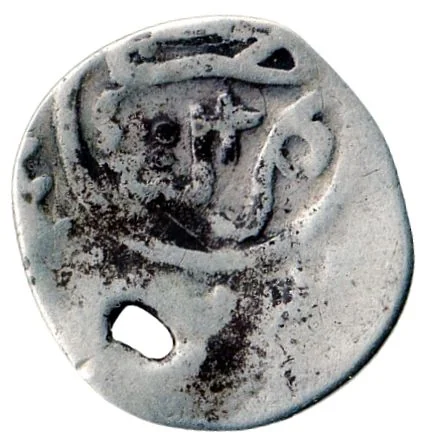
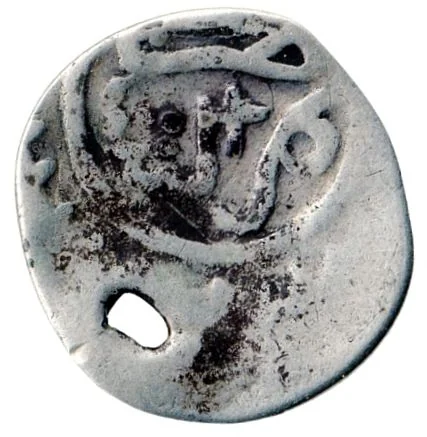
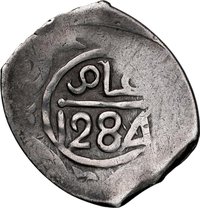
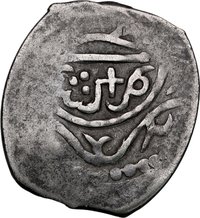
½ dirham – Morocco
Add to wishlist
Morocco
Context
References
Numista: #157022
Value
Bullion value: $3.60
Mintings
| Year | Mint Mark | Mintage | Quality | Collection |
|---|---|---|---|---|
| 1866 | — | — | ||
| 1867 | — | — | ||
| 1869 | — | — |
Historical background
In 1866, Morocco's currency situation was characterized by profound instability and fragmentation, a direct reflection of the country's political and economic decline. The Alawite Sultanate, while nominally independent, was under increasing European financial pressure and had suffered military defeat by Spain in 1860, which resulted in a large war indemnity. To pay this debt, the Makhzen (government) was forced to borrow from British bankers, pledging customs revenues as collateral. This external burden strained the treasury and accelerated the debasement of the domestic coinage.
The monetary system itself was a complex and chaotic mix. The primary unit was the silver dirham, but its weight and purity were not standardized, leading to a proliferation of different coinages in circulation. These included not only official Sultanic mintings but also older coins, Spanish duros, and other foreign currencies, all valued by weight and metal content rather than face value. The gold benduqi was used for large transactions, while low-value copper falus served for everyday purchases. This lack of a unified, trusted currency stifled internal trade and made fiscal administration exceedingly difficult for the state.
Consequently, the year 1866 fell within a protracted period of monetary crisis. The government's response, including attempts to introduce a new copper coinage, often led to inflation and public distrust, as the intrinsic value of the coins frequently fell below their nominal value. This unstable environment facilitated the penetration of European commercial and financial interests, setting the stage for the deeper economic dependencies and reforms that would culminate in the establishment of a French-protected State Bank in 1907 and, ultimately, the colonial protectorate in 1912.
The monetary system itself was a complex and chaotic mix. The primary unit was the silver dirham, but its weight and purity were not standardized, leading to a proliferation of different coinages in circulation. These included not only official Sultanic mintings but also older coins, Spanish duros, and other foreign currencies, all valued by weight and metal content rather than face value. The gold benduqi was used for large transactions, while low-value copper falus served for everyday purchases. This lack of a unified, trusted currency stifled internal trade and made fiscal administration exceedingly difficult for the state.
Consequently, the year 1866 fell within a protracted period of monetary crisis. The government's response, including attempts to introduce a new copper coinage, often led to inflation and public distrust, as the intrinsic value of the coins frequently fell below their nominal value. This unstable environment facilitated the penetration of European commercial and financial interests, setting the stage for the deeper economic dependencies and reforms that would culminate in the establishment of a French-protected State Bank in 1907 and, ultimately, the colonial protectorate in 1912.
✨ Legendary