

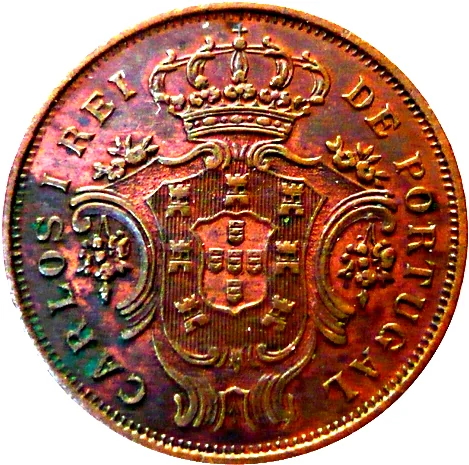
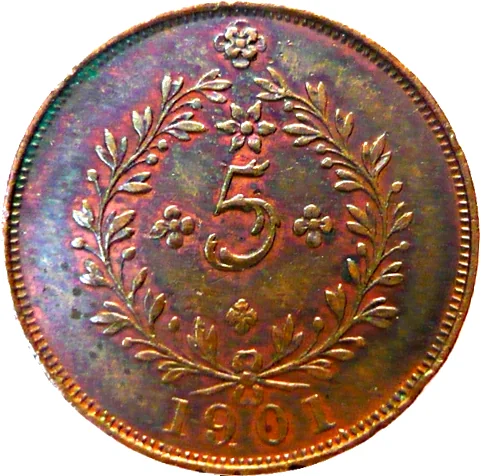
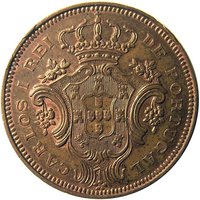
Obverse
Description:
Arms with a crown.
Inscription:
CARLOS I REI DE PORTUGAL
Translation:
Charles I King of Portugal
Script: Latin
Language: Portuguese
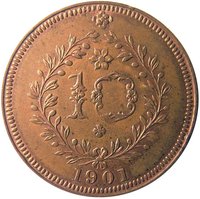
Reverse
Edge
Plain
Categories
| Symbols> Coat of Arms |
| Symbol> Crown |
Mintings
| Year | Mint Mark | Mintage | Quality | Collection |
|---|---|---|---|---|
| 1901 | — | 800,000 |
Historical background
In 1901, the Azores archipelago, as an integral part of the Kingdom of Portugal, operated under the national Portuguese monetary system. The official currency was the Portuguese real (plural: réis), a system that had been in place for centuries. Transactions, both large and small, were conducted in réis, with banknotes and coins issued by the Bank of Portugal circulating alongside older, worn coins from various periods of Portuguese history. The economy was primarily agrarian and export-oriented, with whale oil, pineapples, and tea being key commodities, and their trade was accounted for in the national currency.
However, the currency situation on the islands was not without its complexities. Due to the Azores' strategic location in the mid-Atlantic as a key stop for transoceanic shipping and whaling fleets, foreign coins, particularly British sovereigns and U.S. gold dollars, were also commonly found in circulation. These foreign coins were often preferred for larger transactions and international trade because of their recognized gold value and stability, especially as Portugal itself struggled with periodic economic instability and currency devaluation. This created a de facto dual-currency environment in port cities like Ponta Delgada and Horta.
The year 1901 fell within a period of transition for Portuguese currency. The real, which required dealing in very large numbers (e.g., 1,000 réis), was becoming increasingly unwieldy. This would lead to a significant reform just a decade later, in 1911, when Portugal introduced the escudo, worth 1,000 réis, as part of a broader republican overhaul following the 1910 revolution. Therefore, in 1901, the Azores were using an aging monetary system that was subtly influenced by foreign commerce and was on the cusp of a major national change that would soon reach its shores.
However, the currency situation on the islands was not without its complexities. Due to the Azores' strategic location in the mid-Atlantic as a key stop for transoceanic shipping and whaling fleets, foreign coins, particularly British sovereigns and U.S. gold dollars, were also commonly found in circulation. These foreign coins were often preferred for larger transactions and international trade because of their recognized gold value and stability, especially as Portugal itself struggled with periodic economic instability and currency devaluation. This created a de facto dual-currency environment in port cities like Ponta Delgada and Horta.
The year 1901 fell within a period of transition for Portuguese currency. The real, which required dealing in very large numbers (e.g., 1,000 réis), was becoming increasingly unwieldy. This would lead to a significant reform just a decade later, in 1911, when Portugal introduced the escudo, worth 1,000 réis, as part of a broader republican overhaul following the 1910 revolution. Therefore, in 1901, the Azores were using an aging monetary system that was subtly influenced by foreign commerce and was on the cusp of a major national change that would soon reach its shores.
🌱 Common