

1 Ruble (Vladimir Ilyich Lenin) – Soviet Union
Circulating commemorative coins
Commemoration: 115th Anniversary of the Birth of Vladimir Ilyich Lenin
Russia
Context
Years: 1985–1988
Country: Russia 
Issuer: Soviet Union 
Period:
(1922—1991)
Currency:
(1961—1991)
Demonetization: 1991
Total mintage: 2,055,000
Material
Diameter: 31 mm
Weight: 12.8 g
Thickness: 2.3 mm
Shape: Round
Composition: Copper-nickel
Technique: Milled
References
Y: #Click to copy to clipboard197.1
Numista: #10537
Value
Exchange value: 1 SUR
Obverse
Description:
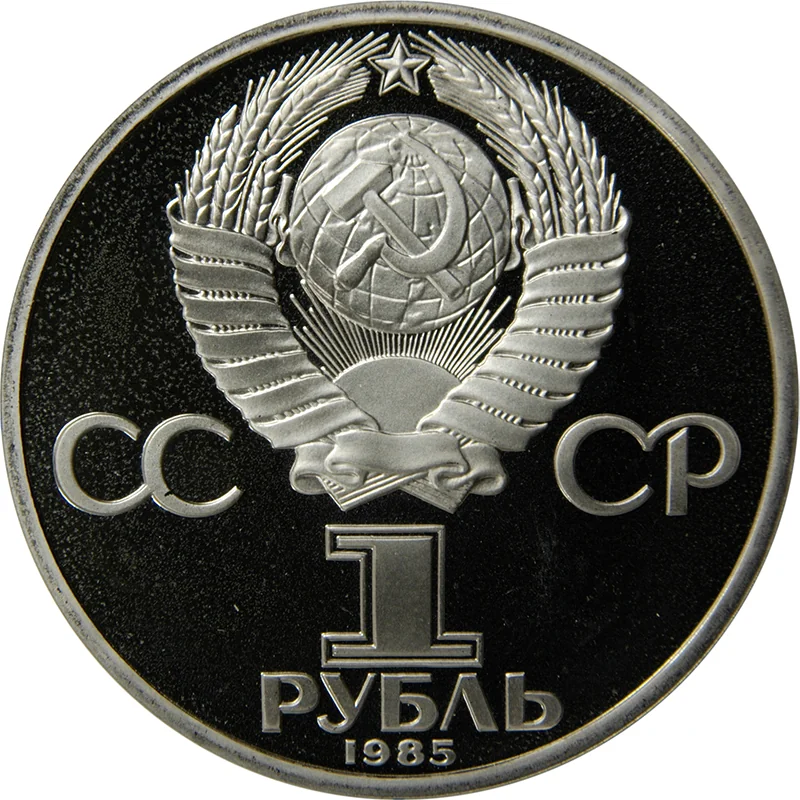
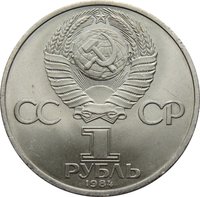
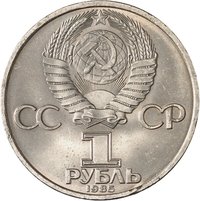
The Soviet Union's coat of arms; value.
Inscription:
СССР
1
РУБЛЬ
1985
1
РУБЛЬ
1985
Translation:
THE USSR
1
RUBLE
1985
1
RUBLE
1985
Script: Cyrillic
Language: Russian
Engraver: Sergey Mikhaylovich Ivanov
Reverse
Description:
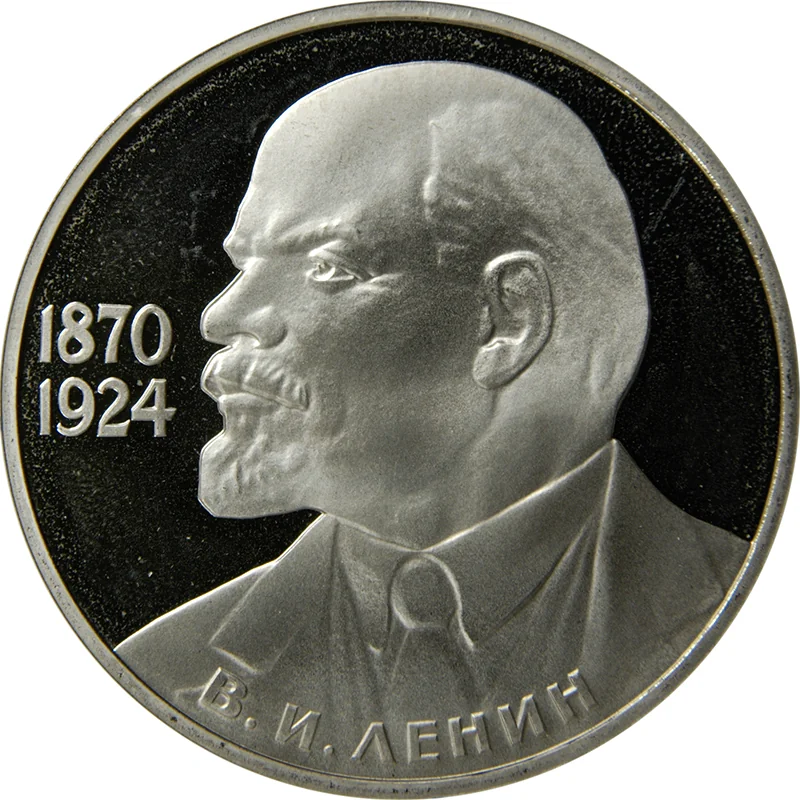
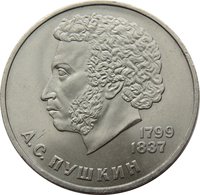
Portrait of Vladimir Lenin.
Inscription:
1870
1924
В.И. ЛЕНИН
1924
В.И. ЛЕНИН
Translation:
1870
1924
V.I. LENIN
1924
V.I. LENIN
Script: Cyrillic
Language: Russian
Engraver: Alexander Vasilievich Kozlov
Edge
Smooth with inscription
Legend:
Y#197.1 : ОДИН РУБЛЬ • ОДИН РУБЛЬ •
Y#197.2 : ОДИН РУБЛЬ • 1988 • Н •
Y#197.2 : ОДИН РУБЛЬ • 1988 • Н •
Translation:
ONE RUBLE • ONE RUBLE •
Language: Russian;
ONE RUBLE • 1988 • N •
Language: Russian;
ONE RUBLE • 1988 • N •
Language: Russian
Categories
| Event> Birth anniversary |
Mints
| Name | Mark |
|---|---|
| Saint Petersburg | — |
Mintings
| Year | Mint Mark | Mintage | Quality | Collection |
|---|---|---|---|---|
| 1985 | — | 1,960,000 | ||
| 1985 | — | 40,000 | Proof | |
| 1988 | — | 55,000 | Proof | |
| 1988 | — | — |
Historical background
By 1985, the Soviet Union’s currency situation was characterized by a profound and growing duality. Officially, the ruble was a stable, non-convertible currency managed by Gosbank, with an artificial exchange rate pegged at approximately 0.6 rubles to the US dollar. This facade of strength, however, masked severe underlying economic distortions. The economy was plagued by chronic shortages of consumer goods, endemic waste, and declining productivity. While citizens had money in their savings books—a result of suppressed inflation and few desirable goods to purchase—this accumulated "ruble overhang" represented massive pent-up demand with no corresponding supply, creating a latent inflationary pressure.
This monetary duality was most visible in the existence of a vast black market and a separate, privileged economy. For ordinary citizens, the ruble’s purchasing power was limited to the sparse selection in state stores, leading to long queues and a reliance on personal networks (blat) to obtain goods. Meanwhile, a thriving illegal currency exchange operated, where the ruble’s real value was a fraction of its official rate, often 10-20 times weaker. Parallel to this, the state maintained a system of special "Beriozka" hard-currency stores stocked with imported goods, accessible only to those with foreign currency or special certificates, creating a visible and resented two-tiered society that undermined faith in the ruble.
When Mikhail Gorbachev assumed power in 1985, he inherited this unstable monetary system, which was both a symptom and a cause of the USSR’s deepening stagnation. The overvalued official ruble isolated the Soviet economy from global markets, while the internal disconnect between money and goods eroded labor incentives and public morale. Initial reforms under Perestroika would soon attempt to address these issues by legalizing some cooperative enterprises, but without a comprehensive price reform or move toward convertibility, these steps inadvertently accelerated the monetary crisis. The currency situation of 1985 thus represented a ticking time bomb, setting the stage for the hyperinflation and monetary collapse that would accompany the Union’s dissolution at the end of the decade.
This monetary duality was most visible in the existence of a vast black market and a separate, privileged economy. For ordinary citizens, the ruble’s purchasing power was limited to the sparse selection in state stores, leading to long queues and a reliance on personal networks (blat) to obtain goods. Meanwhile, a thriving illegal currency exchange operated, where the ruble’s real value was a fraction of its official rate, often 10-20 times weaker. Parallel to this, the state maintained a system of special "Beriozka" hard-currency stores stocked with imported goods, accessible only to those with foreign currency or special certificates, creating a visible and resented two-tiered society that undermined faith in the ruble.
When Mikhail Gorbachev assumed power in 1985, he inherited this unstable monetary system, which was both a symptom and a cause of the USSR’s deepening stagnation. The overvalued official ruble isolated the Soviet economy from global markets, while the internal disconnect between money and goods eroded labor incentives and public morale. Initial reforms under Perestroika would soon attempt to address these issues by legalizing some cooperative enterprises, but without a comprehensive price reform or move toward convertibility, these steps inadvertently accelerated the monetary crisis. The currency situation of 1985 thus represented a ticking time bomb, setting the stage for the hyperinflation and monetary collapse that would accompany the Union’s dissolution at the end of the decade.
🌱 Common