

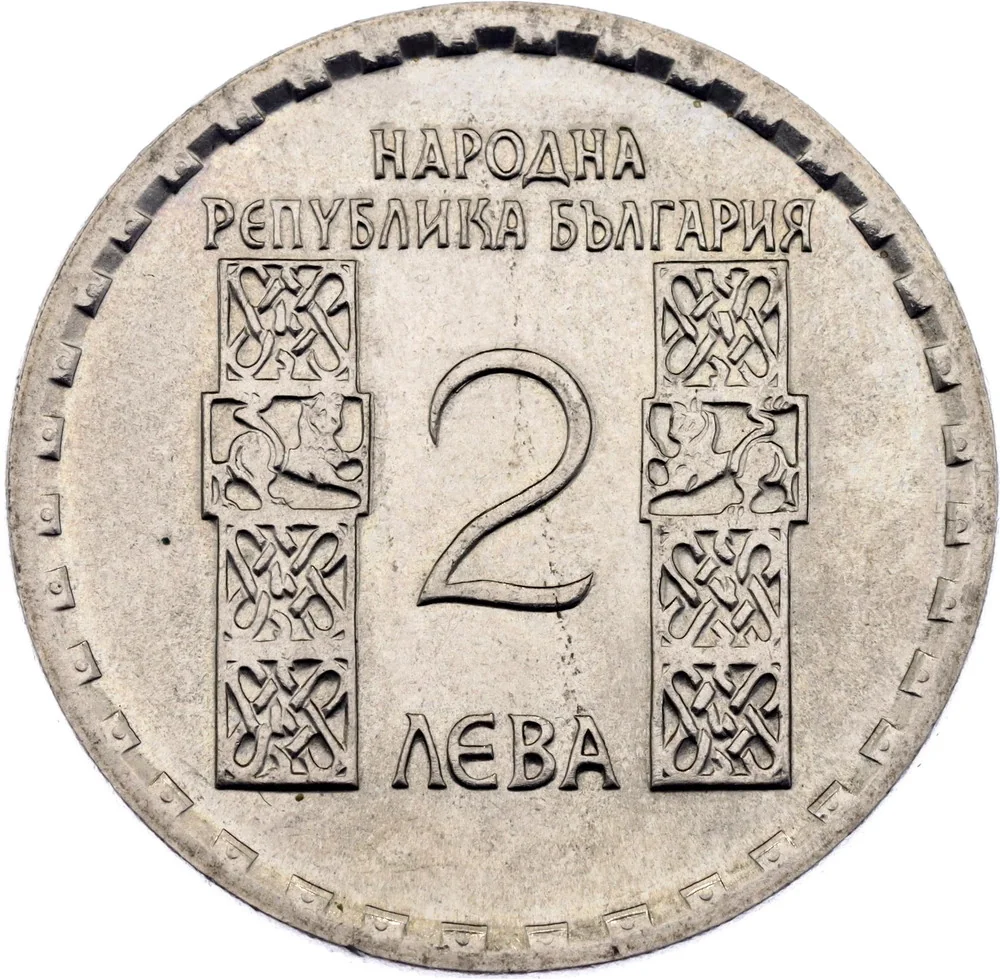
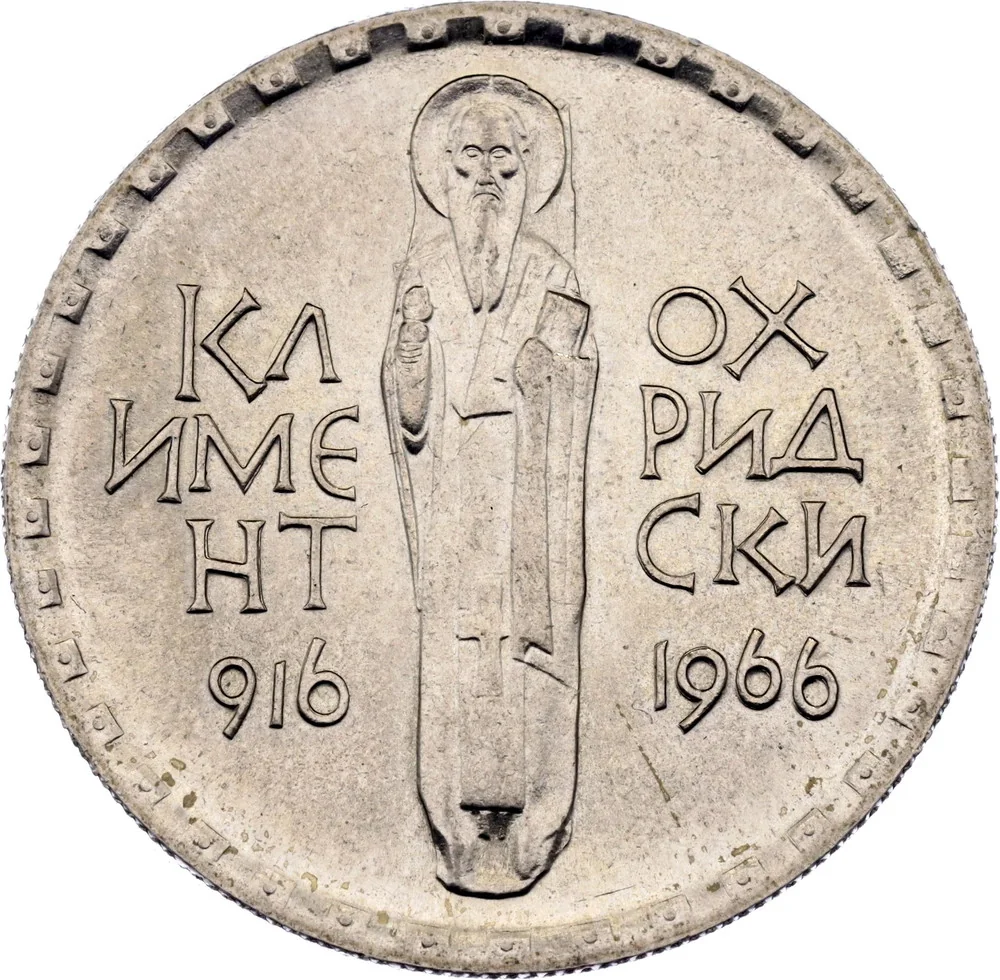
2 leva (Ohridski) – Bulgaria
Add to wishlist
Circulating commemorative coins
Commemoration: 1050th Anniversary - Death of Ohridski, Founder of the First European University
Bulgaria
Context
Year: 1966
Issuer: Bulgaria
Period:
(1946—1990)
Currency:
(1962—1999)
Demonetized: Yes
Total mintage: 506,000
Material
Diameter: 30 mm
Weight: 11 g
Thickness: 2 mm
Shape: Round
Composition: Copper-nickel
Technique: Milled
Alignment: Medal alignment
flip
References
KM: #
Numista: #10535
Value
Exchange value: 2 BGL
Obverse
Reverse
Description:
St. Clement of Ohrid.
Inscription:
КЛИМЕНТ ОХРИДСКИ
916 1966
916 1966
Translation:
Clement of Ohrid
916 1966
916 1966
Script: Cyrillic
Language: Macedonian
Edge
Milled
Mints
| Name | Mark |
|---|---|
| Bulgarian Mint | — |
Mintings
| Year | Mint Mark | Mintage | Quality | Collection |
|---|---|---|---|---|
| 1966 | — | 506,000 |
Historical background
In 1966, Bulgaria operated under a centrally planned economy and its currency, the lev, was part of a complex, multi-tiered monetary system typical of the Eastern Bloc. The official exchange rate was set by the Bulgarian State Bank at a fixed, highly overvalued rate of 1.17 leva to 1 US dollar, a rate used almost exclusively for state accounting in foreign trade. This artificial rate bore no relation to the currency's actual purchasing power or market forces, as the economy was isolated from global capital markets and focused on fulfilling the targets of the state's Five-Year Plan.
Alongside this official rate, a separate and more realistic "non-commercial" or "tourist" rate existed, which was significantly less favorable (approximately 2.00 leva per dollar in the mid-1960s). This rate applied to limited personal transactions, such as remittances from abroad or exchanges by a small number of foreign tourists. Crucially, a vibrant black market for hard currency also persisted, where the lev traded at a substantial discount, reflecting its true scarcity and the suppressed demand for Western goods and travel beyond the Iron Curtain. The currency was non-convertible, meaning it could not be freely exchanged outside the country, reinforcing state control over all economic activity.
The currency regime of 1966 thus served as a tool for economic control and isolation. It allowed the state to subsidize prioritized industries through the overvalued official rate while strictly rationing access to foreign exchange. This system effectively shielded domestic industries from international competition and prevented capital flight, but it also created distortions, suppressed consumer choice, and contributed to the chronic shortages of quality goods that characterized the later decades of the socialist economy.
Alongside this official rate, a separate and more realistic "non-commercial" or "tourist" rate existed, which was significantly less favorable (approximately 2.00 leva per dollar in the mid-1960s). This rate applied to limited personal transactions, such as remittances from abroad or exchanges by a small number of foreign tourists. Crucially, a vibrant black market for hard currency also persisted, where the lev traded at a substantial discount, reflecting its true scarcity and the suppressed demand for Western goods and travel beyond the Iron Curtain. The currency was non-convertible, meaning it could not be freely exchanged outside the country, reinforcing state control over all economic activity.
The currency regime of 1966 thus served as a tool for economic control and isolation. It allowed the state to subsidize prioritized industries through the overvalued official rate while strictly rationing access to foreign exchange. This system effectively shielded domestic industries from international competition and prevented capital flight, but it also created distortions, suppressed consumer choice, and contributed to the chronic shortages of quality goods that characterized the later decades of the socialist economy.
🌱 Common