

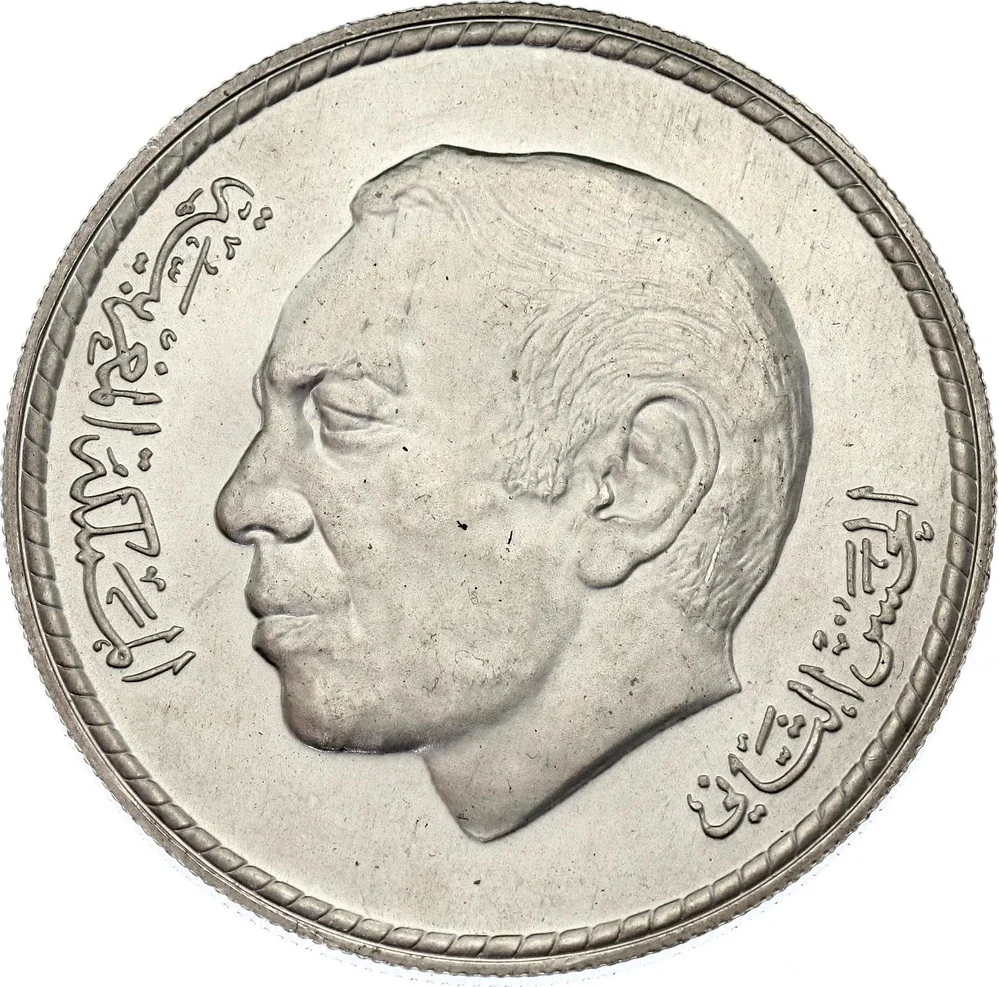
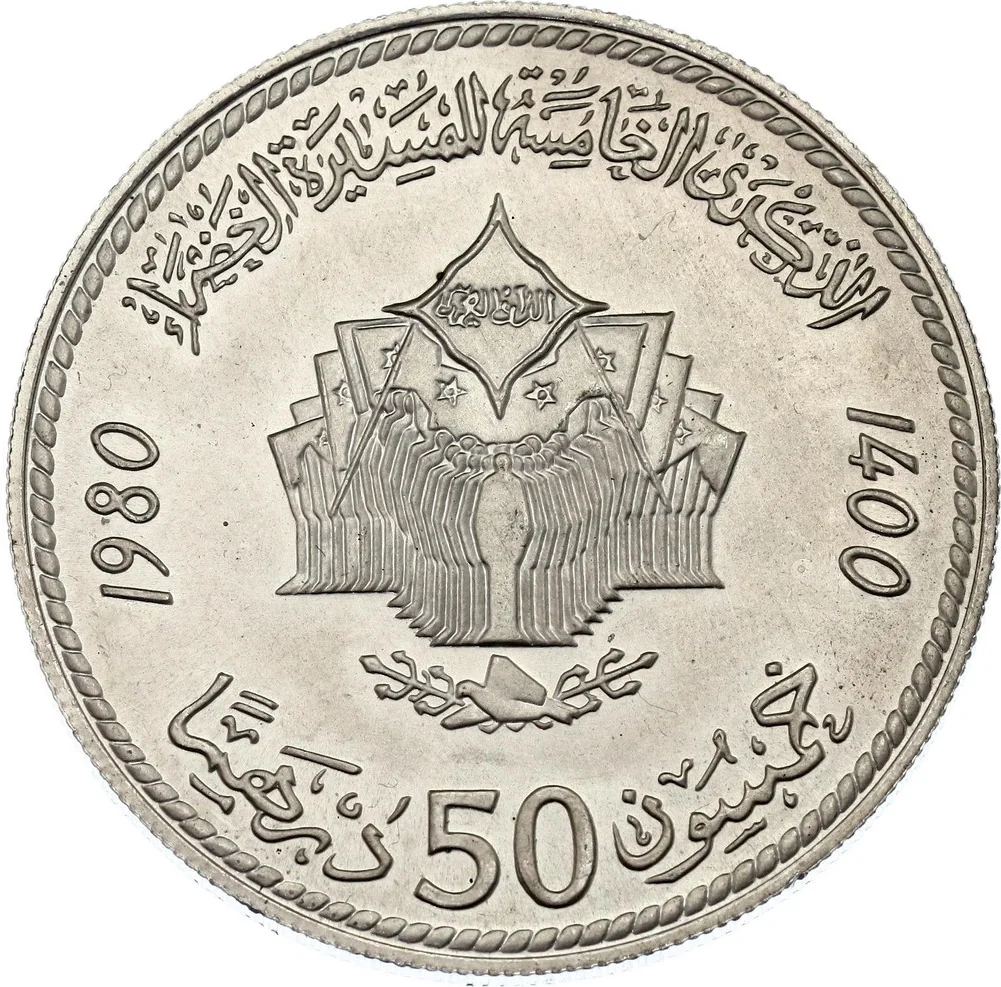
50 dirhams (Green March) – Morocco
Add to wishlist
Non-circulating coins
Commemoration: 5th Anniversary of the Green March
Morocco
Context
Year: 1980
Islamic (Hijri) Year:: 1400
Issuer: Morocco
Ruler: Hassan II
Currency:
(since 1960)
Total mintage: 1,200
Material
References
Y: #
Numista: #156547
Value
Exchange value: 50 MAD
Bullion value: $82.42
Mints
| Name | Mark |
|---|---|
| Royal Mint | — |
Mintings
| Year | Mint Mark | Mintage | Quality | Collection |
|---|---|---|---|---|
| 1980 | — | 1,000 | ||
| 1980 | — | 200 | Proof |
Historical background
In 1980, Morocco's currency situation was characterized by a tightly managed exchange rate regime under the dirham, which was not freely convertible. The country operated a multi-tier exchange rate system, a complex mechanism where different rates were applied to different categories of transactions (e.g., essential imports vs. luxury goods, remittances vs. tourism). This system, overseen by Bank Al-Maghrib (the central bank), was designed to conserve scarce foreign exchange reserves, control capital flows, and protect the balance of payments. The official parity was pegged to a basket of currencies, heavily weighted toward the French franc, reflecting Morocco's deep historical and trade ties with France.
Economically, the early 1980s were a period of significant strain, which directly pressured the currency. Morocco was grappling with the aftermath of the costly war in the Western Sahara, a heavy debt burden from ambitious development projects in the 1970s, and the global oil shocks. These factors led to large fiscal and current account deficits. Consequently, foreign exchange reserves were under pressure, and the gap between the official exchange rate and the black-market rate for the dirham widened noticeably. This disparity highlighted the currency's overvaluation and the underlying economic stresses.
The situation in 0 set the stage for a major economic transformation later in the decade. The persistent imbalances and the inefficiencies of the multi-tier system eventually compelled the government to seek structural adjustment programs from the International Monetary Fund (IMF) and the World Bank. These programs, initiated in 1983, would lead to profound reforms, including a unification of the exchange rates, a substantial devaluation of the dirham, and a gradual move toward greater convertibility—marking the beginning of Morocco's shift toward a more liberalized economy.
Economically, the early 1980s were a period of significant strain, which directly pressured the currency. Morocco was grappling with the aftermath of the costly war in the Western Sahara, a heavy debt burden from ambitious development projects in the 1970s, and the global oil shocks. These factors led to large fiscal and current account deficits. Consequently, foreign exchange reserves were under pressure, and the gap between the official exchange rate and the black-market rate for the dirham widened noticeably. This disparity highlighted the currency's overvaluation and the underlying economic stresses.
The situation in 0 set the stage for a major economic transformation later in the decade. The persistent imbalances and the inefficiencies of the multi-tier system eventually compelled the government to seek structural adjustment programs from the International Monetary Fund (IMF) and the World Bank. These programs, initiated in 1983, would lead to profound reforms, including a unification of the exchange rates, a substantial devaluation of the dirham, and a gradual move toward greater convertibility—marking the beginning of Morocco's shift toward a more liberalized economy.

💎 Extremely Rare