

1 penny – Fiji
Add to wishlist
Fiji
Context
Year: 1936
Issuer: Fiji
Ruler: Edward VIII
Currency:
(1873—1969)
Demonetization: 30 June 1969
Total mintage: 120,000
Material
Diameter: 26 mm
Weight: 6.48 g
Shape: Round with a round hole
Composition: Copper-nickel
Technique: Milled
Alignment: Medal alignment
flip
References
KM: #
Numista: #15619
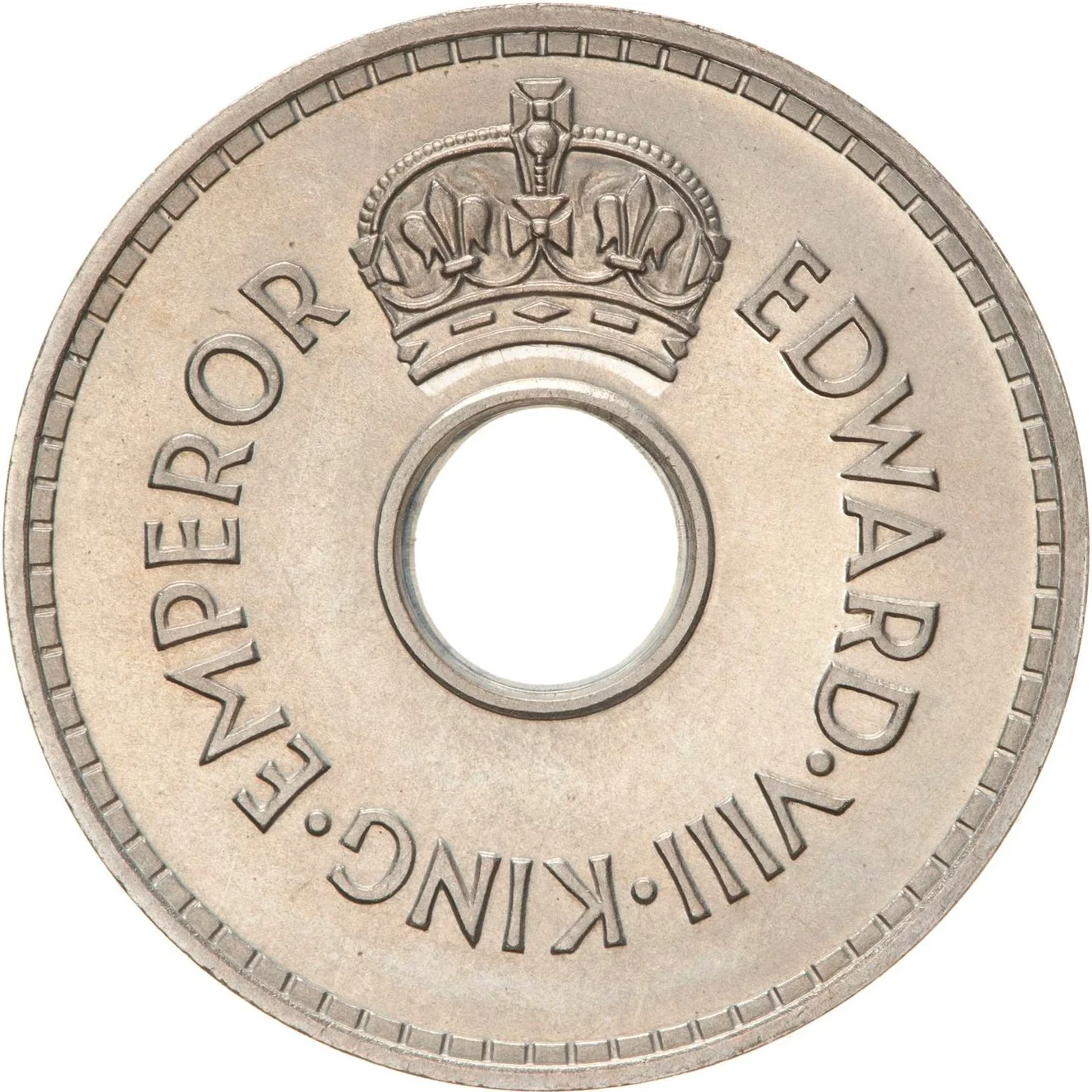
Obverse
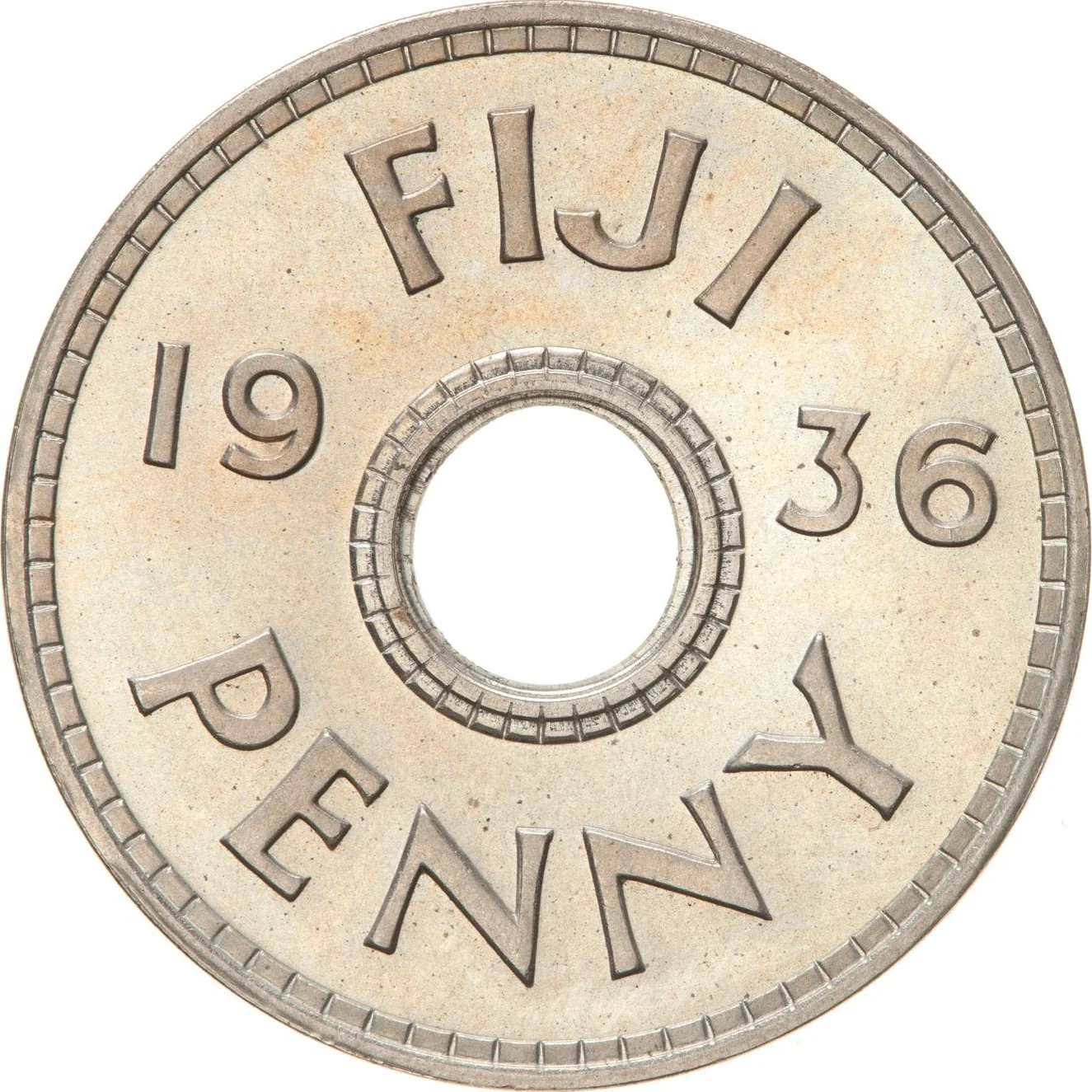
Reverse
Description:
Date flanking center hole, denomination below.
Inscription:
FIJI
19 36
PENNY
19 36
PENNY
Script: Latin
Edge
Plain
Mints
| Name | Mark |
|---|---|
| Royal Mint (Tower Hill) | — |
Mintings
| Year | Mint Mark | Mintage | Quality | Collection |
|---|---|---|---|---|
| 1936 | — | 120,000 | ||
| 1936 | — | — | Proof |
Historical background
In 1936, Fiji's currency situation was firmly under the control of the British colonial administration, operating within the framework of the sterling area. The official currency was the Fiji pound (F£), which was pegged at par with the British pound sterling (GBP). This meant that banknotes and coins issued in Fiji were directly interchangeable with sterling, ensuring stability in trade and finance with the United Kingdom, which dominated Fiji's external commerce. The currency was issued by a board of commissioners established under the Currency Ordinance of 1934, which centralized and formalized the monetary system, replacing earlier private bank issues.
The economy relied heavily on sugar exports, with the industry controlled by the Colonial Sugar Refining Company of Australia. This export-oriented structure meant that currency stability was paramount, and the peg to sterling provided a reliable anchor. However, the global economic context of the 1930s, still recovering from the Great Depression, influenced local conditions. While the peg offered stability, it also meant Fiji imported the monetary policy of Britain, including the effects of the UK's departure from the gold standard in 1931, which had devalued sterling and provided some indirect relief to Fiji's export sector.
Domestically, the currency in circulation was a mix of British coinage and locally issued Fiji government notes. The system was designed for administrative efficiency and colonial fiscal control, with little regard for independent monetary policy. For the ethnically diverse population, including Fijians, Indo-Fijian indentured labourers and descendants, and Europeans, the currency system was a practical tool of daily life and the plantation economy, but its governance remained exclusively in the hands of the colonial authorities, reflecting Fiji's political and economic status as a dependent territory within the British Empire.
The economy relied heavily on sugar exports, with the industry controlled by the Colonial Sugar Refining Company of Australia. This export-oriented structure meant that currency stability was paramount, and the peg to sterling provided a reliable anchor. However, the global economic context of the 1930s, still recovering from the Great Depression, influenced local conditions. While the peg offered stability, it also meant Fiji imported the monetary policy of Britain, including the effects of the UK's departure from the gold standard in 1931, which had devalued sterling and provided some indirect relief to Fiji's export sector.
Domestically, the currency in circulation was a mix of British coinage and locally issued Fiji government notes. The system was designed for administrative efficiency and colonial fiscal control, with little regard for independent monetary policy. For the ethnically diverse population, including Fijians, Indo-Fijian indentured labourers and descendants, and Europeans, the currency system was a practical tool of daily life and the plantation economy, but its governance remained exclusively in the hands of the colonial authorities, reflecting Fiji's political and economic status as a dependent territory within the British Empire.
🌱 Common