

1 Peseta – Spain
Spain
Context
Year: 1876
Issuer: Spain 
Ruler: Alfonso XII
Currency:
(1868—2001)
Demonetization: 20 February 1939
Total mintage: 4,427,000
Material
References
KM: #Click to copy to clipboard672
Numista: #15606
Value
Exchange value: 1 ESP
Bullion value: $12.04
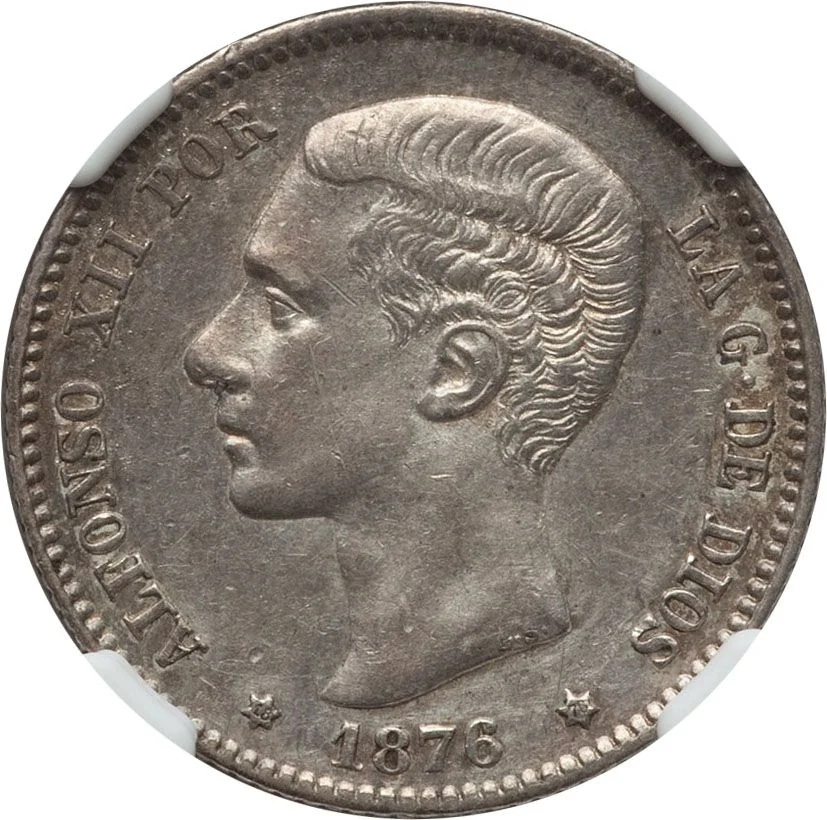
Obverse
Description:
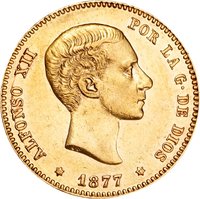
King Alfonso XII facing left.
Inscription:
ALFONSO XII POR LA G· DE DIOS
G· S·
🟌 1876 🟌
G· S·
🟌 1876 🟌
Translation:
By the grace of God, Alfonso XII
King of Spain, 1876
King of Spain, 1876
Script: Latin
Language: Spanish
Engraver: Gregorio Sellán y González
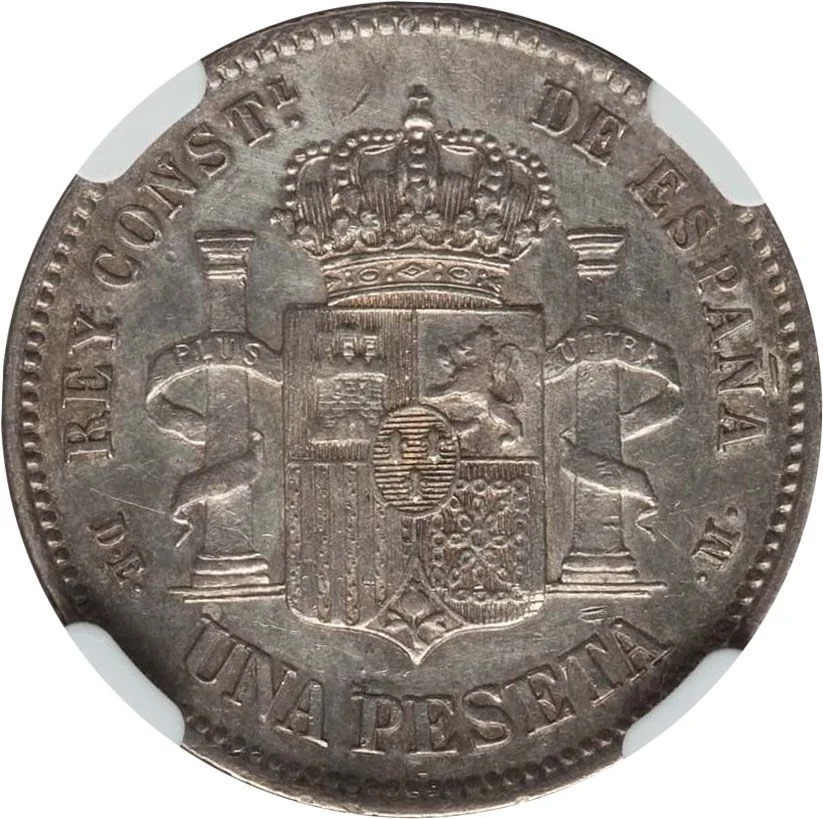
Reverse
Description:
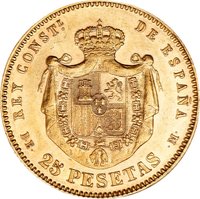
Spanish coat of arms with the Pillars of Hercules.
Inscription:
REY CONSTL. DE ESPAÑA
PLUS ULTRA
D·E· UNA PESETA ·M·
PLUS ULTRA
D·E· UNA PESETA ·M·
Translation:
KING CONSTITUTIONAL OF SPAIN
MORE BEYOND
D E ONE PESETA M
MORE BEYOND
D E ONE PESETA M
Script: Latin
Engraver: Gregorio Sellán y González
Edge
Reeded
Categories
| Person> Monarch |
| Symbols> Coat of Arms |
Mints
| Name | Mark |
|---|---|
| Royal Mint of Madrid | (🟌) |
Mintings
| Year | Mint Mark | Mintage | Quality | Collection |
|---|---|---|---|---|
| 1876 | 🟌 | 4,427,000 |
Historical background
In 1876, Spain’s currency situation was characterized by the dominance of the peseta, which had been established as the sole national currency by the 1868 decree following the Glorious Revolution. This move aimed to unify a chaotic monetary system that had previously circulated a mix of regional coins, old reales, and foreign currencies. By 1876, the peseta was firmly entrenched, part of a broader European trend of monetary standardization tied to the Latin Monetary Union's principles, though Spain was not an official member. The country operated on a bimetallic standard (gold and silver), but this system was under immense international strain due to the falling global price of silver, which was beginning to distort the fixed legal ratio between the two metals.
The year itself fell within the Bourbon Restoration period, a time of relative political stability that fostered economic recovery. However, the currency faced significant challenges. The overvaluation of silver under the official bimetallic law led to Gresham's Law in practice: gold coins were increasingly hoarded or exported, while cheaper silver flooded into circulation, threatening the gold reserves. This effectively pushed Spain toward a de facto silver standard, isolating it from the major European powers like Britain and Germany, which were moving toward a gold standard. Consequently, international exchange rates for the peseta became more volatile and unfavorable.
This unstable monetary foundation contributed to persistent budget deficits and inflation, problems the government struggled to control. While the peseta provided domestic unity, its external value and the underlying standard were becoming contentious issues. The debates of 1876 thus set the stage for future monetary reforms, culminating in the eventual suspension of silver coinage in 1883 and Spain's definitive shift toward a de jure gold standard in the early 20th century, a prolonged process born from the vulnerabilities exposed in this era.
The year itself fell within the Bourbon Restoration period, a time of relative political stability that fostered economic recovery. However, the currency faced significant challenges. The overvaluation of silver under the official bimetallic law led to Gresham's Law in practice: gold coins were increasingly hoarded or exported, while cheaper silver flooded into circulation, threatening the gold reserves. This effectively pushed Spain toward a de facto silver standard, isolating it from the major European powers like Britain and Germany, which were moving toward a gold standard. Consequently, international exchange rates for the peseta became more volatile and unfavorable.
This unstable monetary foundation contributed to persistent budget deficits and inflation, problems the government struggled to control. While the peseta provided domestic unity, its external value and the underlying standard were becoming contentious issues. The debates of 1876 thus set the stage for future monetary reforms, culminating in the eventual suspension of silver coinage in 1883 and Spain's definitive shift toward a de jure gold standard in the early 20th century, a prolonged process born from the vulnerabilities exposed in this era.
🌱 Common