

50 cents (Apollo 11) – United States
Add to wishlist
Non-circulating coins
Commemoration: Apollo 11 50th Anniversary
United States
Context
Material
Diameter: 30.6 mm
Weight: 11.34 g
Thickness: 3.12 mm
Shape: Domed round
Magnetic: No
Technique: Milled
Alignment: Coin alignment
flip
References
KM: #
Numista: #155919
Value
Exchange value: 0.50 USD = $0.50
Inflation-adjusted value: 0.64 USD
Obverse
Description:
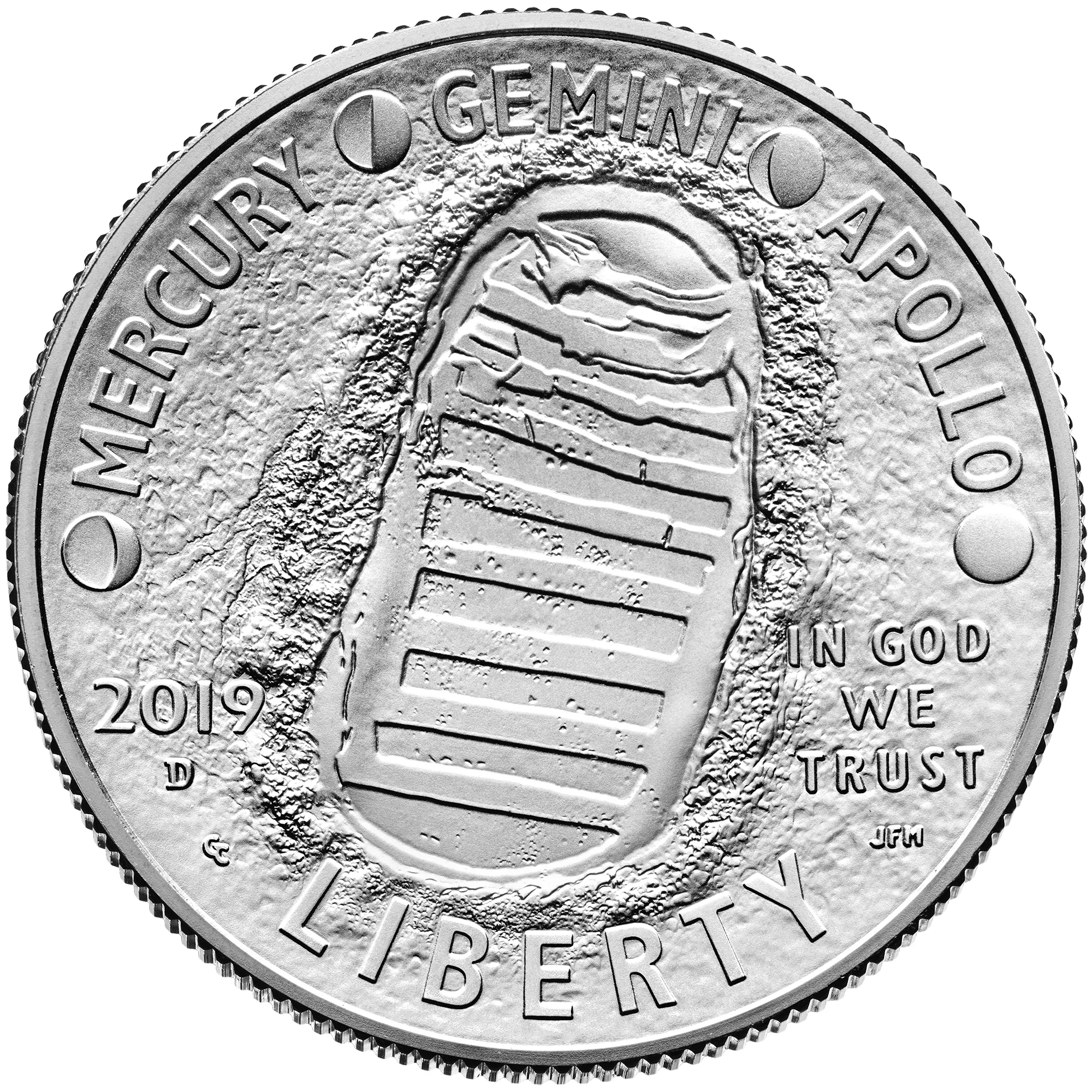
Shoe print on the moon, with spaceflight program names between lunar phases above and an inscription below.
Inscription:
🌖 MERCURY 🌗 GEMINI 🌘 APOLLO 🌑
2019
D
IN GOD WE TRUST
LIBERTY
GC JFM
2019
D
IN GOD WE TRUST
LIBERTY
GC JFM
Script: Latin
Engraver: Joseph Menna
Designer: Gary Cooper
Reverse
Description:
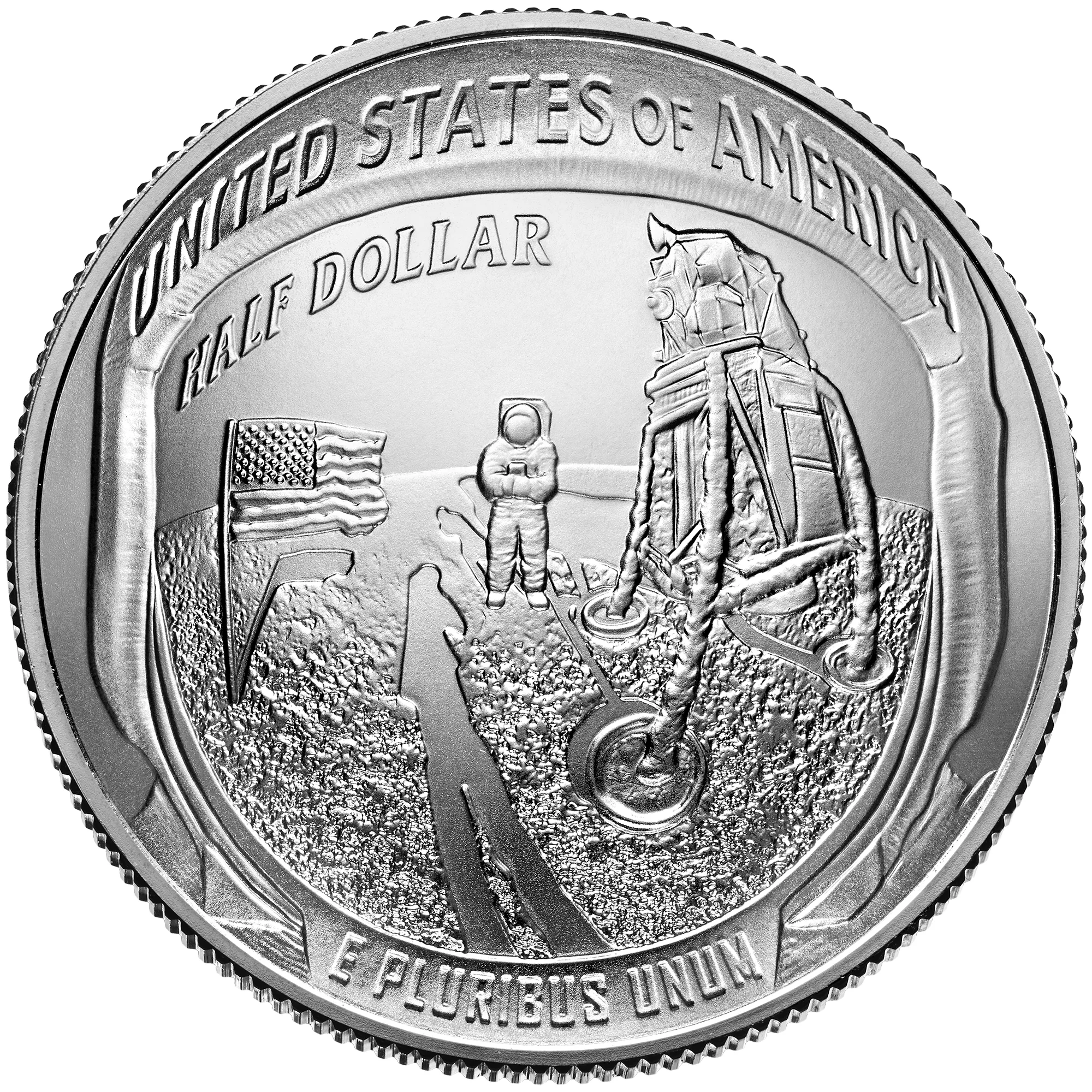
A close-up of Buzz Aldrin's helmet on the Moon, reflecting Neil Armstrong, the U.S. flag, and the lunar lander.
Inscription:
UNITED STATES OF AMERICA
HALF DOLLAR
E PLURIBUS UNUM
PH
HALF DOLLAR
E PLURIBUS UNUM
PH
Translation:
UNITED STATES OF AMERICA
HALF DOLLAR
OUT OF MANY, ONE
PH
HALF DOLLAR
OUT OF MANY, ONE
PH
Script: Latin
Designer and engraver: Phebe Hemphill
Edge
Reeded
Categories
| Symbol> Flag |
| Space |
| Science> Technology |
Mints
| Name | Mark |
|---|---|
| United States Mint of Denver | D |
| United States Mint of San Francisco | S |
Historical background
In 2019, the United States currency situation was characterized by a period of relative stability and policy normalization following the decade-long recovery from the 2008 financial crisis. The Federal Reserve, having steadily raised interest rates nine times since 2015, paused its tightening cycle in 2019. This shift was a response to muted inflation pressures and growing concerns about a global economic slowdown, exacerbated by ongoing trade tensions, particularly with China. The U.S. dollar, as measured by the Dollar Index (DXY), remained strong throughout much of the year, buoyed by the U.S. economy's relative outperformance compared to Europe and Asia, which reinforced its status as a safe-haven asset.
Domestically, key monetary policy debates centered on the appropriate path for interest rates. After a final rate hike in December 2018, the Fed reversed course in 2019, cutting rates three times in what Chairman Jerome Powell termed a "mid-cycle adjustment." This insurance easing aimed to sustain the record-long economic expansion and shield the economy from external headwinds. Meanwhile, inflation continued to run persistently below the Fed's 2% symmetric target, a puzzling phenomenon that fueled discussions about the Phillips curve and the central bank's policy framework.
The year also saw significant operational focus on the financial system's plumbing. In September, a technical shortage of bank reserves triggered a spike in overnight lending rates in the repo market, causing the federal funds rate to breach its target range. This episode revealed unexpected fragility in liquidity conditions and prompted the New York Fed to intervene with large-scale repurchase operations to calm markets. This event underscored the ongoing challenges of managing the monetary system in a post-crisis regulatory environment and set the stage for the Fed's decision to resume expanding its balance sheet in October, a move it carefully framed as distinct from the quantitative easing of the prior decade.
Domestically, key monetary policy debates centered on the appropriate path for interest rates. After a final rate hike in December 2018, the Fed reversed course in 2019, cutting rates three times in what Chairman Jerome Powell termed a "mid-cycle adjustment." This insurance easing aimed to sustain the record-long economic expansion and shield the economy from external headwinds. Meanwhile, inflation continued to run persistently below the Fed's 2% symmetric target, a puzzling phenomenon that fueled discussions about the Phillips curve and the central bank's policy framework.
The year also saw significant operational focus on the financial system's plumbing. In September, a technical shortage of bank reserves triggered a spike in overnight lending rates in the repo market, causing the federal funds rate to breach its target range. This episode revealed unexpected fragility in liquidity conditions and prompted the New York Fed to intervene with large-scale repurchase operations to calm markets. This event underscored the ongoing challenges of managing the monetary system in a post-crisis regulatory environment and set the stage for the Fed's decision to resume expanding its balance sheet in October, a move it carefully framed as distinct from the quantitative easing of the prior decade.
🌟 Uncommon