

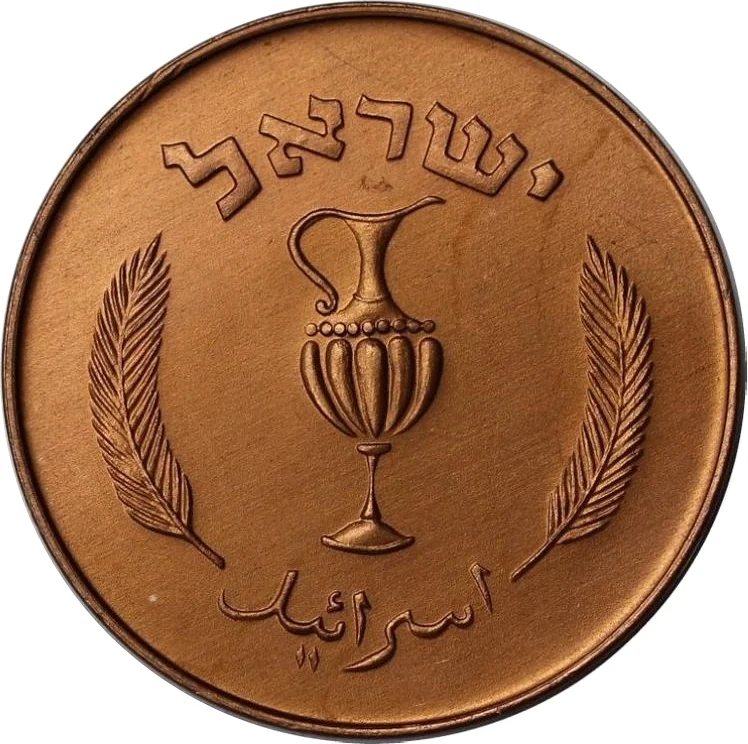
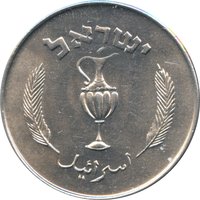
Obverse
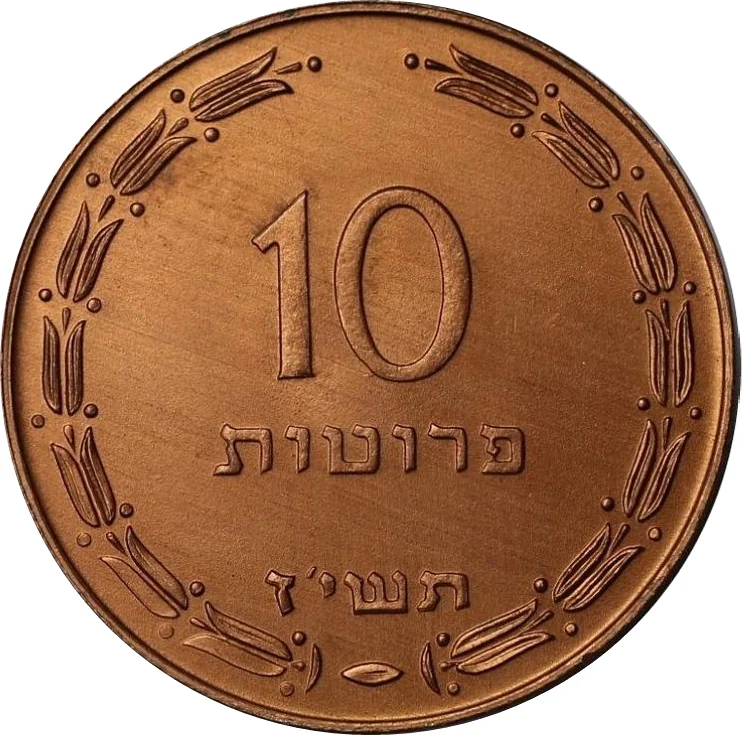
Reverse
Edge
Plain
Categories
| Symbol> Wreath |
| Object> Container or tableware |
Mints
| Name | Mark |
|---|---|
| Government Printer - Israel Mint | — |
Mintings
| Year | Mint Mark | Mintage | Quality | Collection |
|---|---|---|---|---|
| 1957 | — | 1,088,000 |
Historical background
In 1957, Israel's currency situation was defined by the Israeli lira (also known as the Israeli pound), which had been introduced in 1952 to replace the Palestinian pound. This period was one of significant economic strain, characterized by a dual exchange rate system implemented to manage severe foreign currency shortages and control inflation. The government maintained an official, overvalued rate for essential imports like food and fuel, while a parallel, depreciated "free" rate applied to most other transactions. This complex system led to widespread black-market activity and economic distortions, as businesses and individuals sought more favorable rates.
The economic backdrop was the "austerity period" (Tzena), which extended through the 1950s. The state was burdened by the costs of mass immigration absorption, infrastructure development, and national security. Chronic trade deficits and reliance on foreign loans and reparations from West Germany created persistent balance-of-payments pressures. The Bank of Israel, established in 1954, grappled with these challenges but had limited tools, as monetary policy was largely subordinate to the government's fiscal needs and its policy of directing credit to priority sectors.
By the latter half of the 1950s, the inefficiencies of the dual-rate system became unsustainable. Consequently, 1957 marked a pivotal year of monetary reform. In response to recommendations from a foreign economic advisory mission, the government announced a plan to unify the exchange rates, a process that was fully implemented in the devaluation of 1959. This move devalued the lira significantly, simplified the currency regime, and aimed to boost exports by making Israeli goods more competitive—a crucial step toward liberalizing the controlled economy and integrating Israel into the global financial system.
The economic backdrop was the "austerity period" (Tzena), which extended through the 1950s. The state was burdened by the costs of mass immigration absorption, infrastructure development, and national security. Chronic trade deficits and reliance on foreign loans and reparations from West Germany created persistent balance-of-payments pressures. The Bank of Israel, established in 1954, grappled with these challenges but had limited tools, as monetary policy was largely subordinate to the government's fiscal needs and its policy of directing credit to priority sectors.
By the latter half of the 1950s, the inefficiencies of the dual-rate system became unsustainable. Consequently, 1957 marked a pivotal year of monetary reform. In response to recommendations from a foreign economic advisory mission, the government announced a plan to unify the exchange rates, a process that was fully implemented in the devaluation of 1959. This move devalued the lira significantly, simplified the currency regime, and aimed to boost exports by making Israeli goods more competitive—a crucial step toward liberalizing the controlled economy and integrating Israel into the global financial system.
🌱 Common