

6 Euro (Hellenic Mathematical Society) – Greece
Non-circulating coins
Commemoration: Centenary of the Hellenic Mathematical Society
Greece
Obverse
Description:
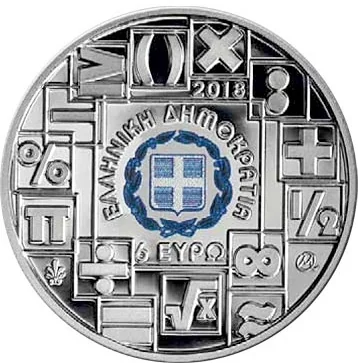
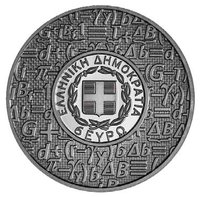
Featuring geometric math symbols, this design centers on the Greek Coat of Arms in blue on a wreath and cross. "HELLENIC REPUBLIC" in Greek encircles it, with "2018" above and "6 EURO" below.
Inscription:
2018
ΕΛΛΗΝΙΚΗ ΔΗΜΟΚΡΑΤΙΑ
6 ΕΥΡΩ
ΕΛΛΗΝΙΚΗ ΔΗΜΟΚΡΑΤΙΑ
6 ΕΥΡΩ
Translation:
HELLENIC REPUBLIC
6 EURO
6 EURO
Script: Greek
Language: Greek
Engraver: M. Antonatou
Reverse
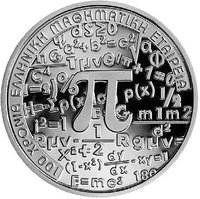
Description:
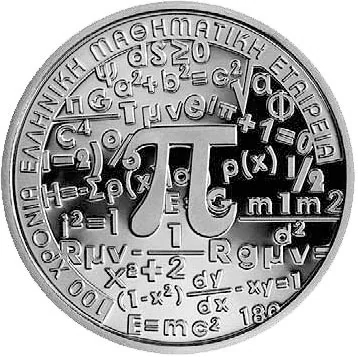
Centered on the Greek letter π, the design is surrounded by equations and partially encircled by the Greek text “100 YEARS HELLENIC MATHEMATICAL SOCIETY.”
Inscription:
100 ΧΡΟΝΙΑ ΕΛΛΗΝΙΚΗ ΜΑΘΗΜΑΤΙΚΗ ΕΤΑΙΡΙΑ
Translation:
100 YEARS HELLENIC MATHEMATICAL SOCIETY
Script: Greek
Language: Greek
Engraver: M. Antonatou
Edge
Plain
Categories
| Science |
| Symbols> Coat of Arms |
Mints
| Name | Mark |
|---|---|
| National Mint of the Bank of Greece | — |
Mintings
| Year | Mint Mark | Mintage | Quality | Collection |
|---|---|---|---|---|
| 2018 | — | 1,500 | Proof |
Historical background
By 2018, Greece was in the final year of its third and last international bailout program, having endured nearly a decade of severe austerity. The immediate threat of a chaotic exit from the eurozone (a "Grexit") had receded since the peak of the crisis in 2015, but the country remained under strict supervision by its creditors—the European Commission, European Central Bank, and International Monetary Fund. The primary focus was on completing the mandated reforms and achieving a "clean exit" in August 2018, with the aim of regaining full market access and ending emergency financial lifelines. However, the economy and banking system remained fragile, with high non-performing loans and continued reliance on European Central Bank support for liquidity.
The currency situation itself was stable but artificially so; Greece remained part of the Eurozone and used the euro. The stability was maintained through stringent capital controls that had been imposed in the summer of 2015 to prevent a bank run and the collapse of the financial system. These controls, though gradually relaxed by 2018, still limited cash withdrawals and cross-border transfers, acting as a constant reminder of the country's fragile financial position. The underlying debate was about long-term sustainability: whether Greece could grow its economy and manage its enormous public debt burden—which exceeded 180% of GDP—while staying inside the euro without perpetual external oversight.
The year concluded with Greece successfully exiting the bailout program in August, marking a symbolic return to financial normality. However, it did so without a precautionary credit line, choosing instead for a "clean break" while committing to maintain strict budget surpluses for years to come. This exit confirmed the continuation of the euro as Greece's currency, but the nation's economic sovereignty remained constrained by enhanced post-program surveillance. The legacy of the crisis meant that while the acute currency existential threat was over, the challenges of debt, growth, and restoring the banking system's health within the euro framework persisted well beyond 2018.
The currency situation itself was stable but artificially so; Greece remained part of the Eurozone and used the euro. The stability was maintained through stringent capital controls that had been imposed in the summer of 2015 to prevent a bank run and the collapse of the financial system. These controls, though gradually relaxed by 2018, still limited cash withdrawals and cross-border transfers, acting as a constant reminder of the country's fragile financial position. The underlying debate was about long-term sustainability: whether Greece could grow its economy and manage its enormous public debt burden—which exceeded 180% of GDP—while staying inside the euro without perpetual external oversight.
The year concluded with Greece successfully exiting the bailout program in August, marking a symbolic return to financial normality. However, it did so without a precautionary credit line, choosing instead for a "clean break" while committing to maintain strict budget surpluses for years to come. This exit confirmed the continuation of the euro as Greece's currency, but the nation's economic sovereignty remained constrained by enhanced post-program surveillance. The legacy of the crisis meant that while the acute currency existential threat was over, the challenges of debt, growth, and restoring the banking system's health within the euro framework persisted well beyond 2018.

💎 Very Rare