

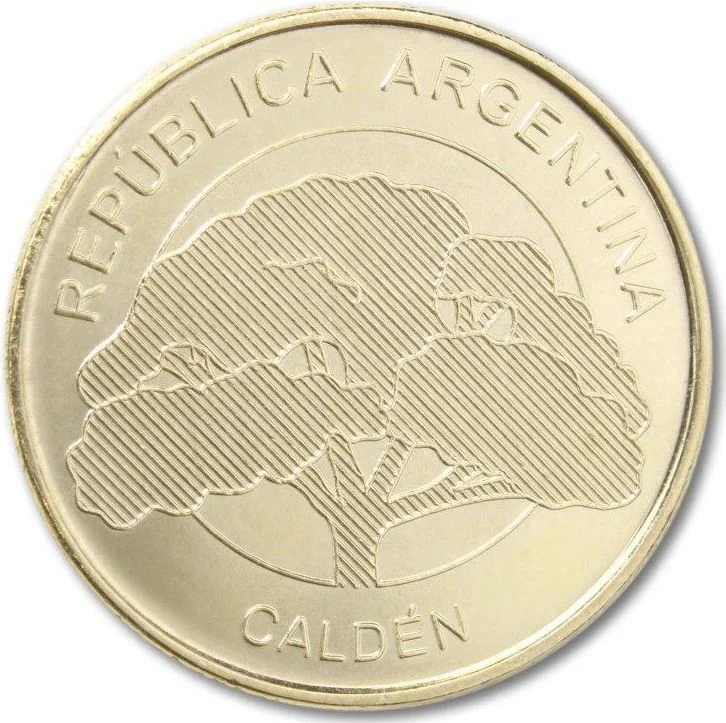
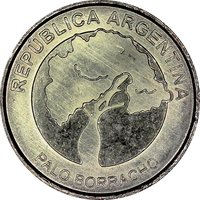
Obverse
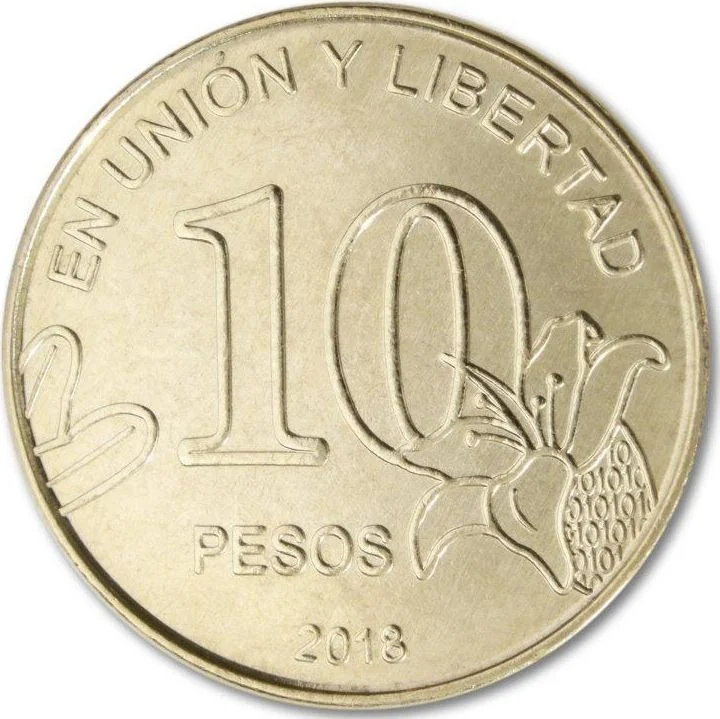
Reverse
Description:
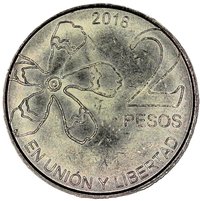
The reverse features a caldén flower and leaves, with the denomination "10 PESOS" positioned centrally to symbolize the tree's regional origin. The motto "EN UNIÓN Y LIBERTAD" arches above, and the minting year "2018" below.
Inscription:
EN UNIÓN Y LIBERTAD
10 PESOS
2018
10 PESOS
2018
Translation:
In Union and Liberty
10 Pesos
2018
10 Pesos
2018
Script: Latin
Language: Spanish
Edge
Reeded
Mints
| Name | Mark |
|---|---|
| Buenos Aires | — |
Mintings
| Year | Mint Mark | Mintage | Quality | Collection |
|---|---|---|---|---|
| 2018 | — | 50,000,000 | ||
| 2019 | — | 100,000,000 | ||
| 2020 | — | — |
Historical background
Argentina entered 2018 in the midst of a profound currency crisis, marked by a severe loss of confidence in the peso. This turmoil was the culmination of years of fiscal deficits, high inflation, and reliance on external borrowing. In an effort to curb capital flight and stabilize the economy, the government, led by President Mauricio Macri, had aggressively hiked interest rates and secured a record $50 billion standby loan agreement with the International Monetary Fund (IMF) in June. Despite these measures, investor fears over the country's ability to service its debt and persistent double-digit inflation kept pressure on the currency.
The situation reached a critical point in late April and early May 2018, triggering a sharp devaluation event known as the "mini-crisis." The peso lost over 20% of its value against the US dollar in a single week, forcing the Central Bank to intervene heavily by selling reserves and again raising interest rates to 40%. This episode shattered the government's strategy of a gradual, market-driven adjustment and exposed the fragility of its economic program. The crisis was exacerbated by a drought that devastated agricultural exports, a primary source of dollar inflows, and by global financial tightening led by the US Federal Reserve.
By the end of 2018, the peso had depreciated by over 50% against the dollar for the year, one of the worst performances of any currency globally. Inflation soared to nearly 48%, eroding wages and pushing poverty rates higher. The IMF deal was expanded to $57 billion in September, but the attached austerity conditions further dampened economic growth, leading to a severe recession. This turbulent year severely undermined public confidence in the government's management and set the stage for the economic upheaval that would dominate the subsequent electoral cycle.
The situation reached a critical point in late April and early May 2018, triggering a sharp devaluation event known as the "mini-crisis." The peso lost over 20% of its value against the US dollar in a single week, forcing the Central Bank to intervene heavily by selling reserves and again raising interest rates to 40%. This episode shattered the government's strategy of a gradual, market-driven adjustment and exposed the fragility of its economic program. The crisis was exacerbated by a drought that devastated agricultural exports, a primary source of dollar inflows, and by global financial tightening led by the US Federal Reserve.
By the end of 2018, the peso had depreciated by over 50% against the dollar for the year, one of the worst performances of any currency globally. Inflation soared to nearly 48%, eroding wages and pushing poverty rates higher. The IMF deal was expanded to $57 billion in September, but the attached austerity conditions further dampened economic growth, leading to a severe recession. This turbulent year severely undermined public confidence in the government's management and set the stage for the economic upheaval that would dominate the subsequent electoral cycle.
🌱 Very Common