

15 euro (Jaan Tõnisson) – Estonia
Add to wishlist
Non-circulating coins
Commemoration: 150th anniversary of the birth of Jaan Tõnisson
Estonia
Context
Material
References
KM: #
Numista: #155233
Value
Exchange value: 15 EUR
Bullion value: $65.66
Inflation-adjusted value: 22.68 EUR
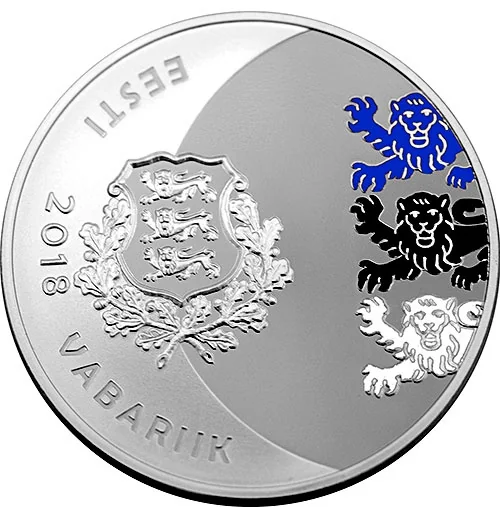
Obverse
Description:
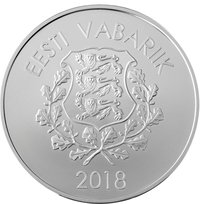
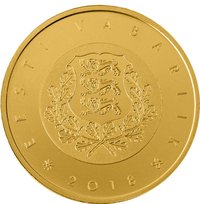
National symbol, lion emblem.
Inscription:
EESTI 2018 VABARIIK
Translation:
REPUBLIC OF ESTONIA 2018
Script: Latin
Language: Estonian
Engraver: Sebastian Mikołajczak
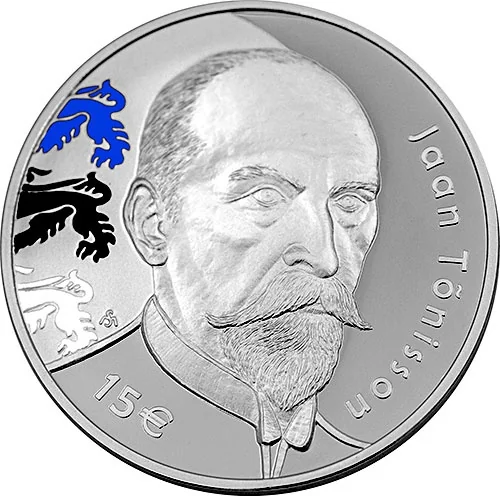
Reverse
Description:
Jaan Tõnisson portrait. Colored lions and lettering.
Inscription:
Jaan Tõnisson
15€
15€
Translation:
Jaan Tõnisson
15€
15€
Script: Latin
Language: Estonian
Engraver: Sebastian Mikołajczak
Edge
Plain
Categories
| Animal> Feline |
| Symbols> Coat of Arms |
| Event> Birth anniversary |
| Mustache/Beard |
| Person> Politician |
Mints
| Name | Mark |
|---|---|
| Lithuanian Mint | — |
Mintings
| Year | Mint Mark | Mintage | Quality | Collection |
|---|---|---|---|---|
| 2018 | — | 5,000 | Proof |
Historical background
In 2018, Estonia was a fully integrated member of the Eurozone, having adopted the euro as its official currency on January 1, 2011. This move replaced the Estonian kroon, which had been pegged to the euro (and previously the Deutsche Mark) since its reintroduction in 1992, providing remarkable monetary stability. By 2018, the euro was well-established in daily life, with public support for the currency remaining consistently high, largely due to its association with economic security and Estonia's firm political and economic alignment with core European institutions.
The macroeconomic context in 2018 was one of robust growth but rising inflationary pressures. Estonia's economy was expanding rapidly, with GDP growth exceeding 3%, leading to a tight labor market and significant wage increases. This domestic demand-driven growth began to push inflation noticeably above the Eurozone average, reaching around 3.4% for the year. Consequently, the key monetary policy levers—interest rates and liquidity controls—were set by the European Central Bank (ECB) in Frankfurt, not Tallinn. This meant Estonia had to navigate the balancing act of a booming national economy within a single monetary framework designed for the entire, more heterogenous, Eurozone.
Discussions around currency in Estonia during 2018 were therefore not about a potential return to the kroon, but rather focused on the implications of the common currency for national competitiveness and housing market stability. There was active debate among economists and policymakers about whether the ECB's accommodative policy, appropriate for larger struggling economies, was excessively fueling credit and asset price growth in a already overheating Estonian economy. Furthermore, Estonia continued to be a leading advocate for digital innovation and e-governance, closely monitoring the ECB's explorations into digital currency, which aligned with the country's own forward-looking, tech-driven economic identity.
The macroeconomic context in 2018 was one of robust growth but rising inflationary pressures. Estonia's economy was expanding rapidly, with GDP growth exceeding 3%, leading to a tight labor market and significant wage increases. This domestic demand-driven growth began to push inflation noticeably above the Eurozone average, reaching around 3.4% for the year. Consequently, the key monetary policy levers—interest rates and liquidity controls—were set by the European Central Bank (ECB) in Frankfurt, not Tallinn. This meant Estonia had to navigate the balancing act of a booming national economy within a single monetary framework designed for the entire, more heterogenous, Eurozone.
Discussions around currency in Estonia during 2018 were therefore not about a potential return to the kroon, but rather focused on the implications of the common currency for national competitiveness and housing market stability. There was active debate among economists and policymakers about whether the ECB's accommodative policy, appropriate for larger struggling economies, was excessively fueling credit and asset price growth in a already overheating Estonian economy. Furthermore, Estonia continued to be a leading advocate for digital innovation and e-governance, closely monitoring the ECB's explorations into digital currency, which aligned with the country's own forward-looking, tech-driven economic identity.
💎 Very Rare