

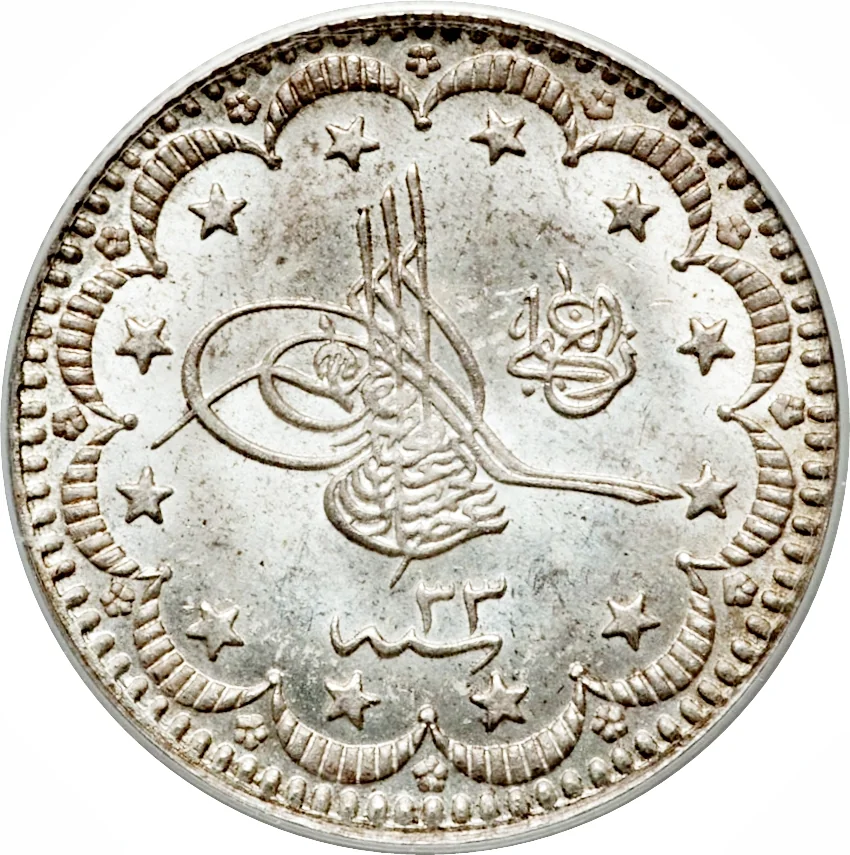
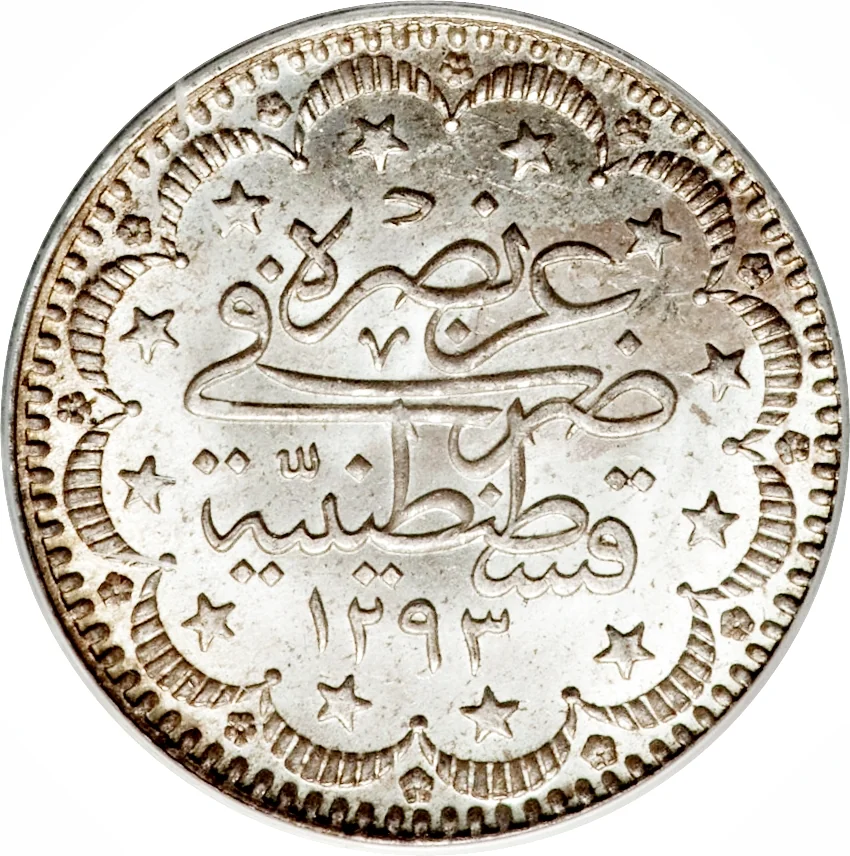
5 Kurush – Ottoman Empire
Turkey
Context
Years: 1883–1908
Country: Turkey 
Issuer: Ottoman Empire
Ruler: Abdul Hamid II
Currency:
(1844—1923)
Demonetized: Yes
Total mintage: 17,239,000
Material
References
KM: #Click to copy to clipboard737
Numista: #15521
Value
Bullion value: $14.28
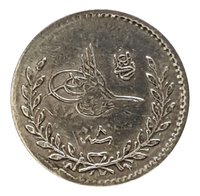
Obverse
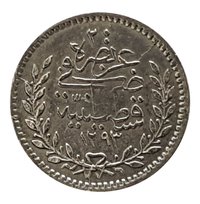
Reverse
Edge
Reeded
Mints
| Name | Mark |
|---|---|
| Constantinople | — |
Mintings
| Year | Mint Mark | Mintage | Quality | Collection |
|---|---|---|---|---|
| 1883 | — | 82,000 | ||
| 1884 | — | 614,000 | ||
| 1886 | — | 1,788,000 | ||
| 1887 | — | 1,880,000 | ||
| 1888 | — | 2,182,000 | ||
| 1889 | — | 380,000 | ||
| 1890 | — | 194,000 | ||
| 1891 | — | 914,000 | ||
| 1892 | — | 1,337,000 | ||
| 1892 | — | 12,000 | ||
| 1893 | — | 31,000 | ||
| 1894 | — | 162,000 | ||
| 1895 | — | 18,000 | ||
| 1896 | — | 8,000 | ||
| 1897 | — | 7,000 | ||
| 1898 | — | 126,000 | ||
| 1899 | — | 13,000 | ||
| 1900 | — | 8,000 | ||
| 1901 | — | 16,000 | ||
| 1902 | — | 6,000 | ||
| 1903 | — | 7,000 | ||
| 1904 | — | 38,000 | ||
| 1905 | — | 3,175,000 | ||
| 1906 | — | 3,334,000 | ||
| 1907 | — | 907,000 | ||
| 1908 | — | — |
Historical background
By 1883, the Ottoman Empire's currency situation was a complex and precarious reflection of its broader financial and political decline. The empire operated on a bimetallic system in theory, but in practice it was dominated by the kaime, a heavily depreciated paper currency first issued during the Crimean War. These notes, intended as temporary debt instruments, had become permanent and were subject to rampant counterfeiting and wild fluctuations in value, causing severe inflation and economic instability. Alongside these circulated a bewildering variety of metallic coins, including Ottoman gold liras, silver mecidiye coins, and a multitude of foreign currencies like British pounds, French francs, and Austrian thalers, which were often preferred for major transactions due to their stability.
This monetary chaos was a direct symptom of the empire's crippling debt, which had led to the establishment of the Ottoman Public Debt Administration (OPDA) in 1881. This institution, controlled by European creditors, had taken direct charge of key state revenues to ensure debt repayment. A primary goal of the OPDA was to reform the currency and restore fiscal order. Consequently, 1883 fell within a critical period of transition, as the empire, under the OPDA's pressure, was preparing to retire the discredited kaime and move toward a new, stable monetary standard based on gold.
Therefore, the currency situation in 1883 was one of awaited reform amidst ongoing turmoil. The old paper money was deeply distrusted, metallic money was scarce and heterogeneous, and economic sovereignty was severely constrained by foreign creditors. The stage was set for the major monetary reform that would come in the following years, culminating in the adoption of the gold lira standard and the establishment of the Ottoman Bank as a state bank in the late 1880s, finally creating a unified and stable currency—albeit under continued foreign financial oversight.
This monetary chaos was a direct symptom of the empire's crippling debt, which had led to the establishment of the Ottoman Public Debt Administration (OPDA) in 1881. This institution, controlled by European creditors, had taken direct charge of key state revenues to ensure debt repayment. A primary goal of the OPDA was to reform the currency and restore fiscal order. Consequently, 1883 fell within a critical period of transition, as the empire, under the OPDA's pressure, was preparing to retire the discredited kaime and move toward a new, stable monetary standard based on gold.
Therefore, the currency situation in 1883 was one of awaited reform amidst ongoing turmoil. The old paper money was deeply distrusted, metallic money was scarce and heterogeneous, and economic sovereignty was severely constrained by foreign creditors. The stage was set for the major monetary reform that would come in the following years, culminating in the adoption of the gold lira standard and the establishment of the Ottoman Bank as a state bank in the late 1880s, finally creating a unified and stable currency—albeit under continued foreign financial oversight.
🌱 Common