

5 Hryven (Kobzar Choir Creation) – Ukraine
Non-circulating coins
Commemoration: 100th Anniversary of the Creation of the Kobzar Choir
Ukraine
Context
Year: 2018
Issuer: Ukraine 
Issuing organization: National Bank of Ukraine
Period:
(since 1991)
Currency:
(since 1996)
Total mintage: 40,000
Material
Diameter: 35 mm
Weight: 16.54 g
Shape: Round
Composition: Nickel brass
Magnetic: No
Technique: Milled
Alignment: Medal alignment
flip
References
KM: #Click to copy to clipboard903
Numista: #154887
Value
Exchange value: 5 UAH
Obverse
Description:
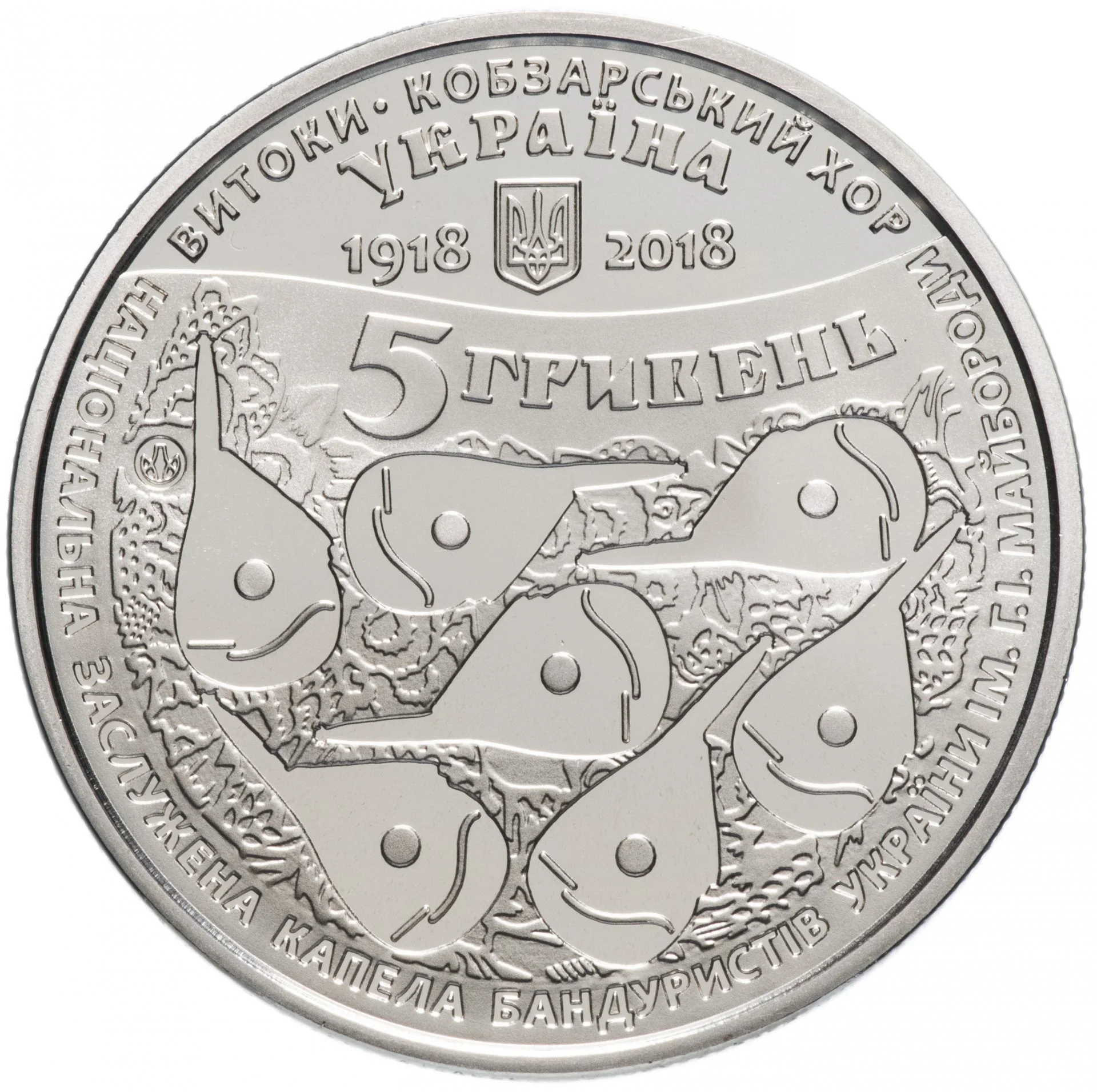
Against a smooth background: "УКРАЇНА" above Ukraine's small coat of arms, flanked by 1918 and 2018. Against a relief background: the face value "5 ГРИВЕНЬ" above seven stylized banduras on a floral pattern. The circular inscription reads: "ВИТОКИ • КОБЗАРСЬКИЙ ХОР (угорі); НАЦІОНАЛЬНА ЗАСЛУЖЕНА КАПЕЛА БАНДУРИСТІВ УКРАЇНИ ІМ. Г. І. МАЙБОРОДИ".
Inscription:
ВИТОКИ • КОБЗАРСЬКИЙ ХОР
НАЦІОНАЛЬНА ЗАСЛУЖЕНА КАПЕЛА БАНДУРИСТІВ УКРАЇНИ ІМ. Г. І. МАЙБОРОДИ
УКРАЇНА
5 ГРИВЕНЬ
1918 2018
НАЦІОНАЛЬНА ЗАСЛУЖЕНА КАПЕЛА БАНДУРИСТІВ УКРАЇНИ ІМ. Г. І. МАЙБОРОДИ
УКРАЇНА
5 ГРИВЕНЬ
1918 2018
Translation:
VITOKY • KOBZAR CHOIR
NATIONAL HONORED BANDURIST CAPELLA OF UKRAINE NAMED AFTER H. I. MAIBORODY
UKRAINE
5 HRYVEN
1918 2018
NATIONAL HONORED BANDURIST CAPELLA OF UKRAINE NAMED AFTER H. I. MAIBORODY
UKRAINE
5 HRYVEN
1918 2018
Script: Cyrillic
Language: Ukrainian
Engraver: Volodymyr Atamanchuk
Reverse
Description:
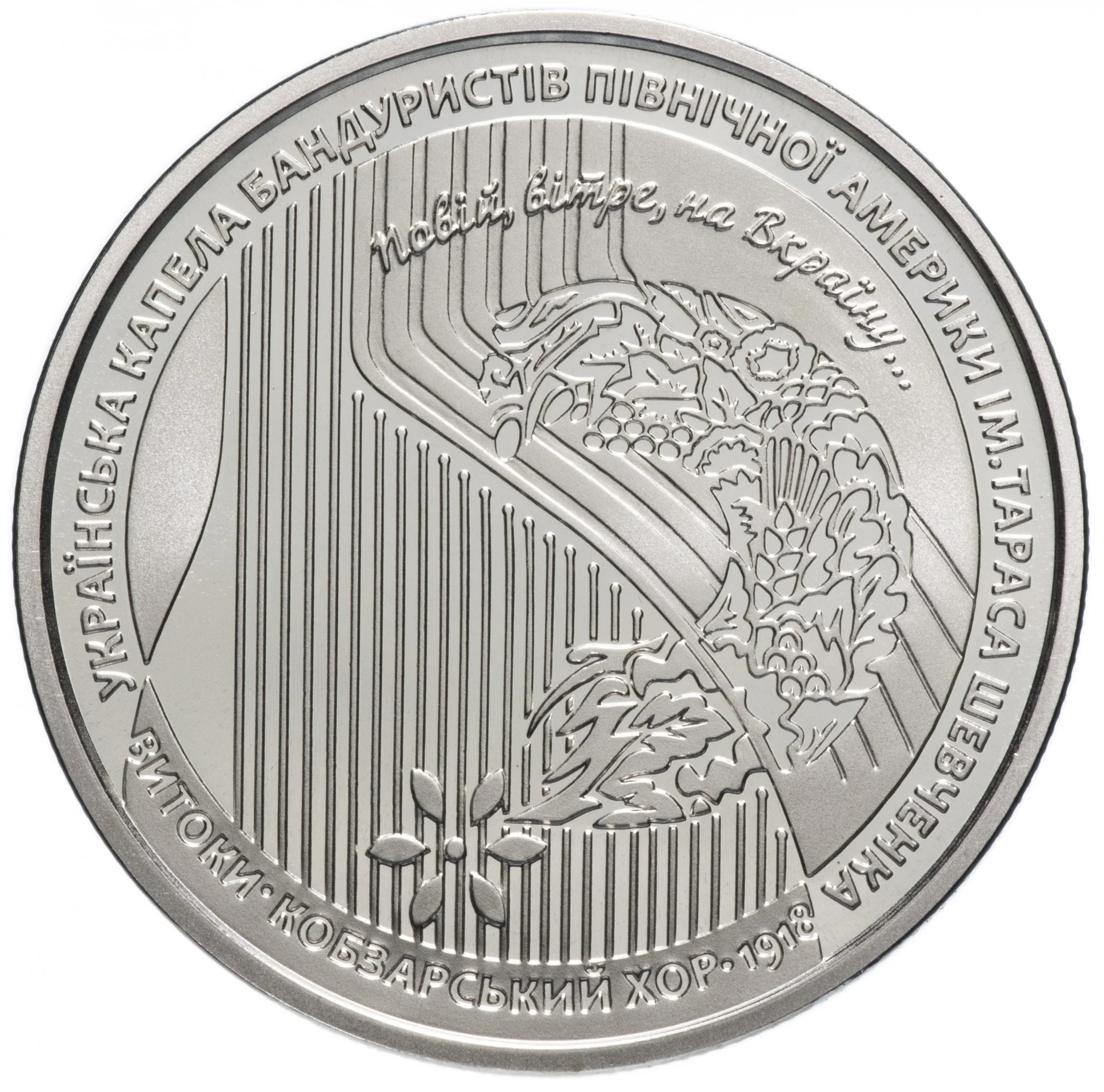
A stylized bandura fragment with strings, beside a wreath topped with the words "ПОВІЙ, ВІТРЕ, НА ВКРАЇНУ…". Around it, a circular inscription reads: "УКРАЇНСЬКА КАПЕЛА БАНДУРИСТІВ ПІВНІЧНОЇ АМЕРИКИ ІМ. ТАРАСА ШЕВЧЕНКА, ВИТОКИ • КОБЗАРСЬКИЙ ХОР • 1918".
Inscription:
ПОВІЙ, ВІТРЕ, НА ВКРАЇНУ…
УКРАЇНСЬКА КАПЕЛА БАНДУРИСТІВ ПІВНІЧНОЇ АМЕРИКИ ІМ. ТАРАСА ШЕВЧЕНКА, ВИТОКИ • КОБЗАРСЬКИЙ ХОР • 1918
УКРАЇНСЬКА КАПЕЛА БАНДУРИСТІВ ПІВНІЧНОЇ АМЕРИКИ ІМ. ТАРАСА ШЕВЧЕНКА, ВИТОКИ • КОБЗАРСЬКИЙ ХОР • 1918
Translation:
Blow, wind, onto Ukraine…
TARAS SHEVCHENKO UKRAINIAN BANDURIST CHAPEL OF NORTH AMERICA, VYTOKY • KOBZAR CHOIR • 1918
TARAS SHEVCHENKO UKRAINIAN BANDURIST CHAPEL OF NORTH AMERICA, VYTOKY • KOBZAR CHOIR • 1918
Script: Cyrillic
Language: Ukrainian
Engraver: Volodymyr Atamanchuk
Edge
Reeded
Mints
| Name | Mark |
|---|---|
| National Bank of Ukraine Banknote Printing and Minting Works | — |
Mintings
| Year | Mint Mark | Mintage | Quality | Collection |
|---|---|---|---|---|
| 2018 | — | 40,000 | Special Uncirculated |
Historical background
In 2018, Ukraine's currency, the hryvnia (UAH), demonstrated remarkable stability, a significant achievement following the severe economic and currency crisis of 2014-2015. During that earlier period, the hryvnia had lost nearly 70% of its value against the US dollar due to the combined shocks of the Russian annexation of Crimea, war in the Donbas region, collapsing exports, and a loss of foreign reserves. By 2018, however, the National Bank of Ukraine (NBU) had successfully implemented a managed floating exchange rate regime, supported by a crucial $17.5 billion International Monetary Fund (IMF) program. This stability was underpinned by consistent foreign currency inflows from robust agricultural exports, steady remittances from workers abroad, and improved investor confidence due to ongoing, though often slow, reform efforts.
The central bank's primary focus in 2018 was on building foreign exchange reserves and maintaining tight monetary policy to control inflation. After dipping below $5 billion in early 2015, Ukraine's international reserves were steadily rebuilt, reaching a five-year high of over $20 billion by the end of 2018. This buffer provided crucial protection against external shocks. Furthermore, the NBU maintained a high discount rate (18% for most of the year) to curb inflationary pressures, which had spiked to over 60% in 2015 but were brought down to a single-digit annual rate by late 2018. This combination of factors allowed the hryvnia to trade within a relatively narrow corridor of around UAH 27-28 per US dollar throughout the year.
Despite this surface stability, underlying vulnerabilities persisted. The economy remained heavily dependent on volatile commodity exports, particularly steel and grain. Structural reforms in areas like the judiciary and state-owned enterprises, which were key to unlocking further IMF tranches and sustaining long-term confidence, faced significant political resistance and delays. Consequently, while 2018 represented a year of hard-won monetary stabilization and a pause from crisis, it was a stability that remained fragile and contingent on continued external financial support and the politically difficult implementation of deeper economic reforms.
The central bank's primary focus in 2018 was on building foreign exchange reserves and maintaining tight monetary policy to control inflation. After dipping below $5 billion in early 2015, Ukraine's international reserves were steadily rebuilt, reaching a five-year high of over $20 billion by the end of 2018. This buffer provided crucial protection against external shocks. Furthermore, the NBU maintained a high discount rate (18% for most of the year) to curb inflationary pressures, which had spiked to over 60% in 2015 but were brought down to a single-digit annual rate by late 2018. This combination of factors allowed the hryvnia to trade within a relatively narrow corridor of around UAH 27-28 per US dollar throughout the year.
Despite this surface stability, underlying vulnerabilities persisted. The economy remained heavily dependent on volatile commodity exports, particularly steel and grain. Structural reforms in areas like the judiciary and state-owned enterprises, which were key to unlocking further IMF tranches and sustaining long-term confidence, faced significant political resistance and delays. Consequently, while 2018 represented a year of hard-won monetary stabilization and a pause from crisis, it was a stability that remained fragile and contingent on continued external financial support and the politically difficult implementation of deeper economic reforms.
🌟 Limited