

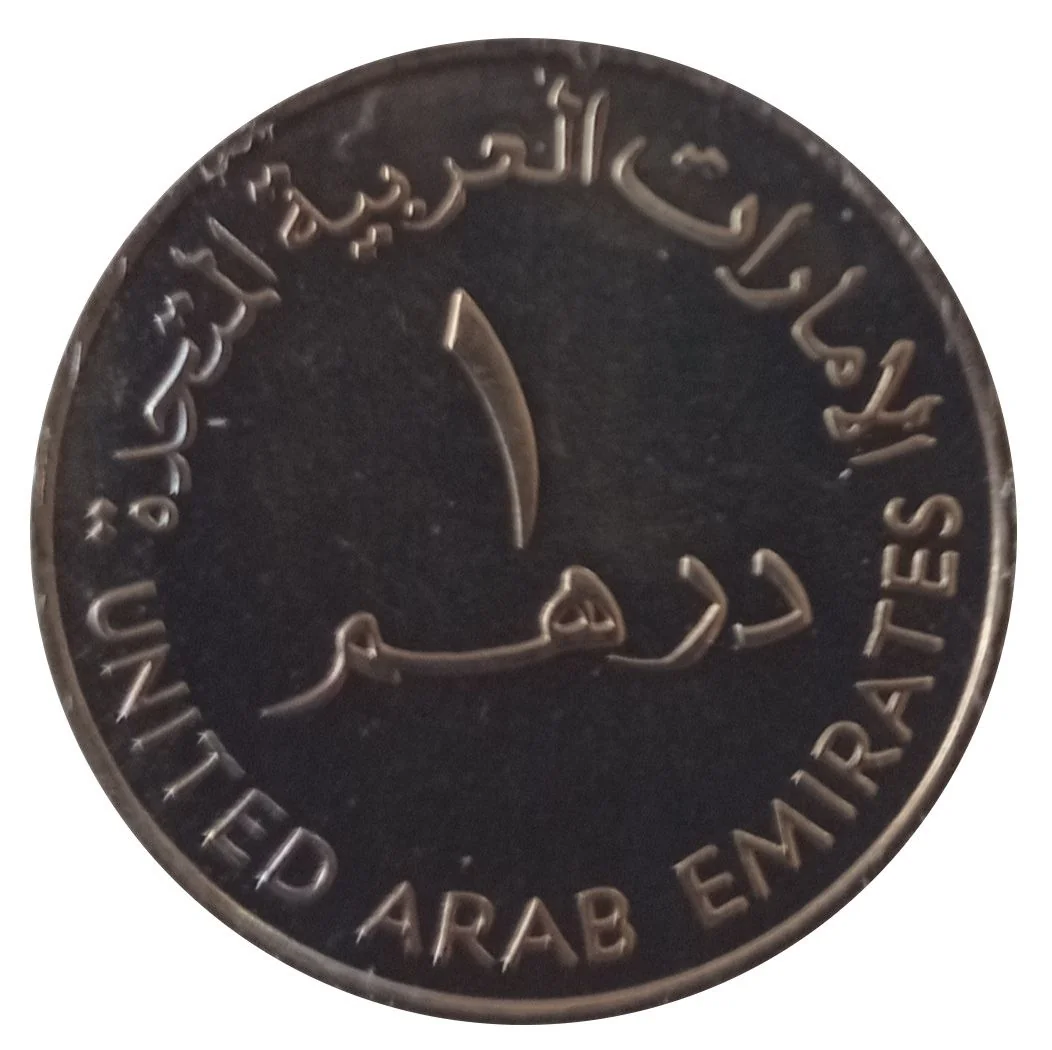
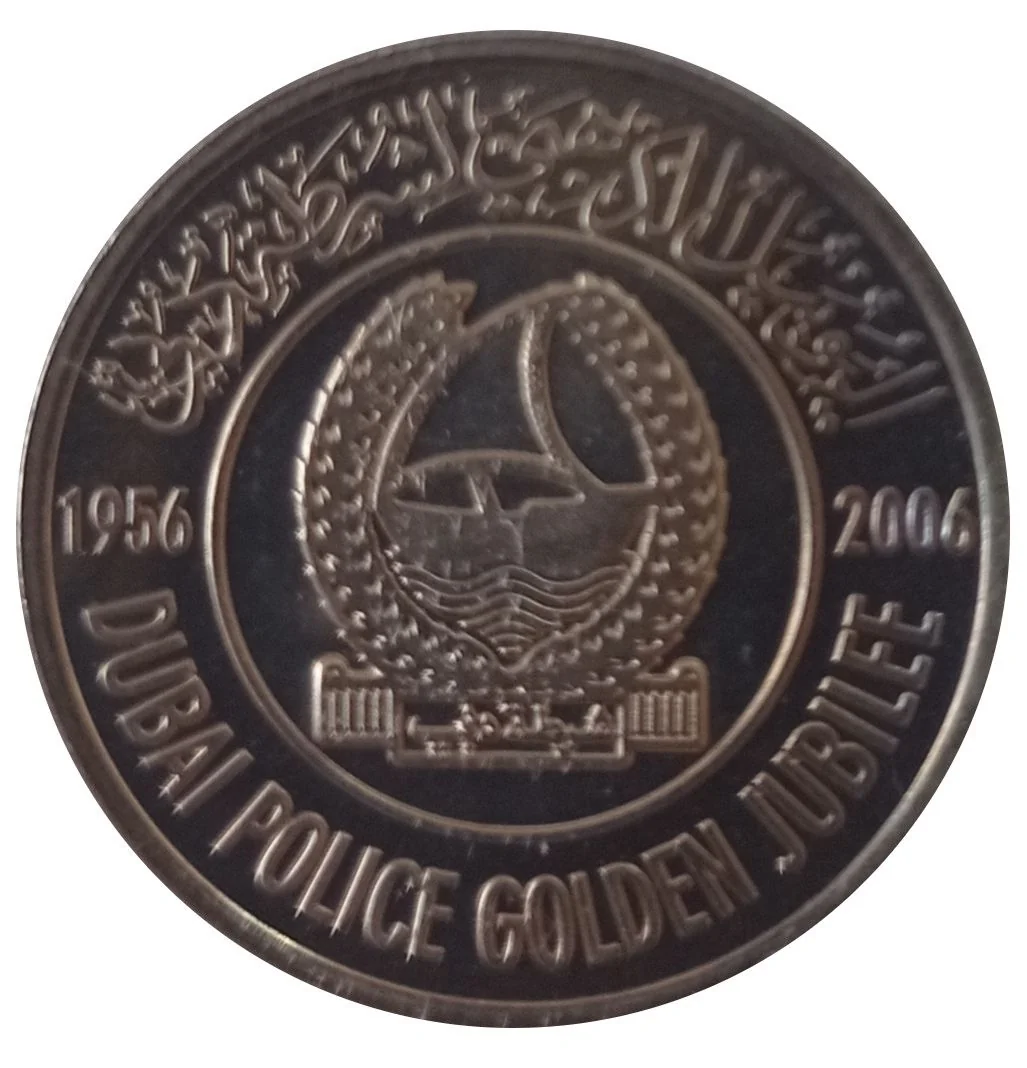
1 Dirham – United Arab Emirates
Circulating commemorative coins
Commemoration: Dubai Police Golden Jubilee (1956-2006)
United Arab Emirates
Context
Year: 2006
Issuer: United Arab Emirates 
Ruler: Khalifa bin Zayed Al Nahyan
Currency:
(since 1973)
Total mintage: 250,000
Material
Diameter: 23.8 mm
Weight: 6.4 g
Thickness: 1.9 mm
Shape: Round
Composition: Copper-nickel
Technique: Milled
Alignment: Medal alignment
flip
References
KM: #Click to copy to clipboard78
Numista: #15469
Value
Exchange value: 1 AED
Obverse
Reverse
Edge
Reeded
Mintings
| Year | Mint Mark | Mintage | Quality | Collection |
|---|---|---|---|---|
| 2006 | — | 250,000 |
Historical background
In 2006, the currency situation in the United Arab Emirates was defined by the UAE Dirham's (AED) long-standing and firm peg to the United States Dollar. This peg, established in 1997 at a fixed rate of approximately AED 3.6725 per USD, provided crucial stability for the UAE's rapidly growing, trade-oriented economy. It anchored monetary policy, reduced exchange rate risk for foreign investors, and supported the hydrocarbon sector, where oil exports are priced in dollars. This stability was a cornerstone of the economic boom, fueling massive real estate and infrastructure projects, particularly in Dubai and Abu Dhabi.
However, by 2006, the peg was also creating significant economic challenges. With the US Federal Reserve raising interest rates to combat inflation, the UAE's central bank was compelled to follow suit to maintain the peg, even though the local economy was overheating from a different source—a massive credit-fueled property and investment boom. This mismatch meant that rising interest rates, intended to cool the US economy, were instead adding fuel to the UAE's own inflationary pressures. Furthermore, a weakening US Dollar on global markets meant the Dirham was also depreciating against other major currencies like the Euro and Pound, making imports more expensive and contributing to inflation, which was becoming a growing public concern.
Consequently, 2006 was a year of intense speculation and debate about a potential revaluation or even the abandonment of the dollar peg. Market pressure led to forward rates pricing in an expected appreciation of the Dirham. Publicly, UAE officials, particularly from the Central Bank, repeatedly reaffirmed their commitment to the peg, emphasizing stability. Privately, however, discussions were underway about possible alternatives, including pegging to a basket of currencies. This tension set the stage for the dramatic events of 2007, when speculation peaked and Gulf Cooperation Council neighbors like Kuwait broke ranks by de-pegging from the dollar, though the UAE itself ultimately maintained its fixed exchange rate throughout the year.
However, by 2006, the peg was also creating significant economic challenges. With the US Federal Reserve raising interest rates to combat inflation, the UAE's central bank was compelled to follow suit to maintain the peg, even though the local economy was overheating from a different source—a massive credit-fueled property and investment boom. This mismatch meant that rising interest rates, intended to cool the US economy, were instead adding fuel to the UAE's own inflationary pressures. Furthermore, a weakening US Dollar on global markets meant the Dirham was also depreciating against other major currencies like the Euro and Pound, making imports more expensive and contributing to inflation, which was becoming a growing public concern.
Consequently, 2006 was a year of intense speculation and debate about a potential revaluation or even the abandonment of the dollar peg. Market pressure led to forward rates pricing in an expected appreciation of the Dirham. Publicly, UAE officials, particularly from the Central Bank, repeatedly reaffirmed their commitment to the peg, emphasizing stability. Privately, however, discussions were underway about possible alternatives, including pegging to a basket of currencies. This tension set the stage for the dramatic events of 2007, when speculation peaked and Gulf Cooperation Council neighbors like Kuwait broke ranks by de-pegging from the dollar, though the UAE itself ultimately maintained its fixed exchange rate throughout the year.
🌱 Fairly Common