

20 Patacas – Macau
Circulating commemorative coins
Commemoration: Ponte Macau
China
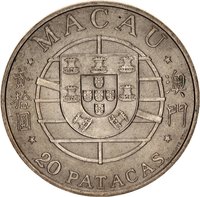
Obverse
Description:
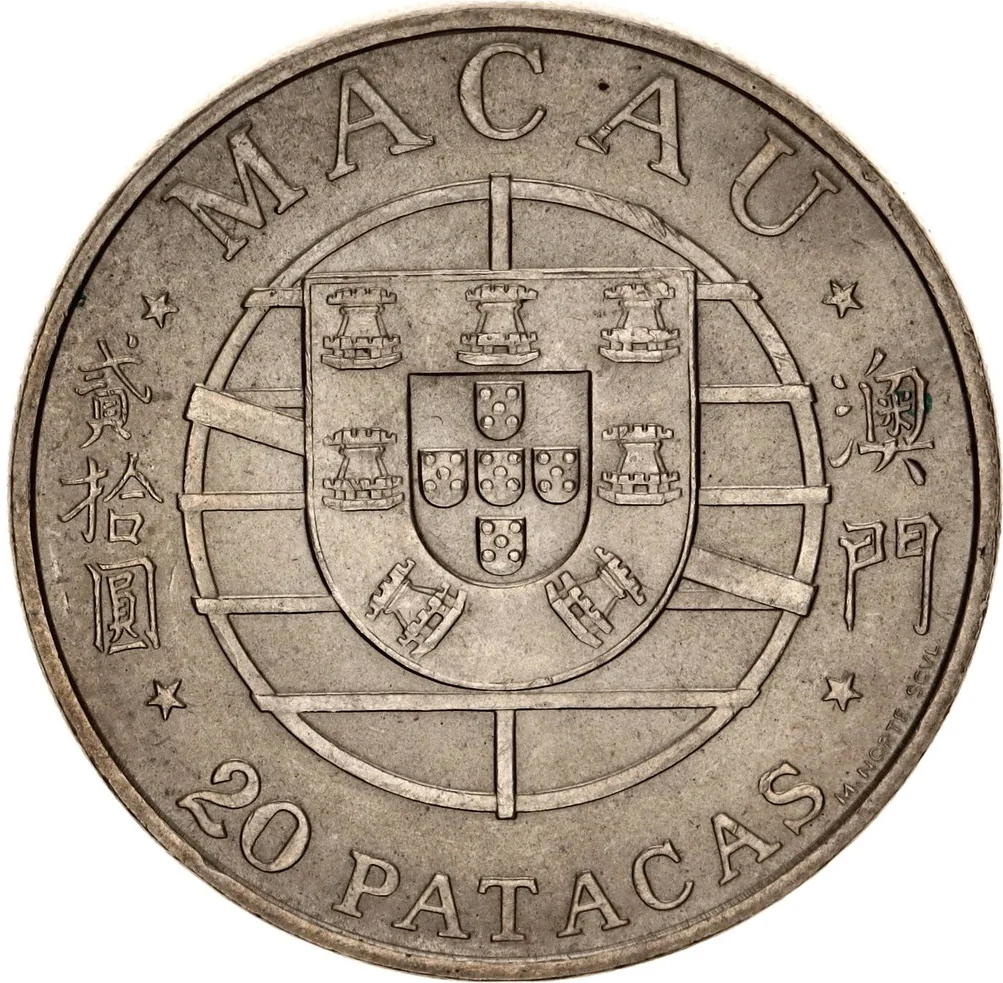
Macau globe shield, value beneath.
Inscription:
* MACAU *
* 20 PATACAS *
M.NORTE. SCVL
* 20 PATACAS *
M.NORTE. SCVL
Translation:
MACAU
20 PATACAS
Minted in the North. Sculptor.
20 PATACAS
Minted in the North. Sculptor.
Languages: Portuguese, Latin
Engraver: Marcelino Norte de Almeida
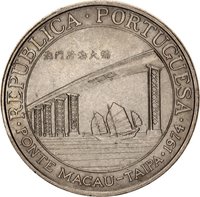
Reverse
Description:
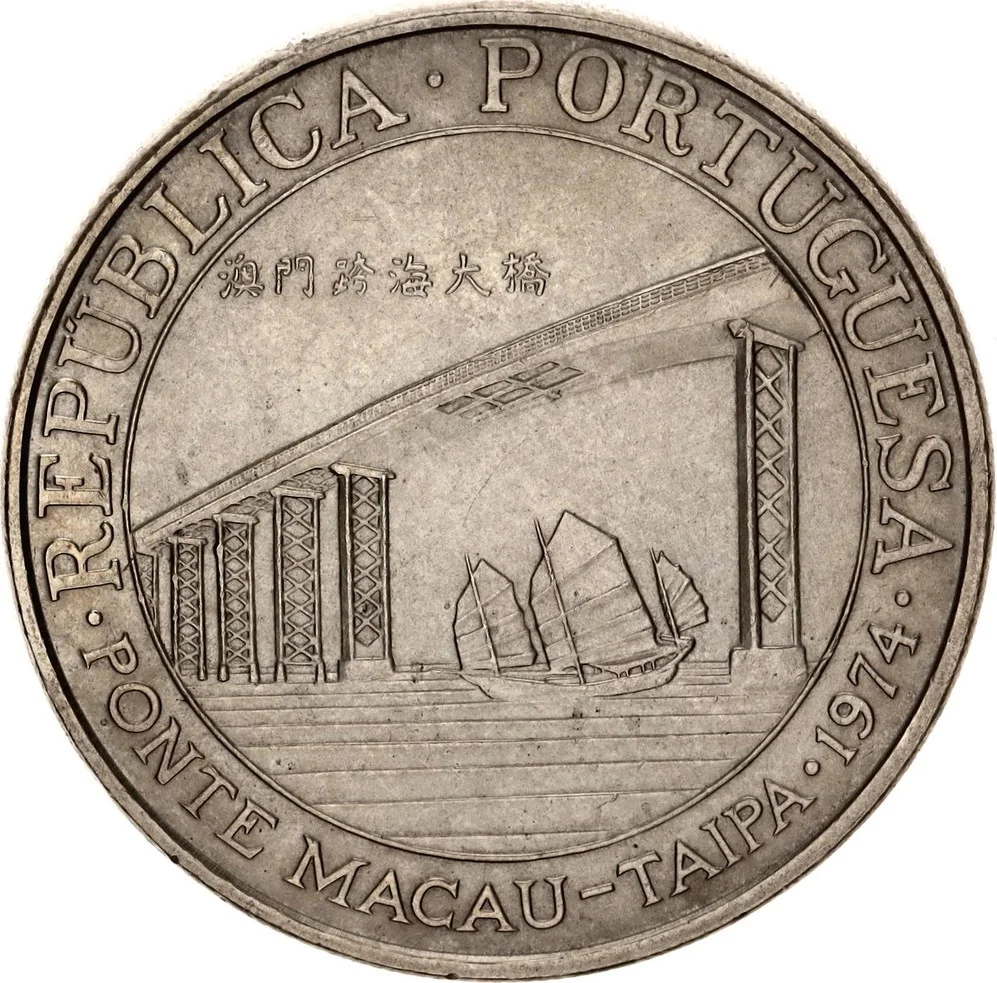
Junk sailing beneath Taipa bridge.
Inscription:
·REPUBLICA · PORTUGUESA·
PONTE MACAU-TAIPA·1974
PONTE MACAU-TAIPA·1974
Translation:
REPUBLIC · PORTUGUESE
PONTE MACAU-TAIPA · 1974
PONTE MACAU-TAIPA · 1974
Language: Portuguese
Engraver: Marcelino Norte de Almeida
Edge
Reeded
Categories
| Building> Bridge |
| Transportation> Watercraft |
Mints
| Name | Mark |
|---|---|
| Imprensa Nacional - Casa da Moeda | — |
Mintings
| Year | Mint Mark | Mintage | Quality | Collection |
|---|---|---|---|---|
| 1974 | — | 1,000,000 |
Historical background
In 1974, Macau's currency situation was characterized by a complex and informal multi-currency system, heavily dominated by the Portuguese escudo and the Hong Kong dollar. As a Portuguese overseas province, the escudo was the official legal tender, used for government transactions, salaries of civil servants, and formal trade with Portugal. However, due to Macau's geographic and economic integration with neighboring Hong Kong, the Hong Kong dollar was the de facto preferred currency for most commercial and daily transactions. Its stability and widespread acceptance made it the backbone of the local economy, particularly in tourism, retail, and the nascent banking sector.
This duality reflected Macau's unique political and economic position. The year 1974 was pivotal politically, as the Carnation Revolution in Portugal in April overthrew the Estado Novo dictatorship. The new democratic government in Lisbon swiftly moved to decolonize, declaring its intention to return Macau to Chinese sovereignty. This immediate political shift, however, did not trigger an immediate monetary change. Economically, Macau was still a modest trading port with a growing manufacturing base (textiles and fireworks) and an established gambling industry, all of which were financially oriented toward Hong Kong and Southeast Asia rather than distant Portugal.
Consequently, the currency landscape was in a state of uncertain transition. While the political future was suddenly redirected toward Beijing, the monetary reality remained tied to Hong Kong. The Pataca (MOP), issued by the Banco Nacional Ultramarino, existed but played a secondary role, its value pegged to the Portuguese escudo and thus less stable and trusted than the Hong Kong dollar. The overarching monetary question in 1974 was not yet about integration with the renminbi, but about how long the symbolic but economically weak Portuguese escudo would remain the official currency in a colony whose economic lifeblood flowed in Hong Kong dollars, all under the new shadow of impending political handover.
This duality reflected Macau's unique political and economic position. The year 1974 was pivotal politically, as the Carnation Revolution in Portugal in April overthrew the Estado Novo dictatorship. The new democratic government in Lisbon swiftly moved to decolonize, declaring its intention to return Macau to Chinese sovereignty. This immediate political shift, however, did not trigger an immediate monetary change. Economically, Macau was still a modest trading port with a growing manufacturing base (textiles and fireworks) and an established gambling industry, all of which were financially oriented toward Hong Kong and Southeast Asia rather than distant Portugal.
Consequently, the currency landscape was in a state of uncertain transition. While the political future was suddenly redirected toward Beijing, the monetary reality remained tied to Hong Kong. The Pataca (MOP), issued by the Banco Nacional Ultramarino, existed but played a secondary role, its value pegged to the Portuguese escudo and thus less stable and trusted than the Hong Kong dollar. The overarching monetary question in 1974 was not yet about integration with the renminbi, but about how long the symbolic but economically weak Portuguese escudo would remain the official currency in a colony whose economic lifeblood flowed in Hong Kong dollars, all under the new shadow of impending political handover.
🌱 Fairly Common