

20 pesos (Navy Plan) – Mexico
Add to wishlist
Circulating commemorative coins
Commemoration: 50th Anniversary of "Navy Plan"
Mexico
Context
Material
References
KM: #
Numista: #153879
Value
Exchange value: 20 MXN
Inflation-adjusted value: 30.72 MXN
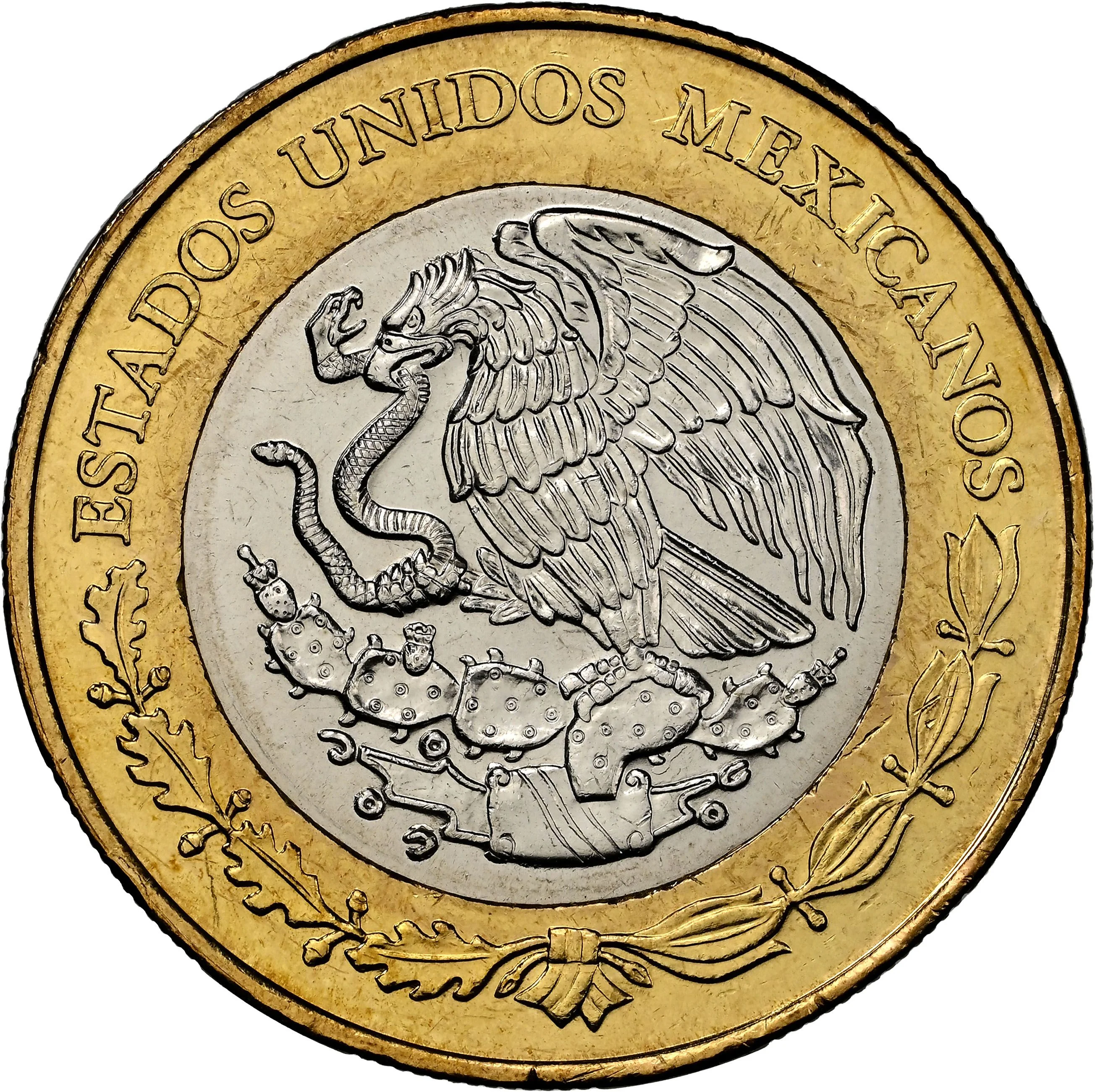
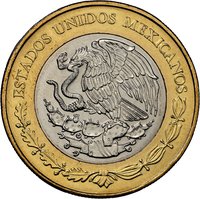
Obverse
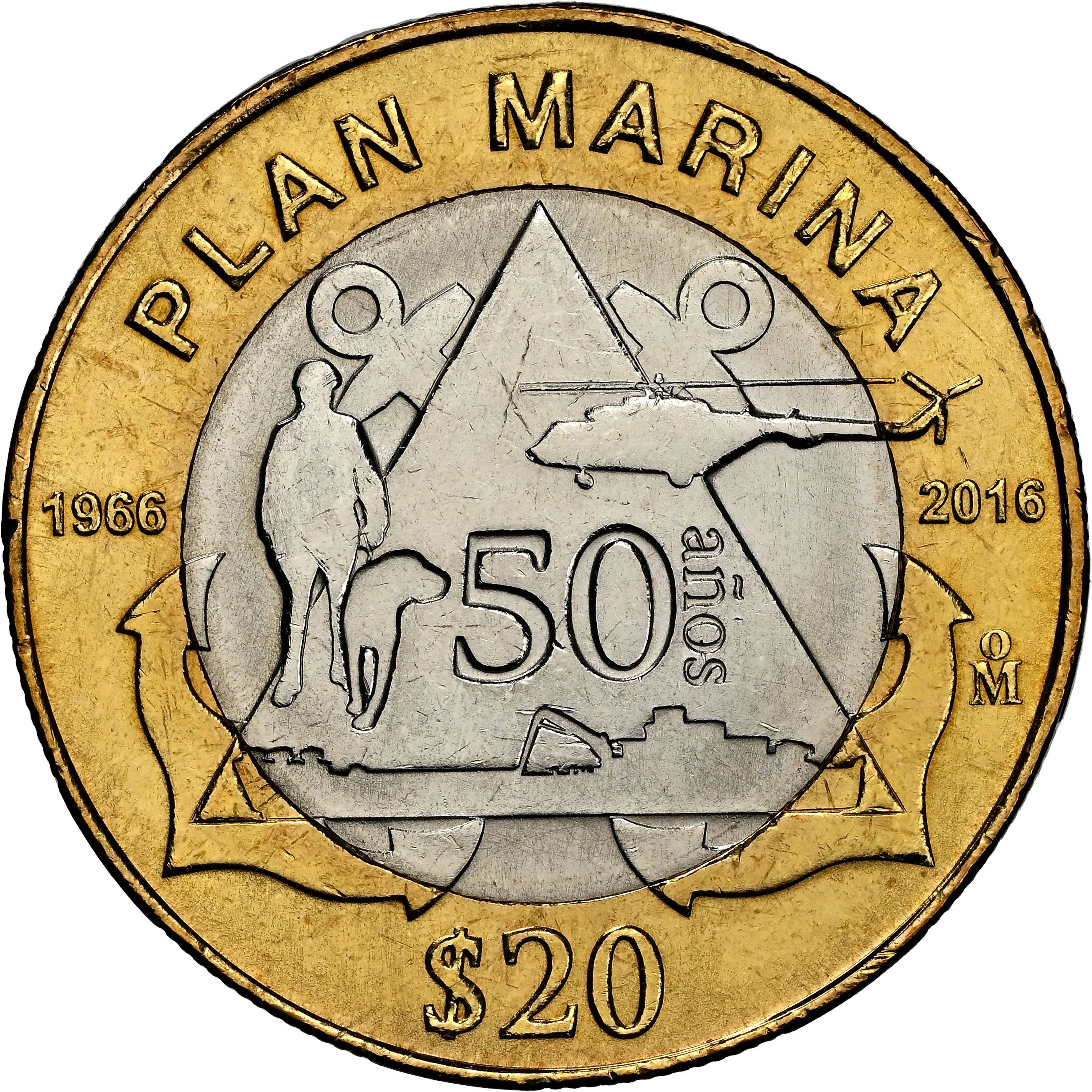
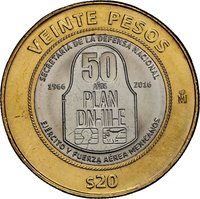
Reverse
Description:
Center: Crossed anchors behind a protective triangle. Above, symbols of the Navy's duty—a K-9 team (ground), helicopter (air), and support vessel (sea). Flanked by dates, with mint mark and value below.
Inscription:
PLAN MARINA
1966 - 2016
50 AÑOS
Mo
$20
1966 - 2016
50 AÑOS
Mo
$20
Translation:
PLAN MARINA
1966 - 2016
50 YEARS
Mo
$20
1966 - 2016
50 YEARS
Mo
$20
Script: Latin
Language: Spanish
Edge
Segmented reeding
Categories
| Transportation> Watercraft |
| Transportation> Aircraft |
| Symbol> Anchor |
| Symbols> Coat of Arms |
| Symbol> Wreath |
| Animal> Dog |
| Animal> Bird> Eagle |
Mints
| Name | Mark |
|---|---|
| Mexican Mint | Mo |
Mintings
| Year | Mint Mark | Mintage | Quality | Collection |
|---|---|---|---|---|
| 2016 | Mo | 5,000,000 |
Historical background
In 2016, Mexico's currency, the peso, faced significant volatility and depreciation, emerging as one of the worst-performing major currencies of the year. The peso's value was heavily influenced by external factors, primarily market anticipation of U.S. monetary policy and political developments. The prospect of rising U.S. interest rates under the Federal Reserve drew capital away from emerging markets like Mexico, while the contentious U.S. presidential election campaign introduced profound uncertainty. As Donald Trump's candidacy gained traction, his rhetoric on renegotiating NAFTA, imposing tariffs, and building a border wall directly threatened Mexico's export-dependent economy, leading to repeated peso sell-offs whenever his prospects improved.
Domestically, the Mexican government and central bank, Banco de México, intervened to stabilize the currency through a combination of interest rate hikes and direct market mechanisms. In February, the bank implemented a surprise 50-basis-point rate increase and later established a discretionary dollar auction program to provide liquidity during periods of extreme volatility. Despite these measures, the peso breached the psychologically significant threshold of 20 pesos per U.S. dollar for the first time in history in November following the U.S. election result, and it ended the year nearly 17% weaker than where it began.
The currency's weakness presented a complex economic picture for Mexico. On one hand, it bolstered the competitiveness of Mexican exports and increased the value of remittances sent home by workers abroad, which reached a record high. On the other hand, it stoked inflationary pressures by making imported goods, particularly gasoline and food, more expensive. This inflation eroded household purchasing power and constrained private consumption, a key driver of economic growth. Consequently, while the manufacturing sector showed resilience, the overall economic growth for 2016 remained modest and below potential, reflecting the challenges posed by a fragile global environment and profound uncertainty regarding the future of its most critical trade relationship.
Domestically, the Mexican government and central bank, Banco de México, intervened to stabilize the currency through a combination of interest rate hikes and direct market mechanisms. In February, the bank implemented a surprise 50-basis-point rate increase and later established a discretionary dollar auction program to provide liquidity during periods of extreme volatility. Despite these measures, the peso breached the psychologically significant threshold of 20 pesos per U.S. dollar for the first time in history in November following the U.S. election result, and it ended the year nearly 17% weaker than where it began.
The currency's weakness presented a complex economic picture for Mexico. On one hand, it bolstered the competitiveness of Mexican exports and increased the value of remittances sent home by workers abroad, which reached a record high. On the other hand, it stoked inflationary pressures by making imported goods, particularly gasoline and food, more expensive. This inflation eroded household purchasing power and constrained private consumption, a key driver of economic growth. Consequently, while the manufacturing sector showed resilience, the overall economic growth for 2016 remained modest and below potential, reflecting the challenges posed by a fragile global environment and profound uncertainty regarding the future of its most critical trade relationship.
🌱 Fairly Common