


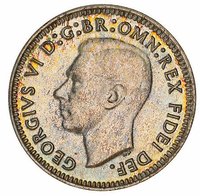
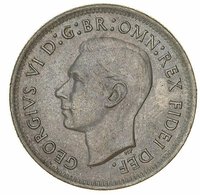
Obverse
Description:
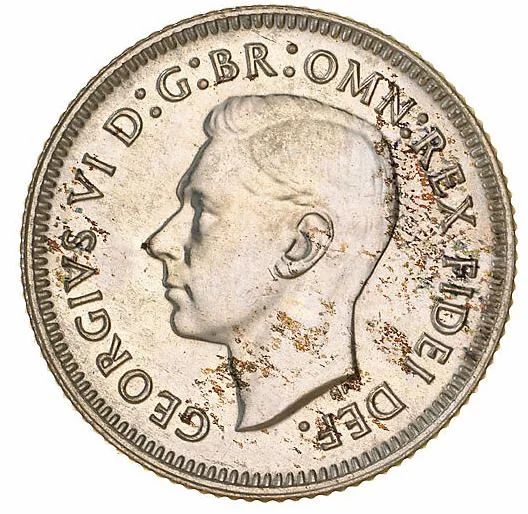
King George VI, left-facing portrait.
Inscription:
GEORGIVS VI D:G:BR:OMN:REX FIDEI DEF.
HP
HP
Translation:
George VI by the Grace of God King of all the Britains Defender of the Faith.
Script: Latin
Language: Latin
Engraver: Thomas Humphrey Paget
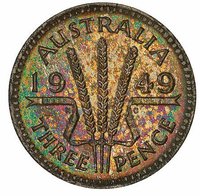
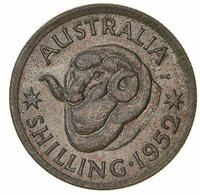
Reverse
Description:
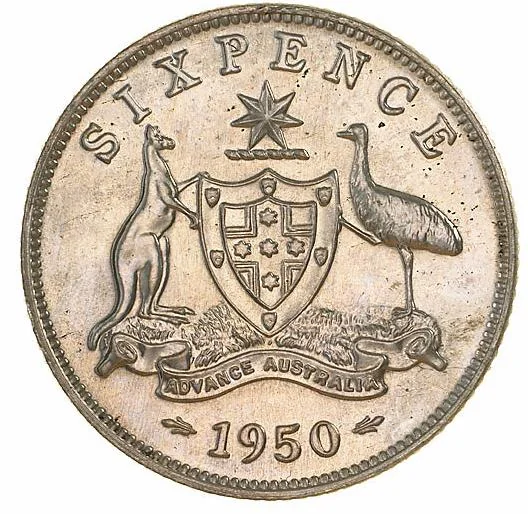
Australian Coat of Arms
Inscription:
SIXPENCE
ADVANCE AUSTRALIA
PL
1951
ADVANCE AUSTRALIA
PL
1951
Script: Latin
Engraver: William Henry James Blakemore
Edge
Reeded
Mints
| Name | Mark |
|---|---|
| Royal Mint | — |
| Royal Mint (Tower Hill) | PL |
Mintings
Historical background
In 1950, Australia's currency system was firmly anchored to the British Pound Sterling under the Sterling Area arrangements, a legacy of its colonial ties and a mechanism for post-war economic stability. The Australian pound (denoted by the £ symbol) was pegged at parity with sterling, meaning its international value was directly determined by the UK's currency. This link facilitated trade and capital flows within the Commonwealth but also meant Australia's monetary policy was largely subordinated to British economic interests and the management of the UK's substantial post-war dollar reserves.
Domestically, the currency was issued and controlled by the Commonwealth Bank, which acted as the nation's central bank. The era was characterised by extensive financial regulation, including strict exchange controls and capital movement restrictions administered by the Bank. These measures were designed to conserve foreign exchange, particularly US dollars, and to support the government's ambitious post-war reconstruction and immigration programmes. The money supply was primarily physical, with banknotes and coins in circulation, and the banking system operated under a regime of prescribed liquidity ratios and interest rate controls.
The period was one of transition and constraint. While the economy was booming due to high commodity prices driven by the Korean War wool boom, the currency's rigid peg and the web of financial controls limited independent policy responses to domestic inflationary pressures. This setting would define monetary challenges for the next decade, eventually leading to a decimalisation debate and, by 1966, the replacement of the Australian pound with the decimal Australian dollar, a significant step toward financial independence.
Domestically, the currency was issued and controlled by the Commonwealth Bank, which acted as the nation's central bank. The era was characterised by extensive financial regulation, including strict exchange controls and capital movement restrictions administered by the Bank. These measures were designed to conserve foreign exchange, particularly US dollars, and to support the government's ambitious post-war reconstruction and immigration programmes. The money supply was primarily physical, with banknotes and coins in circulation, and the banking system operated under a regime of prescribed liquidity ratios and interest rate controls.
The period was one of transition and constraint. While the economy was booming due to high commodity prices driven by the Korean War wool boom, the currency's rigid peg and the web of financial controls limited independent policy responses to domestic inflationary pressures. This setting would define monetary challenges for the next decade, eventually leading to a decimalisation debate and, by 1966, the replacement of the Australian pound with the decimal Australian dollar, a significant step toward financial independence.
🌱 Very Common