

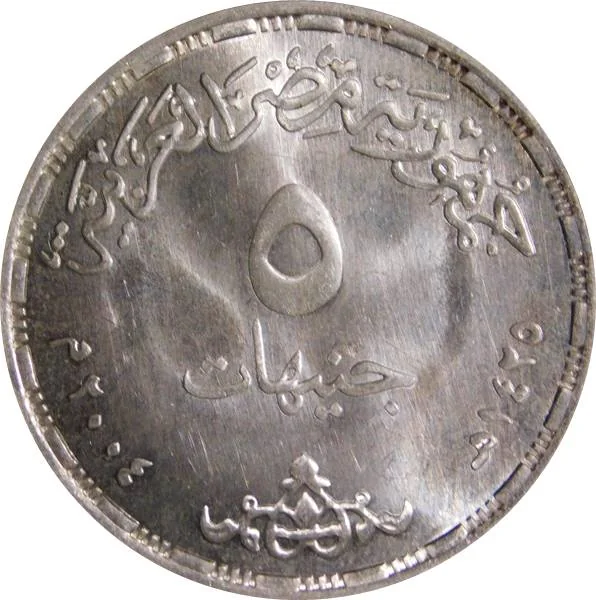
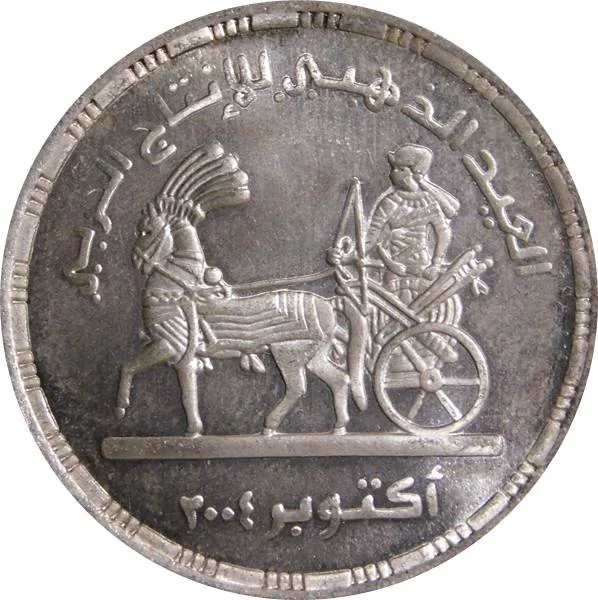
5 Pounds – Egypt
Non-circulating coins
Commemoration: Military Production Golden Jubilee
Egypt
Context
Year: 2004
Islamic (Hijri) Year: 1425
Issuer: Egypt 
Period:
(since 1971)
Currency:
(since 1916)
Total mintage: 800
Material
References
KM: #Click to copy to clipboard935
Numista: #153802
Value
Exchange value: 5 EGP
Bullion value: $36.37
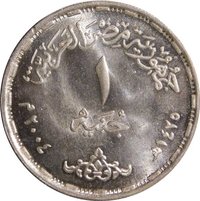
Obverse
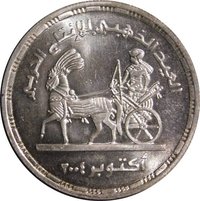
Reverse
Edge
Reeded
Mints
| Name | Mark |
|---|---|
| Egyptian Mint Authority | — |
Mintings
| Year | Mint Mark | Mintage | Quality | Collection |
|---|---|---|---|---|
| 2004 | — | 800 |
Historical background
In 2004, Egypt's currency situation was defined by a heavily managed exchange rate and mounting economic pressures. The Egyptian pound (EGP) was officially pegged to the US dollar, but this peg was maintained through strict capital controls and rationing of foreign currency by the Central Bank of Egypt (CBE). This created a significant divergence between the official rate (approximately EGP 6.2 per USD) and a thriving black market, where the pound traded at a steep discount of around EGP 7.5 per USD. This dual system reflected a scarcity of foreign reserves and a lack of confidence, stifling investment and creating distortions in the economy.
The underlying causes were rooted in structural weaknesses: a large budget deficit, persistent inflation, and a burdensome public sector. The fixed exchange rate, while intended to provide stability, had become unsustainable, overvaluing the pound and hurting export competitiveness. Foreign direct investment remained low, and the economy was struggling to generate sufficient hard currency from its primary sources—tourism, Suez Canal revenues, and remittances—to support the peg and meet growing import demands.
Recognizing these strains, the government of Prime Minister Ahmed Nazif, appointed in July 2004, initiated a decisive shift towards economic liberalization. A key pillar of this reform agenda was a move to a more flexible exchange rate regime. In late December 2004, the CBE announced a surprise 9% devaluation and introduced a new "managed float" system, allowing the pound's value to be determined by interbank trading within a band. This pivotal move marked the beginning of the end for the rigid peg, setting Egypt on a path toward gradual currency liberalization to address the imbalances that had characterized the year.
The underlying causes were rooted in structural weaknesses: a large budget deficit, persistent inflation, and a burdensome public sector. The fixed exchange rate, while intended to provide stability, had become unsustainable, overvaluing the pound and hurting export competitiveness. Foreign direct investment remained low, and the economy was struggling to generate sufficient hard currency from its primary sources—tourism, Suez Canal revenues, and remittances—to support the peg and meet growing import demands.
Recognizing these strains, the government of Prime Minister Ahmed Nazif, appointed in July 2004, initiated a decisive shift towards economic liberalization. A key pillar of this reform agenda was a move to a more flexible exchange rate regime. In late December 2004, the CBE announced a surprise 9% devaluation and introduced a new "managed float" system, allowing the pound's value to be determined by interbank trading within a band. This pivotal move marked the beginning of the end for the rigid peg, setting Egypt on a path toward gradual currency liberalization to address the imbalances that had characterized the year.
💎 Extremely Rare