

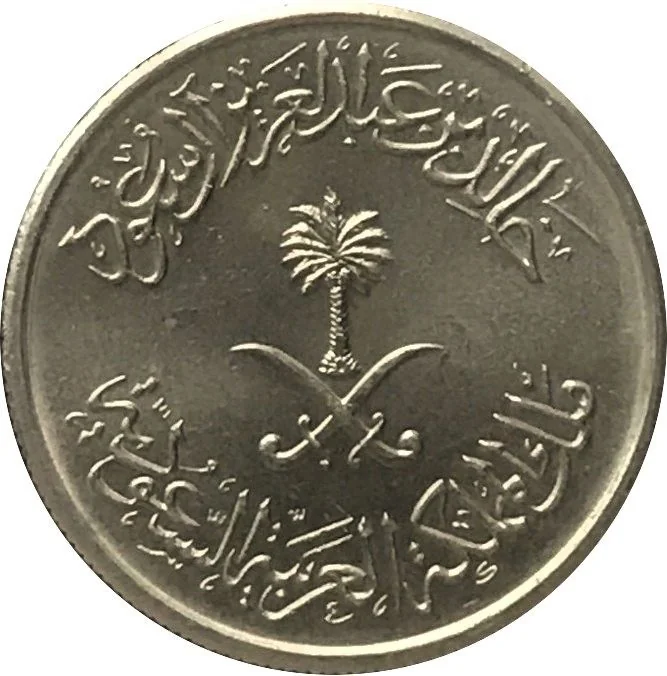
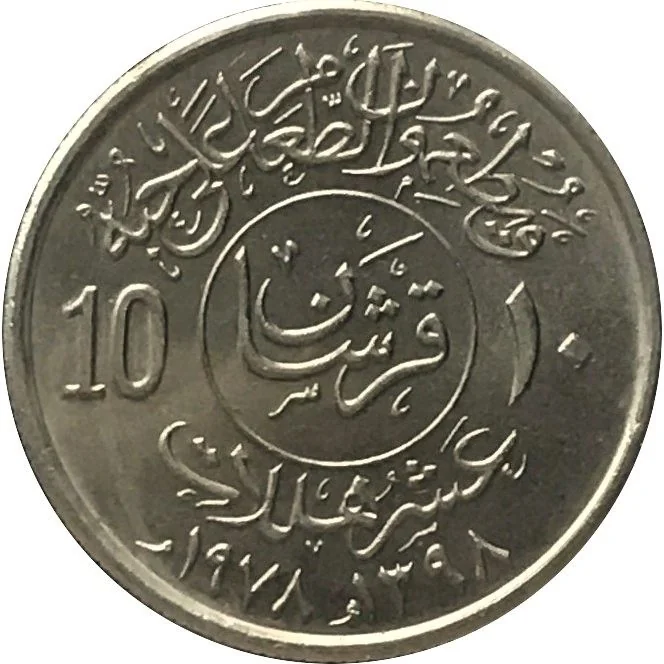
10 halalas – Saudi Arabia
Add to wishlist
Circulating commemorative coins
Commemoration: F.A.O.
Saudi Arabia
Context
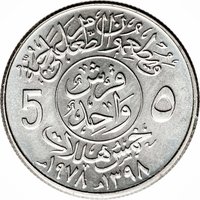
Year: 1978
Islamic (Hijri) Year:: 1398
Issuer: Saudi Arabia
Ruler: Khalid bin Abdulaziz
Currency:
(since 1960)
Total mintage: 1,000,000
Material
Diameter: 21 mm
Weight: 4 g
Thickness: 1.54 mm
Shape: Round
Composition: Copper-nickel
Technique: Milled
Alignment: Medal alignment
flip
References
KM: #
Numista: #10517
Value
Exchange value: 0.10 SAR
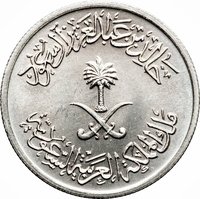
Obverse
Reverse
Edge
Milled
Categories
| Organization> FAO |
| Plant> Tree |
| Symbols> Coat of Arms |
| Object> Cold weapons |
Mints
| Name | Mark |
|---|---|
| Royal Mint | — |
Mintings
| Year | Mint Mark | Mintage | Quality | Collection |
|---|---|---|---|---|
| 1978 | — | 1,000,000 |
Historical background
In 1978, Saudi Arabia's currency situation was fundamentally defined by its immense oil wealth and its fixed exchange rate to the U.S. dollar. The Saudi riyal had been pegged at 3.75 SAR to 1 USD since 1960, a policy maintained to ensure stability for the kingdom's primary export: petroleum, which was priced globally in dollars. This peg provided crucial predictability for government revenues, international trade, and large-scale development projects, anchoring the economy during a period of rapid transformation fueled by the oil price shocks of 1973-74. The nation was in the midst of its second Five-Year Development Plan, channeling petrodollars into massive infrastructure, industrial, and social spending, all financed by dollar-denominated oil sales.
Internally, the currency was managed by the Saudi Arabian Monetary Agency (SAMA), which functioned as the central bank. The primary monetary challenge was not stability against the dollar but managing domestic liquidity and inflationary pressures. The flood of dollar revenues from oil exports created a complex task of "sterilization"—attempting to prevent excessive money supply growth from causing rampant inflation, as the economy absorbed the sudden wealth. This period saw high government spending driving imports and economic expansion, but SAMA's conservative policies, including substantial foreign asset accumulation, helped maintain confidence in the riyal's value.
Globally, the riyal's fate was intertwined with the U.S. dollar, which itself was experiencing volatility in the late 1970s due to high inflation and a shifting international monetary landscape following the collapse of the Bretton Woods system. For Saudi Arabia, the dollar peg was a strategic choice, reinforcing its critical economic and political partnership with the United States. By 1978, this arrangement was deeply institutionalized, creating a stable monetary foundation that supported the kingdom's ambitious development goals while linking its financial destiny directly to the performance of the U.S. economy and the global oil market.
Internally, the currency was managed by the Saudi Arabian Monetary Agency (SAMA), which functioned as the central bank. The primary monetary challenge was not stability against the dollar but managing domestic liquidity and inflationary pressures. The flood of dollar revenues from oil exports created a complex task of "sterilization"—attempting to prevent excessive money supply growth from causing rampant inflation, as the economy absorbed the sudden wealth. This period saw high government spending driving imports and economic expansion, but SAMA's conservative policies, including substantial foreign asset accumulation, helped maintain confidence in the riyal's value.
Globally, the riyal's fate was intertwined with the U.S. dollar, which itself was experiencing volatility in the late 1970s due to high inflation and a shifting international monetary landscape following the collapse of the Bretton Woods system. For Saudi Arabia, the dollar peg was a strategic choice, reinforcing its critical economic and political partnership with the United States. By 1978, this arrangement was deeply institutionalized, creating a stable monetary foundation that supported the kingdom's ambitious development goals while linking its financial destiny directly to the performance of the U.S. economy and the global oil market.
🌱 Fairly Common