

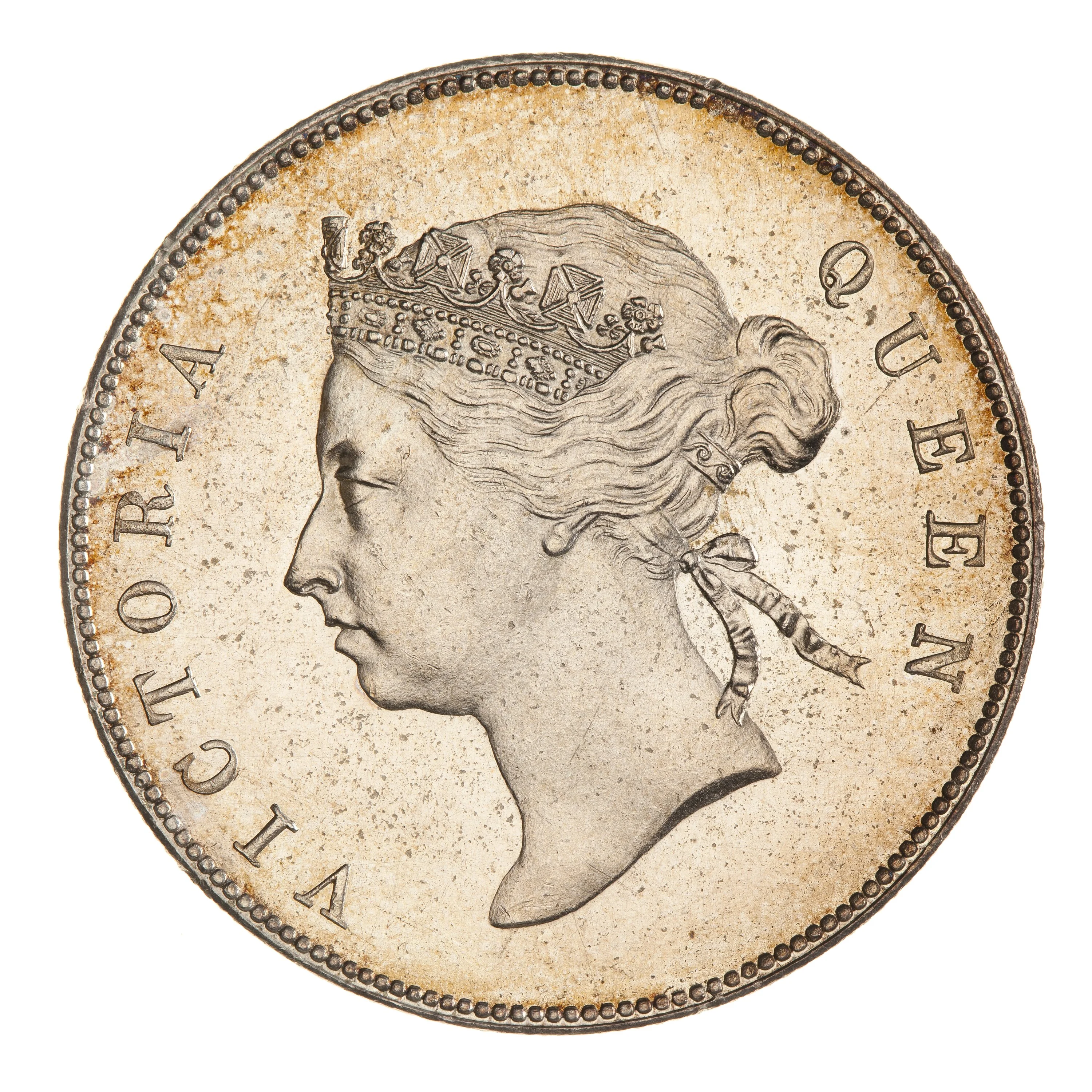
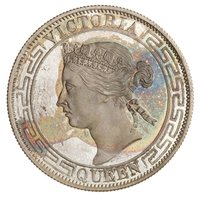
Obverse
Description:
Crowned left-facing bust.
Inscription:
VICTORIA QUEEN
Script: Latin
Engraver: Leonard Charles Wyon
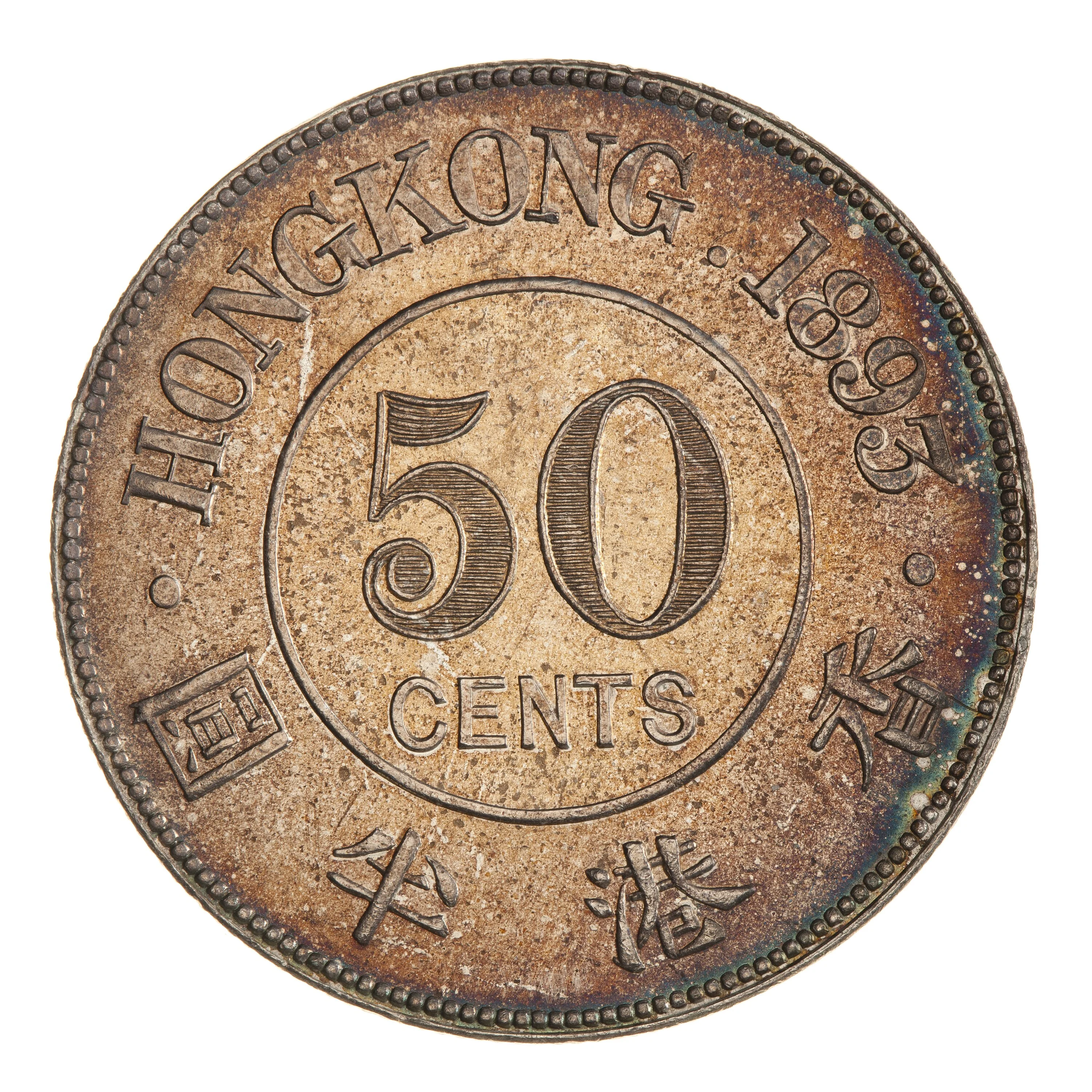
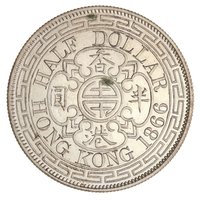
Reverse
Description:
Circle denomination, encircled lettering.
Inscription:
· HONGKONG . 1894 ·
50
CENTS
圓半港香
50
CENTS
圓半港香
Translation:
HONGKONG . 1894 .
50
CENTS
HONG KONG HALF DOLLAR
50
CENTS
HONG KONG HALF DOLLAR
Engraver: Leonard Charles Wyon
Edge
Reeded
Mints
| Name | Mark |
|---|---|
| Royal Mint (Tower Hill) | — |
| Heaton and Sons / The Mint Birmingham | H |
Mintings
Historical background
In 1890, Hong Kong’s currency situation was a complex and practical reflection of its role as a burgeoning British colonial entrepôt. The official currency was the British silver dollar and its subsidiary coinage, but the reality in daily commerce was a multilingual bazaar of circulating media. Alongside the British coinage, Spanish and Mexican "Carolus" silver dollars, Chinese silver sycee (bulion in lump form), and copper cash coins all circulated freely. This created a constant need for assay and exchange, as the value of each item depended on its weight and fineness of silver, leading to a thriving business for money changers and compradors.
The British authorities had been attempting to impose monetary order since the 1860s. The Hong Kong Mint (opened 1866 and closed 1868) had failed to produce a currency that could dominate the market. Consequently, by 1890, the government was relying on the import of British trade dollars—specifically minted for use in the East—and the standardization of the dollar unit. The Hong Kong government issued its own banknotes, but these were denominated in dollars and were essentially receipts for silver deposits held by the note-issuing banks, primarily the Hongkong and Shanghai Banking Corporation (HSBC).
Thus, the system was a de facto silver standard, where all values were ultimately anchored to a specific weight of silver. This tied Hong Kong’s economy to the volatile international price of silver, which was in a long period of decline relative to gold. This instability affected trade balances and was a persistent concern for merchants and the colonial government alike. The year 1890, therefore, found Hong Kong in a transitional and somewhat messy monetary state, caught between local tradition, imperial ambition, and the global forces of the metal markets, awaiting a more unified and stable system.
The British authorities had been attempting to impose monetary order since the 1860s. The Hong Kong Mint (opened 1866 and closed 1868) had failed to produce a currency that could dominate the market. Consequently, by 1890, the government was relying on the import of British trade dollars—specifically minted for use in the East—and the standardization of the dollar unit. The Hong Kong government issued its own banknotes, but these were denominated in dollars and were essentially receipts for silver deposits held by the note-issuing banks, primarily the Hongkong and Shanghai Banking Corporation (HSBC).
Thus, the system was a de facto silver standard, where all values were ultimately anchored to a specific weight of silver. This tied Hong Kong’s economy to the volatile international price of silver, which was in a long period of decline relative to gold. This instability affected trade balances and was a persistent concern for merchants and the colonial government alike. The year 1890, therefore, found Hong Kong in a transitional and somewhat messy monetary state, caught between local tradition, imperial ambition, and the global forces of the metal markets, awaiting a more unified and stable system.
⭐ Somewhat Rare