

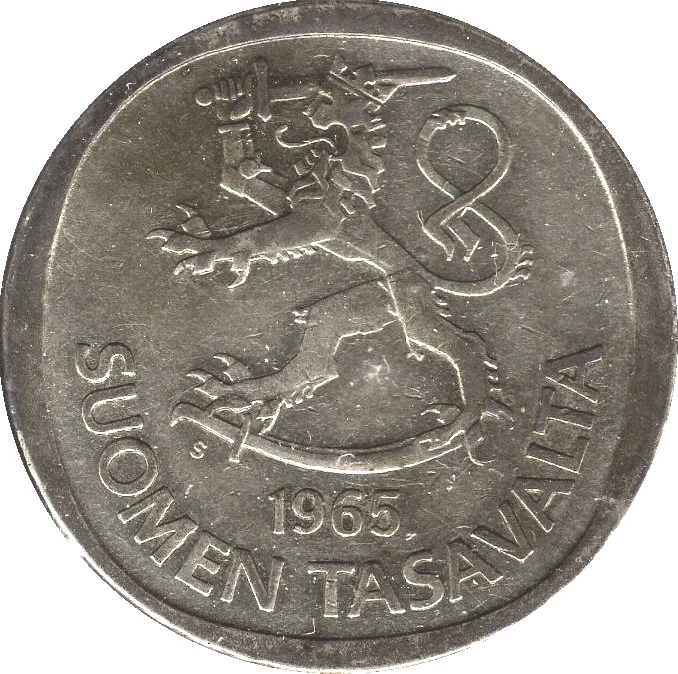
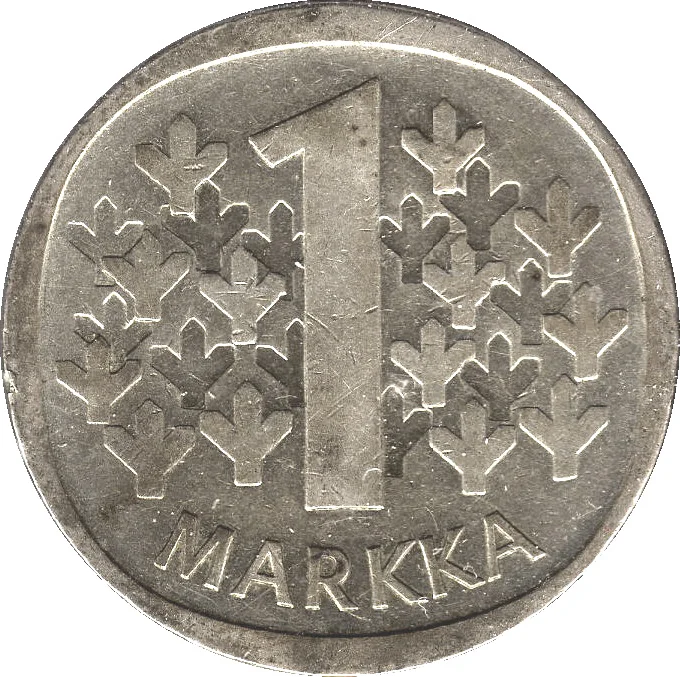
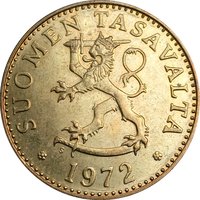
Obverse
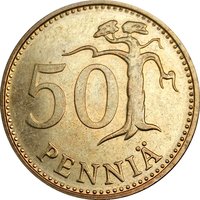
Reverse
Description:
Stylized trees framing a denomination.
Inscription:
1
MARKKA
MARKKA
Script: Latin
Engraver: Heikki Häiväoja
Categories
| Object> Cold weapons |
| Animal> Feline |
| Symbols> Coat of Arms |
Mints
| Name | Mark |
|---|---|
| Mint of Finland | — |
Mintings
| Year | Mint Mark | Mintage | Quality | Collection |
|---|---|---|---|---|
| 1964 | — | 9,999,000 | ||
| 1965 | — | 15,107,000 | ||
| 1966 | — | 15,183,000 | ||
| 1967 | — | 6,249,000 | ||
| 1968 | — | 3,063,000 |
Historical background
In 1964, Finland's currency situation was defined by the Finnish markka (FIM) operating under a fixed exchange rate system, pegged to the US dollar as part of the Bretton Woods international monetary framework. This system, managed by the Bank of Finland, provided stability for trade and investment by tying the markka's value to a major reserve currency. However, it also required the central bank to actively intervene in foreign exchange markets to maintain the agreed-upon parity, limiting independent monetary policy.
Domestically, the era was one of robust economic growth and industrialization, but it was not without inflationary pressures. The fixed exchange rate helped contain imported inflation to a degree, but strong domestic demand and rising wages posed challenges. Consequently, the authorities occasionally resorted to devaluations to restore competitiveness; a significant devaluation had occurred in 1957, and careful management was required to avoid another. The system aimed to balance the needs of a rapidly modernizing export-driven economy—reliant on sectors like forestry and emerging metal and engineering industries—with the imperative of maintaining currency stability.
Looking ahead, the Bretton Woods system itself was showing signs of global strain, though it would not fully unravel until the early 1970s. For Finland in 1964, the currency regime was a cornerstone of economic policy, fostering the stable environment needed for the nation's continued post-war transformation and integration into Western European trade. The situation remained stable for the time being, but it was inherently dependent on both disciplined domestic fiscal policy and the sustainability of the international dollar-gold standard.
Domestically, the era was one of robust economic growth and industrialization, but it was not without inflationary pressures. The fixed exchange rate helped contain imported inflation to a degree, but strong domestic demand and rising wages posed challenges. Consequently, the authorities occasionally resorted to devaluations to restore competitiveness; a significant devaluation had occurred in 1957, and careful management was required to avoid another. The system aimed to balance the needs of a rapidly modernizing export-driven economy—reliant on sectors like forestry and emerging metal and engineering industries—with the imperative of maintaining currency stability.
Looking ahead, the Bretton Woods system itself was showing signs of global strain, though it would not fully unravel until the early 1970s. For Finland in 1964, the currency regime was a cornerstone of economic policy, fostering the stable environment needed for the nation's continued post-war transformation and integration into Western European trade. The situation remained stable for the time being, but it was inherently dependent on both disciplined domestic fiscal policy and the sustainability of the international dollar-gold standard.
🌱 Very Common