

3000 kroner – Denmark
Add to wishlist
Non-circulating coins
Commemoration: Queen Margrethe II's 40th Jubilee of Throne Accession
Denmark
Context
Material
References
KM: #
Numista: #152006
Value
Exchange value: 3000 DKK
Bullion value: $1186.84
Inflation-adjusted value: 3725.67 DKK
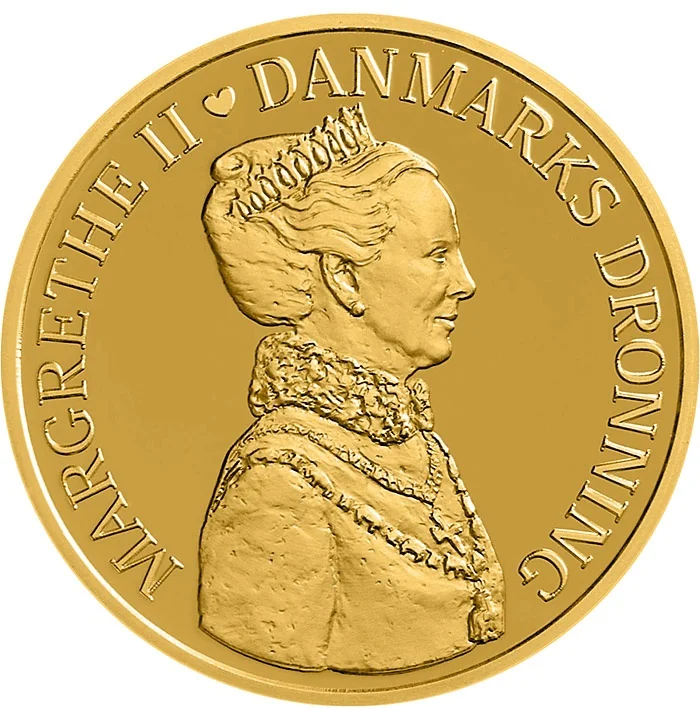
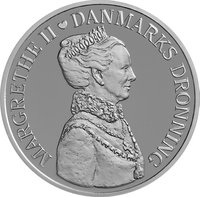
Obverse
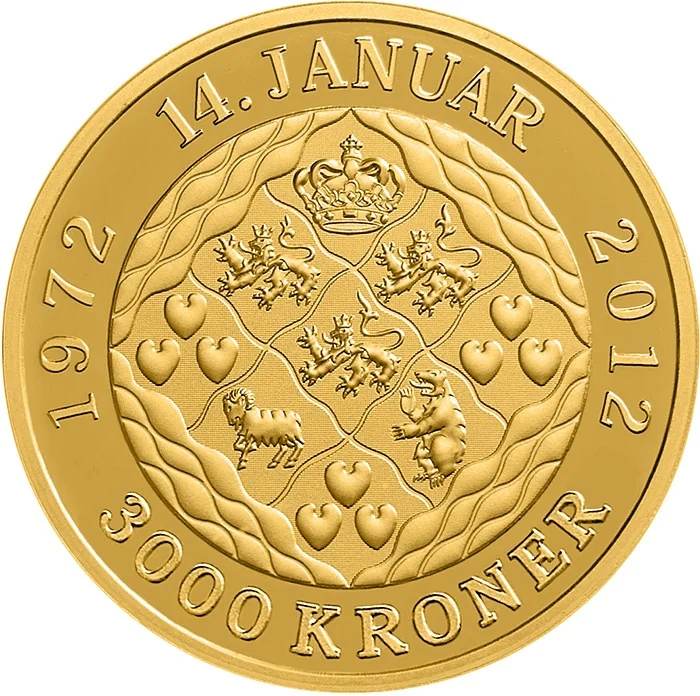
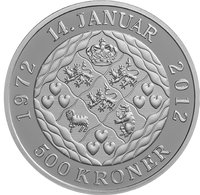
Reverse
Description:
Danish, Faroese, and Greenlandic coat of arms elements, designed by Ronny Andersen from Queen Margrethe's concept.
Inscription:
1972 14. JANUAR 2012
3000 KRONER
3000 KRONER
Script: Latin
Edge
Plain
Mints
| Name | Mark |
|---|---|
| Royal Danish Mint | — |
Mintings
| Year | Mint Mark | Mintage | Quality | Collection |
|---|---|---|---|---|
| 2012 | — | 2,325 |
Historical background
In 2012, Denmark's currency situation was defined by its long-standing policy of maintaining a fixed exchange rate for the Danish krone (DKK) against the euro. This was managed through the European Exchange Rate Mechanism II (ERM II), with a central rate of 7.46038 kroner per euro and a very narrow fluctuation band of ±2.25%. The primary objective of the Danish central bank (Danmarks Nationalbank) was to ensure stability, not to target inflation or growth, making currency defense its paramount task. This policy was a cornerstone of Denmark's economic framework, providing predictability for trade and investment while the country remained outside the Eurozone following its 2000 referendum rejection of adopting the single currency.
The year 2012 presented significant challenges to this stability due to the escalating Eurozone debt crisis. As investors sought safe-haven currencies, substantial capital inflows put intense upward pressure on the krone, threatening to push it above its agreed-upon peg. In response, Danmarks Nationalbank took unprecedented and aggressive action throughout the year, implementing a series of interest rate cuts. By July, it had lowered its key certificate of deposit rate to a historic low of 0.20% and even introduced negative interest rates on certain deposits held by commercial banks, a rare move at the time. The goal was to deliberately make holding kroner less attractive, thereby weakening the currency and defending the peg.
These measures proved successful in maintaining the fixed exchange rate, but they came with consequences. The ultra-low and negative interest rates fueled a boom in the Danish housing market and increased household debt levels, raising concerns about financial stability. Furthermore, the policy effectively imported the European Central Bank's accommodative monetary stance, which was not necessarily tailored to Denmark's specific economic conditions. Thus, while 2012 stands as a testament to Denmark's unwavering commitment to its currency peg, it also highlighted the trade-offs and external vulnerabilities inherent in such a rigid exchange rate policy during a period of severe regional financial turmoil.
The year 2012 presented significant challenges to this stability due to the escalating Eurozone debt crisis. As investors sought safe-haven currencies, substantial capital inflows put intense upward pressure on the krone, threatening to push it above its agreed-upon peg. In response, Danmarks Nationalbank took unprecedented and aggressive action throughout the year, implementing a series of interest rate cuts. By July, it had lowered its key certificate of deposit rate to a historic low of 0.20% and even introduced negative interest rates on certain deposits held by commercial banks, a rare move at the time. The goal was to deliberately make holding kroner less attractive, thereby weakening the currency and defending the peg.
These measures proved successful in maintaining the fixed exchange rate, but they came with consequences. The ultra-low and negative interest rates fueled a boom in the Danish housing market and increased household debt levels, raising concerns about financial stability. Furthermore, the policy effectively imported the European Central Bank's accommodative monetary stance, which was not necessarily tailored to Denmark's specific economic conditions. Thus, while 2012 stands as a testament to Denmark's unwavering commitment to its currency peg, it also highlighted the trade-offs and external vulnerabilities inherent in such a rigid exchange rate policy during a period of severe regional financial turmoil.
💎 Extremely Rare