

1 rupee – Maratha Empire
Add to wishlist
India
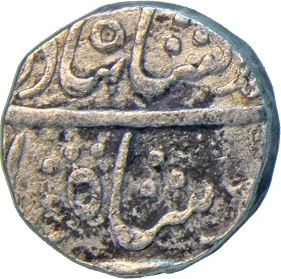
Obverse
Description:
By Ahmad Shah Bahadur
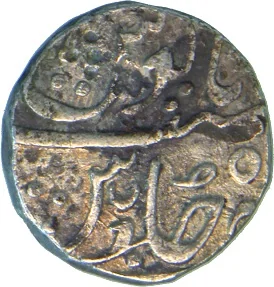
Reverse
Description:
Crescent mint mark
Edge
Plain
Mintings
| Year | Mint Mark | Mintage | Quality | Collection |
|---|---|---|---|---|
| — | — | — |
Historical background
By 1818, the Maratha Empire was in a state of political and economic disarray following its decisive defeat in the Third Anglo-Maratha War. The formal dissolution of the Peshwa's central authority and the imposition of British subsidiary alliances shattered the unified economic space the empire had once fostered. This political fragmentation directly impacted the monetary system, as the various Maratha chiefs who became subsidiary rulers (like the Scindias, Holkars, and Gaekwads) lost the right to issue their own coins in the name of the Mughal Emperor or the Peshwa, a privilege now controlled by the British East India Company.
Consequently, the currency situation was characterized by extreme heterogeneity and confusion. The region was flooded with a multitude of coins from different eras and authorities: old Mughal rupees (like the Alamgiri and Sanat rupees), coins issued by former Peshwas, and the distinct issues of the now-subordinate Maratha chiefs, all circulating alongside Company rupees. These coins varied widely in weight, purity, and value, creating a complex and inefficient system of exchange that hampered trade. The British, recognizing this monetary anarchy as an obstacle to administration and commerce, were already moving to impose standardization.
Thus, 1818 marks a critical juncture—the end of indigenous Maratha monetary sovereignty and the beginning of a forced transition towards a uniform British system. The Treaty agreements systematically stripped the Maratha rulers of their coinage rights, paving the way for the Company's rupee to become the dominant legal tender. The background, therefore, is one of a legacy system in its final, chaotic state, on the brink of being supplanted by the colonial monetary order that would unify India's economy under British control.
Consequently, the currency situation was characterized by extreme heterogeneity and confusion. The region was flooded with a multitude of coins from different eras and authorities: old Mughal rupees (like the Alamgiri and Sanat rupees), coins issued by former Peshwas, and the distinct issues of the now-subordinate Maratha chiefs, all circulating alongside Company rupees. These coins varied widely in weight, purity, and value, creating a complex and inefficient system of exchange that hampered trade. The British, recognizing this monetary anarchy as an obstacle to administration and commerce, were already moving to impose standardization.
Thus, 1818 marks a critical juncture—the end of indigenous Maratha monetary sovereignty and the beginning of a forced transition towards a uniform British system. The Treaty agreements systematically stripped the Maratha rulers of their coinage rights, paving the way for the Company's rupee to become the dominant legal tender. The background, therefore, is one of a legacy system in its final, chaotic state, on the brink of being supplanted by the colonial monetary order that would unify India's economy under British control.

✨ Legendary