

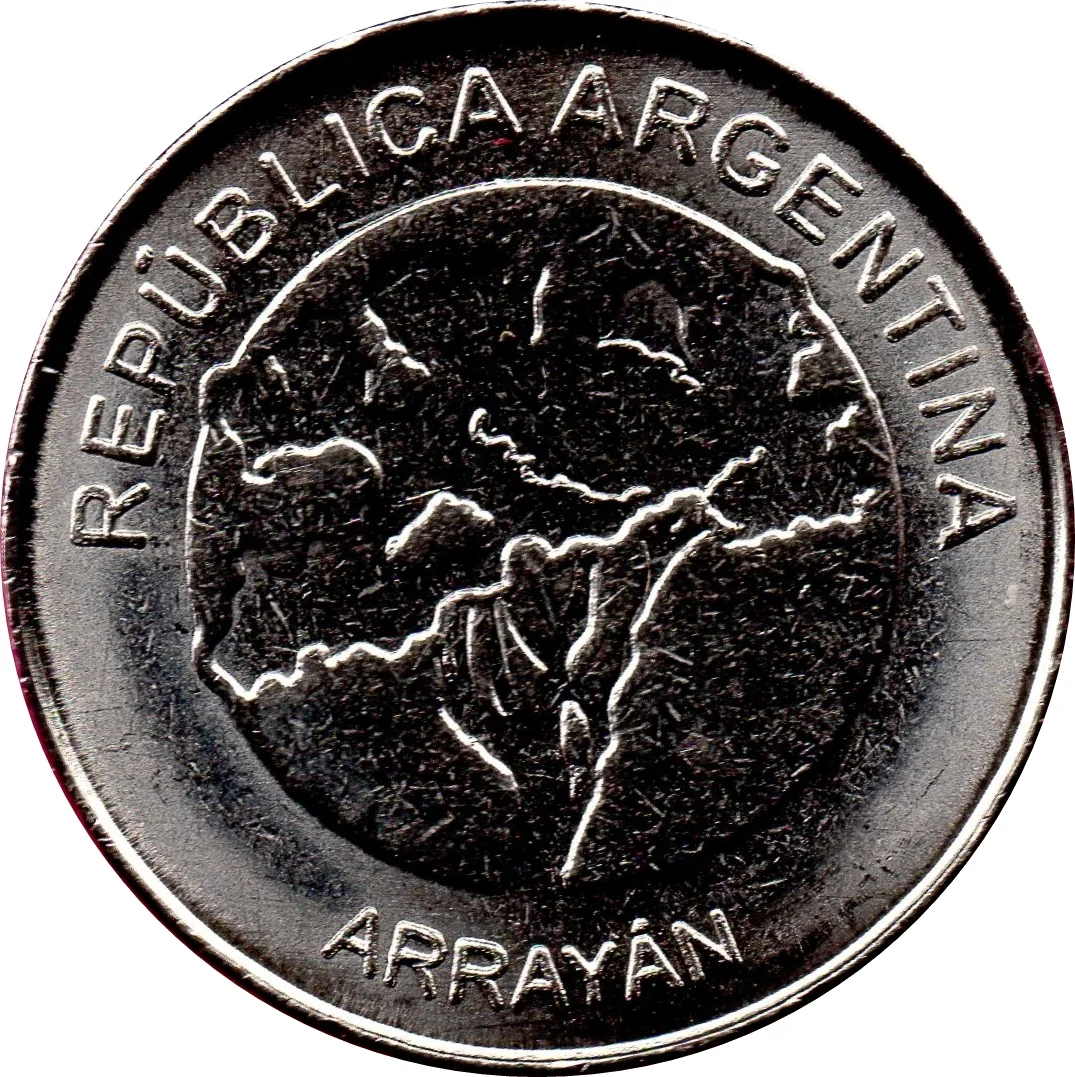
Obverse
Reverse
Description:
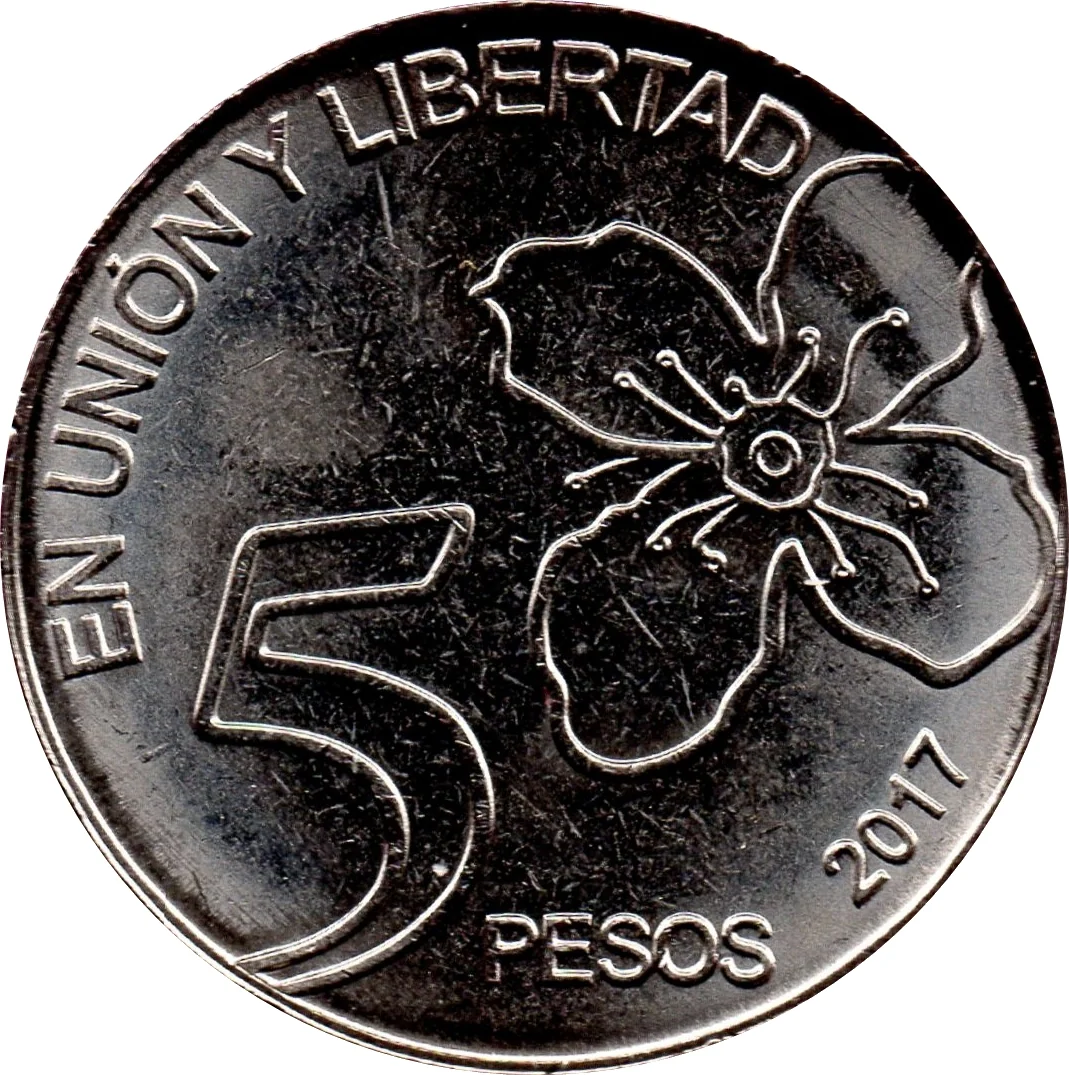
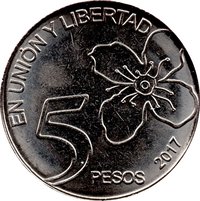
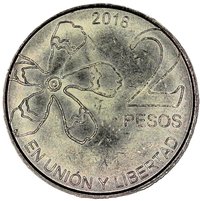
Right, the arrayán flower with mint year "2017". Above, the motto "EN UNION Y LIBERTAD". The "5 PESOS" denomination is placed in Patagonia, the species' most representative region.
Inscription:
EN UNIÓN Y LIBERTAD
5 PESOS
2017
5 PESOS
2017
Translation:
In Union and Liberty
5 Pesos
2017
5 Pesos
2017
Script: Latin
Language: Spanish
Edge
Plain
Mints
| Name | Mark |
|---|---|
| Buenos Aires | — |
Mintings
| Year | Mint Mark | Mintage | Quality | Collection |
|---|---|---|---|---|
| 2017 | — | 200,000,000 | ||
| 2020 | — | — |
Historical background
In 2017, Argentina was in the midst of a significant economic transition under President Mauricio Macri, who had taken office in late 2015. His administration inherited a tightly controlled foreign exchange regime, rampant inflation, and isolation from international capital markets. A central pillar of Macri's policy was the swift removal of capital controls, a move dubbed the "currency normalization." This allowed the Argentine peso to float freely, leading to an immediate and substantial devaluation. The government aimed to eliminate the distorting black market for dollars, attract foreign investment, and rebuild depleted foreign reserves, setting the stage for a painful but necessary economic correction.
Despite these reforms, 2017 was characterized by persistent volatility and a weakening peso. Inflation remained stubbornly high, eroding purchasing power and public confidence. While the government successfully returned to international debt markets with a landmark $16.5 billion bond issuance in 2016, the resulting increase in external debt and ongoing fiscal deficits continued to pressure the currency. The Central Bank intermittently intervened in the foreign exchange market to smooth volatility, but it largely maintained a non-interventionist stance, targeting inflation primarily through high interest rates, which further stifled economic growth.
By the end of 2017, the macroeconomic picture was mixed. The free-floating exchange rate was established, and the economy emerged from recession, growing by 2.7%. However, inflation closed the year at nearly 25%, and the peso had depreciated by approximately 18% against the US dollar over the course of the year. This period laid bare the underlying structural challenges, demonstrating that while lifting controls had solved some immediate distortions, it had not tamed inflation or created stability, foreshadowing the more severe currency crisis that would erupt in 2018.
Despite these reforms, 2017 was characterized by persistent volatility and a weakening peso. Inflation remained stubbornly high, eroding purchasing power and public confidence. While the government successfully returned to international debt markets with a landmark $16.5 billion bond issuance in 2016, the resulting increase in external debt and ongoing fiscal deficits continued to pressure the currency. The Central Bank intermittently intervened in the foreign exchange market to smooth volatility, but it largely maintained a non-interventionist stance, targeting inflation primarily through high interest rates, which further stifled economic growth.
By the end of 2017, the macroeconomic picture was mixed. The free-floating exchange rate was established, and the economy emerged from recession, growing by 2.7%. However, inflation closed the year at nearly 25%, and the peso had depreciated by approximately 18% against the US dollar over the course of the year. This period laid bare the underlying structural challenges, demonstrating that while lifting controls had solved some immediate distortions, it had not tamed inflation or created stability, foreshadowing the more severe currency crisis that would erupt in 2018.
🌱 Very Common