

20 Euro – Vatican City
Non-circulating coins
Commemoration: Pontifical Basilica of Saint Anthony of Padua
Vatican City
Context

Material
References
KM: #Click to copy to clipboard501
Numista: #131043
Value
Exchange value: 20 EUR = $23.63
Bullion value: $917.37
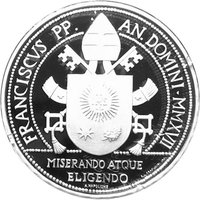
Obverse
Description:
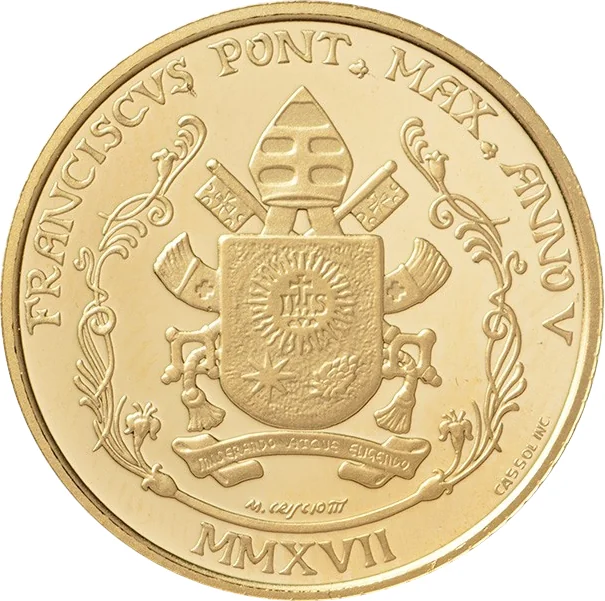
The design features Pope Francis's coat of arms.
Inscription:
FRANCISCVS PONT. MAX. ANNO V
MMXVII
IHS
MISERANDO ATQUE ELIGENDO
M. CRISCIOTTI
CASSOL INC
MMXVII
IHS
MISERANDO ATQUE ELIGENDO
M. CRISCIOTTI
CASSOL INC
Translation:
FRANCIS PONT. MAX. YEAR V
2017
IHS
HAVING MERCY AND CHOOSING
M. CRISCIOTTI
CASSOL INC
2017
IHS
HAVING MERCY AND CHOOSING
M. CRISCIOTTI
CASSOL INC
Script: Latin
Engravers: Mariangela Crisciotti, Maria Angela Cassol
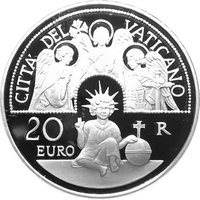
Reverse
Description:
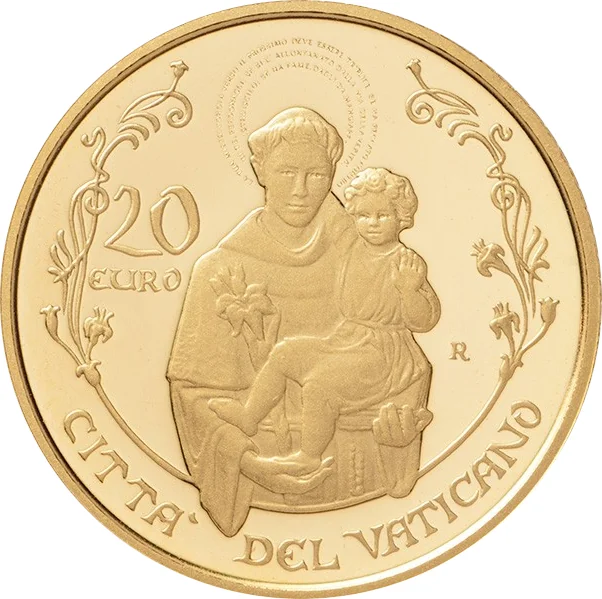
Saint Anthony, depicted as a young friar, holds the infant Jesus and a lily.
Inscription:
20
EURO
R
CITTA' DEL VATICANO
EURO
R
CITTA' DEL VATICANO
Translation:
20 EURO
R
VATICAN CITY
R
VATICAN CITY
Script: Latin
Language: Italian
Engravers: Mariangela Crisciotti, Maria Angela Cassol
Edge
Milled.
Categories
| Person> Religious figure |
| Symbols> Coat of Arms |
Mints
| Name | Mark |
|---|---|
| Rome | R |
Mintings
| Year | Mint Mark | Mintage | Quality | Collection |
|---|---|---|---|---|
| 2017 | R | 1,900 | Proof |
Historical background
In 2017, Vatican City’s currency situation was defined by its unique status as a sovereign city-state within the Eurozone. As a result of the Lateran Treaty with Italy and subsequent agreements with the European Union, Vatican City is not a formal EU member but has a special arrangement allowing it to use the euro as its official currency. Since 2002, it has issued its own limited series of euro coins, which are legal tender across the Eurozone and highly sought after by collectors. These coins feature distinctive designs, often with the image of the reigning Pope, and their minting is strictly capped by an agreement with Italy, acting on behalf of the EU.
The year 2017 saw the continuation of this established system, with the issuance of Vatican euro coins bearing the effigy of Pope Francis. The financial context, however, was still influenced by ongoing reforms initiated under Pope Francis to improve transparency and combat financial misconduct following past scandals. The Institute for the Works of Religion (IOR), often called the Vatican Bank, continued its path of compliance with international anti-money laundering standards, a process that had intensified in the preceding years. This reform effort was crucial for maintaining the Vatican's banking relationships and its ability to operate within the global financial system while using the euro.
Overall, the currency situation in Vatican City in 2017 was one of stability in its monetary issuance but of continued evolution in its broader financial governance. The euro provided a stable and credible currency, while internal reforms aimed to ensure that the city-state's financial institutions operated with greater accountability and in line with European norms. This period represented a balance between maintaining a traditional numismatic program and adapting to modern international financial regulations.
The year 2017 saw the continuation of this established system, with the issuance of Vatican euro coins bearing the effigy of Pope Francis. The financial context, however, was still influenced by ongoing reforms initiated under Pope Francis to improve transparency and combat financial misconduct following past scandals. The Institute for the Works of Religion (IOR), often called the Vatican Bank, continued its path of compliance with international anti-money laundering standards, a process that had intensified in the preceding years. This reform effort was crucial for maintaining the Vatican's banking relationships and its ability to operate within the global financial system while using the euro.
Overall, the currency situation in Vatican City in 2017 was one of stability in its monetary issuance but of continued evolution in its broader financial governance. The euro provided a stable and credible currency, while internal reforms aimed to ensure that the city-state's financial institutions operated with greater accountability and in line with European norms. This period represented a balance between maintaining a traditional numismatic program and adapting to modern international financial regulations.
✨ Legendary