

10 Euro (Submarine Isaac Peral) – Spain
Non-circulating coins
Commemoration: 125th anniversary of the Submarine Isaac Peral
Spain
Context

Material

References
KM: #Click to copy to clipboard1284
Numista: #130466
Value
Exchange value: 10 EUR = $11.81
Bullion value: $69.23
Inflation-adjusted value: 12.58 EUR
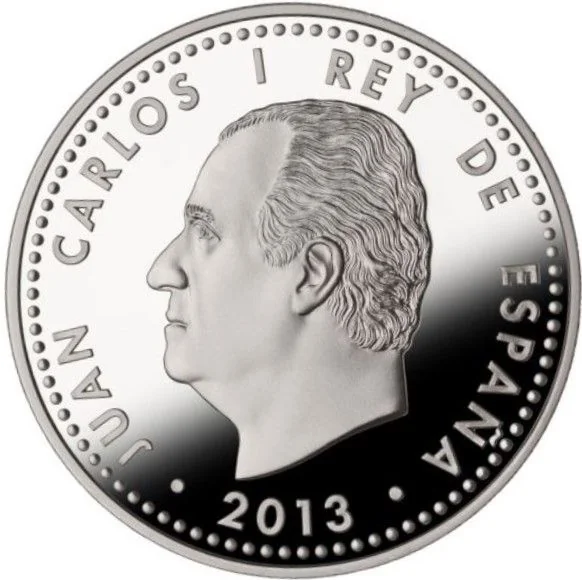
Obverse
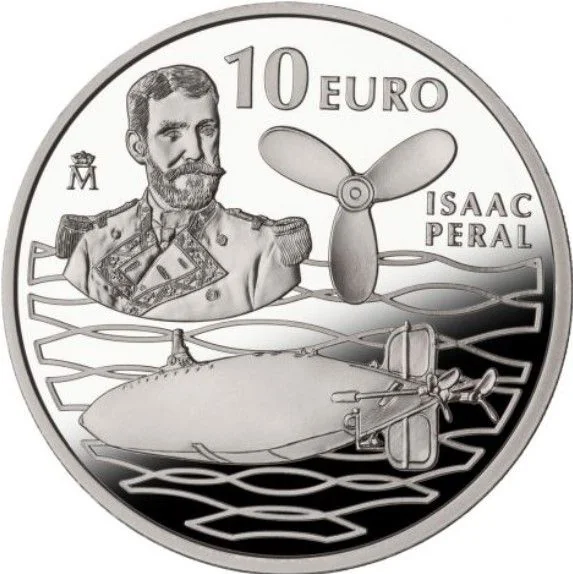
Reverse
Description:
Bust of Isaac Peral with a propeller. Below, his namesake submarine on wavy lines.
Inscription:
10 EURO
M
ISAAC PERAL
M
ISAAC PERAL
Script: Latin
Edge
Reeded
Categories
| Transportation> Watercraft |
| Mustache/Beard |
| Person> Scientist |
Mints
| Name | Mark |
|---|---|
| Royal Mint of Madrid | (M) |
Mintings
| Year | Mint Mark | Mintage | Quality | Collection |
|---|---|---|---|---|
| 2013 | M | 10,000 | Proof |
Historical background
In 2013, Spain was in the midst of a profound economic and banking crisis, but its currency situation was uniquely stable because it was a member of the Eurozone. The country used the euro, having fully adopted it in 2002, which meant it did not have an independent national currency to devalue. This was a double-edged sword: it provided stability and prevented a speculative currency collapse, but it also stripped Spain of the critical tool of monetary devaluation to regain competitiveness against its trading partners. Consequently, the necessary economic adjustments had to occur through a painful internal devaluation—forcing down wages and prices through austerity and high unemployment.
The year was dominated by the aftermath of the 2012 European sovereign debt crisis, with Spain having officially requested a €100 billion European financial assistance package for its banking sector in June of that year. While this averted a full bailout of the state itself, 2013 was a period of stringent conditionality and fiscal consolidation. The government, led by Mariano Rajoy, implemented severe austerity measures and labor market reforms to reduce the budget deficit and address the economy's deep structural issues. The focus was on repairing bank balance sheets, with a comprehensive stress test and restructuring process overseen by the European authorities.
Despite the stable euro, the economic context was dire. Unemployment peaked at over 26% (and above 55% for youth), and the country endured a deep recession with collapsing domestic demand. There was ongoing market pressure on Spanish government bond yields, reflecting fears about sovereign debt sustainability, though these had fallen from their 2012 peaks due to the European Central Bank's pledge to do "whatever it takes" to preserve the euro. The currency situation, therefore, was paradoxically calm on the surface, embedded within the Eurozone's framework, while the underlying economic reality was one of severe distress and a grinding struggle to restore competitiveness without the traditional lever of exchange rate policy.
The year was dominated by the aftermath of the 2012 European sovereign debt crisis, with Spain having officially requested a €100 billion European financial assistance package for its banking sector in June of that year. While this averted a full bailout of the state itself, 2013 was a period of stringent conditionality and fiscal consolidation. The government, led by Mariano Rajoy, implemented severe austerity measures and labor market reforms to reduce the budget deficit and address the economy's deep structural issues. The focus was on repairing bank balance sheets, with a comprehensive stress test and restructuring process overseen by the European authorities.
Despite the stable euro, the economic context was dire. Unemployment peaked at over 26% (and above 55% for youth), and the country endured a deep recession with collapsing domestic demand. There was ongoing market pressure on Spanish government bond yields, reflecting fears about sovereign debt sustainability, though these had fallen from their 2012 peaks due to the European Central Bank's pledge to do "whatever it takes" to preserve the euro. The currency situation, therefore, was paradoxically calm on the surface, embedded within the Eurozone's framework, while the underlying economic reality was one of severe distress and a grinding struggle to restore competitiveness without the traditional lever of exchange rate policy.
✨ Legendary