

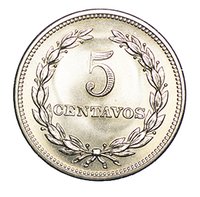
5 Centavos – El Salvador
El Salvador
Context
Years: 1940–1974
Issuer: El Salvador 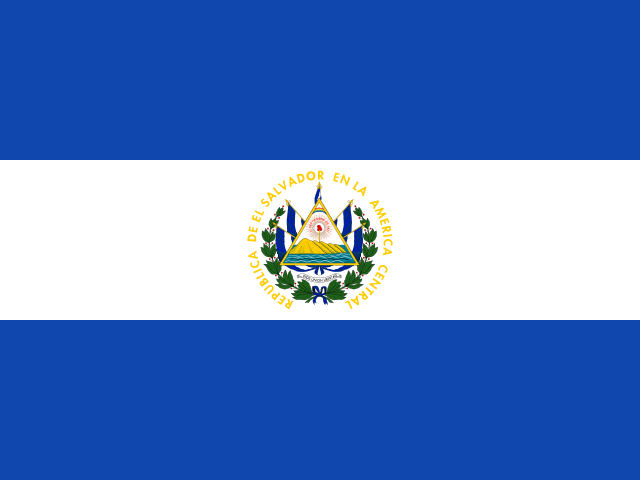
Issuing organization: Central Reserve Bank of El Salvador
Period:
(since 1841)
Currency:
(since 1892)
Demonetization: 1 January 2001
Total mintage: 62,804,000
Material
References
KM: #Click to copy to clipboard134
Numista: #1301
Value
Exchange value: 0.05 SVC
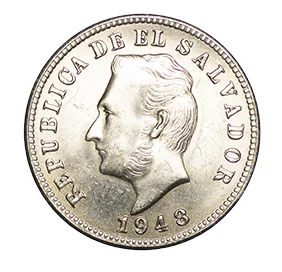
Obverse
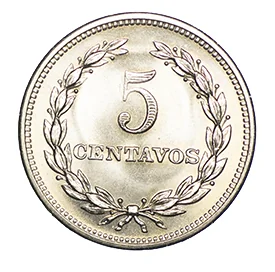
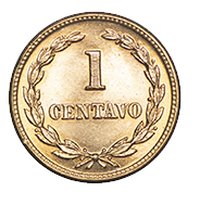
Reverse
Edge
Plain
Categories
| Person> Politician |
| Symbol> Wreath |
Mints
| Name | Mark |
|---|---|
| Royal Mint (Tower Hill) | — |
| Sherritt Mint | — |
| United States Mint of Denver | — |
| United States Mint of Philadelphia | — |
| United States Mint of San Francisco | — |
Mintings
| Year | Mint Mark | Mintage | Quality | Collection |
|---|---|---|---|---|
| 1940 | — | 800,000 | ||
| 1951 | — | 2,000,000 | ||
| 1956 | 1956-1957 | 8,000,000 | ||
| 1961 | — | 6,000,000 | ||
| 1963 | — | 10,000,000 | ||
| 1966 | — | 6,000,000 | ||
| 1967 | — | 10,000,000 | ||
| 1973 | — | 10,000,000 | ||
| 1974 | — | 2,000 | Proof | |
| 1974 | — | 10,002,000 |
Historical background
In 1940, El Salvador's currency system was defined by its adherence to the gold standard and the central role of the Colón, which had been the nation's official currency since 1919. The Colón was pegged to the United States dollar at a fixed rate of 2.5 colones to 1 dollar, a parity established in 1934 and maintained through the management of the Central Reserve Bank of El Salvador, founded in 1934. This peg provided a crucial anchor for stability, especially significant in the wake of the global economic turbulence of the Great Depression, which had severely impacted El Salvador's export-dependent coffee economy.
The period was characterized by monetary conservatism and limited currency in circulation. The economy remained primarily agrarian, with a large subsistence sector, meaning many transactions occurred outside the formal monetary system. Physical currency—silver coins and paper notes—was dominant, and its supply was tightly controlled to defend the dollar peg. This conservative approach prioritized external stability and the interests of the coffee-growing elite over domestic credit expansion or economic diversification, which kept the financial system relatively small and underdeveloped.
Internationally, the outbreak of World War II in 1939 created new pressures and disruptions. While the fixed exchange rate provided a semblance of stability, the war began to disrupt global trade networks, affecting the prices and export routes for Salvadoran coffee. Furthermore, the U.S. dollar itself had undergone a devaluation and left the classical gold standard in 1933-34, meaning the Colón was effectively pegged to a managed currency rather than a direct gold commodity. Thus, by 1940, El Salvador's currency situation was one of fragile, externally-oriented stability, with its underlying foundations becoming increasingly dependent on U.S. monetary policy and vulnerable to the escalating shocks of a world at war.
The period was characterized by monetary conservatism and limited currency in circulation. The economy remained primarily agrarian, with a large subsistence sector, meaning many transactions occurred outside the formal monetary system. Physical currency—silver coins and paper notes—was dominant, and its supply was tightly controlled to defend the dollar peg. This conservative approach prioritized external stability and the interests of the coffee-growing elite over domestic credit expansion or economic diversification, which kept the financial system relatively small and underdeveloped.
Internationally, the outbreak of World War II in 1939 created new pressures and disruptions. While the fixed exchange rate provided a semblance of stability, the war began to disrupt global trade networks, affecting the prices and export routes for Salvadoran coffee. Furthermore, the U.S. dollar itself had undergone a devaluation and left the classical gold standard in 1933-34, meaning the Colón was effectively pegged to a managed currency rather than a direct gold commodity. Thus, by 1940, El Salvador's currency situation was one of fragile, externally-oriented stability, with its underlying foundations becoming increasingly dependent on U.S. monetary policy and vulnerable to the escalating shocks of a world at war.
🌱 Very Common