

500 Lire – Vatican City
Non-circulating coins
Commemoration: Book of the Evangelists
Vatican City
Context
Year: 1977
Issuer: Vatican City 
Ruler: Paul VI
Currency:
(1929—2001)
Demonetized: Yes
Total mintage: 160,000
Material
References
KM: #Click to copy to clipboard132
Numista: #13007
Value
Exchange value: 500 VAL
Bullion value: $25.98
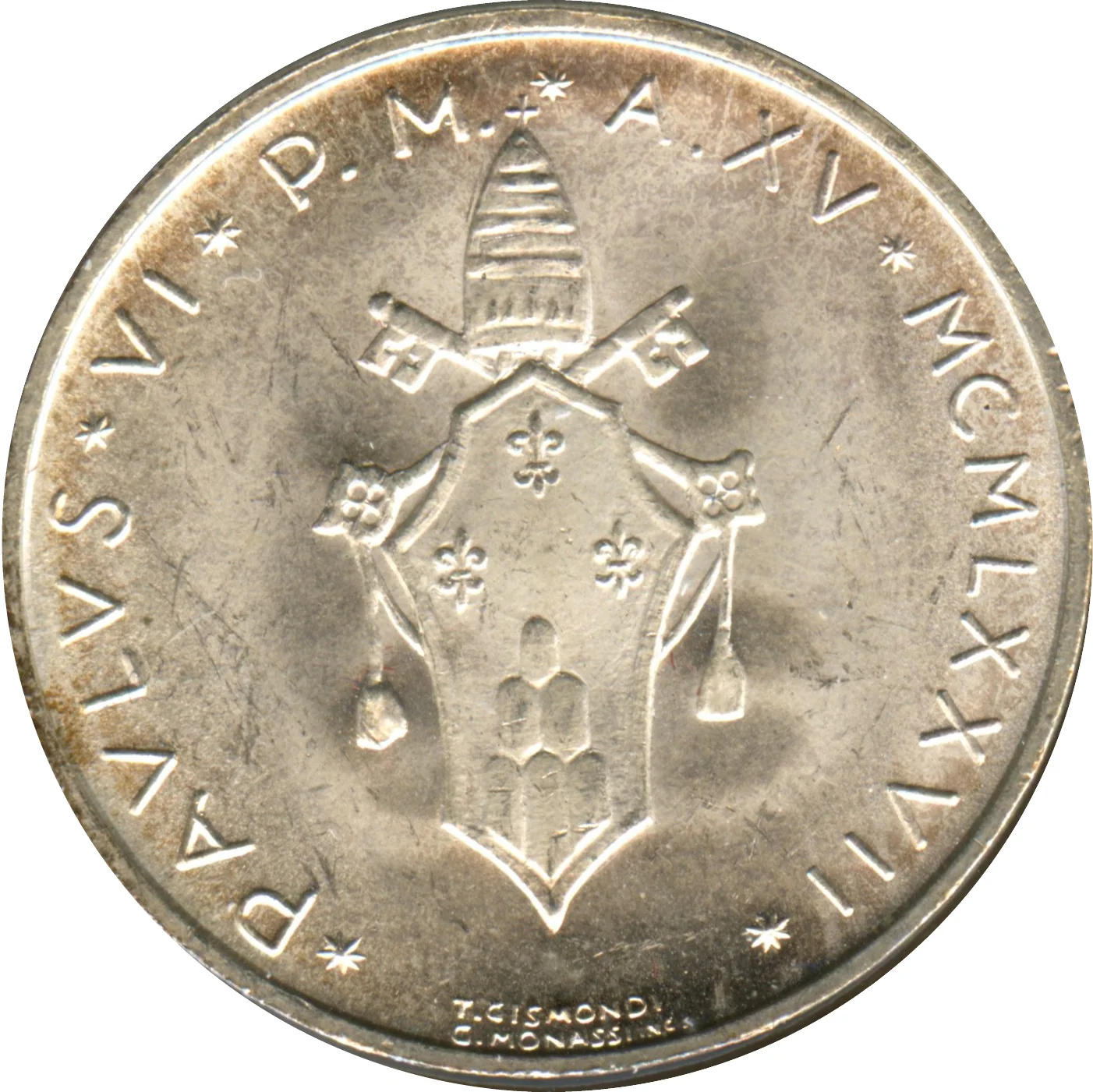
Obverse
Description:
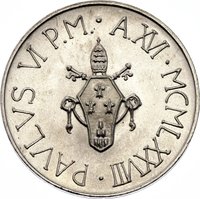
Pope VI's crowned shield with date beside.
Inscription:
·PAVLVS·VI·P.M. A.XV·MCMLXXVII·
Script: Latin
Engraver: Tomas Gismondi
Reverse
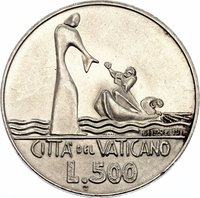
Description:
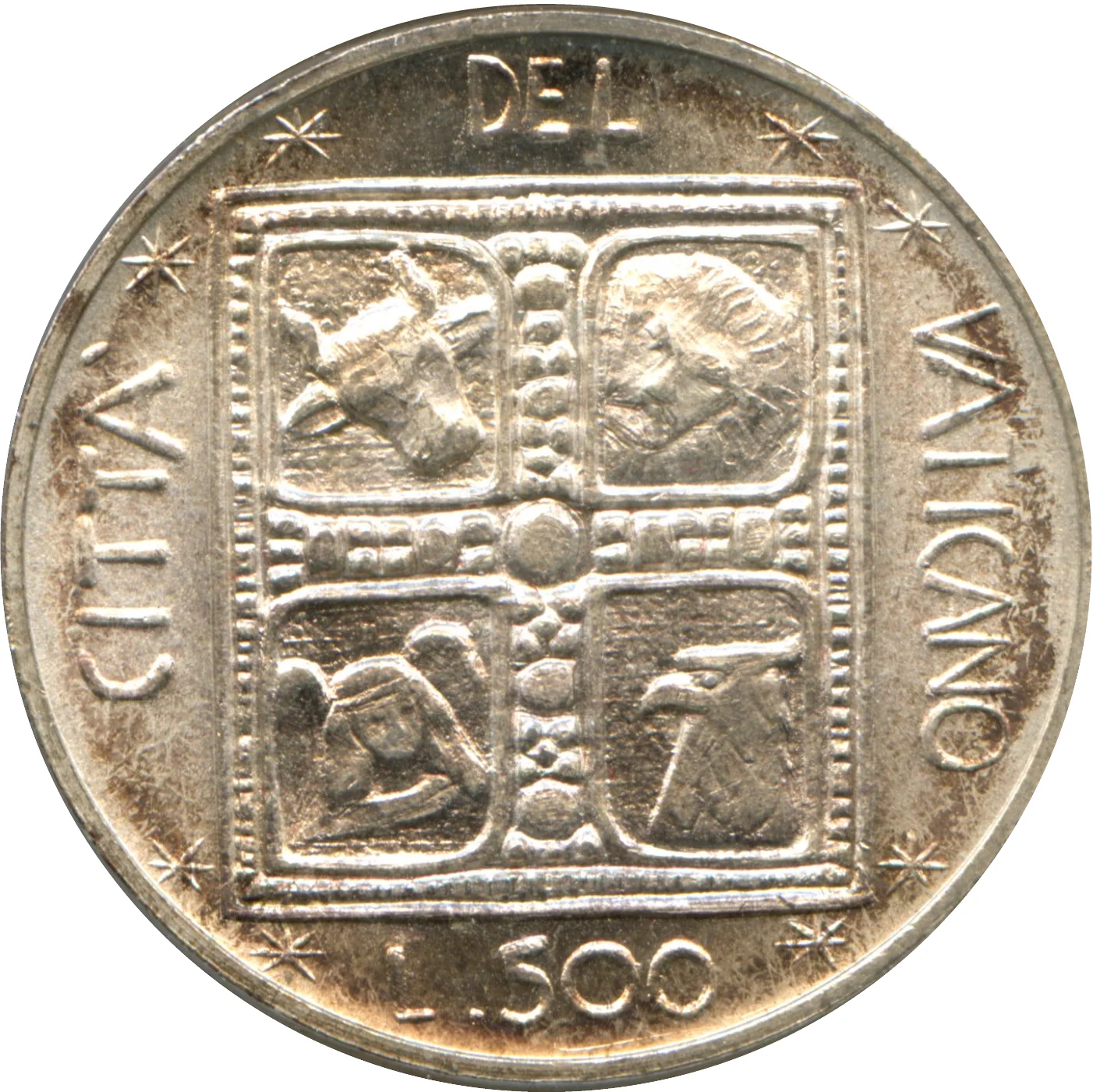
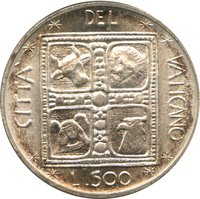
Animal heads in the cross frame symbolize the four evangelists: the ox (Luke), lion (Mark), man (Matthew), and eagle (John), with the denomination below.
Inscription:
CITTA' DEL VATICANO
L.500
L.500
Translation:
Vatican City
500 Lire
500 Lire
Script: Latin
Language: Italian
Engraver: Tomas Gismondi
Edge
Lettering
Legend:
IN . NOMINE . DOMINI - 3 CROSSES
Translation:
In the name of the Lord
Language: Latin
Mints
| Name | Mark |
|---|---|
| Rome | — |
Mintings
| Year | Mint Mark | Mintage | Quality | Collection |
|---|---|---|---|---|
| 1977 | — | 160,000 |
Historical background
In 1977, Vatican City's currency situation was defined by its unique status as a sovereign city-state without an independent monetary system. Following the 1929 Lateran Treaty, Italy granted the Vatican the right to issue its own coinage, the Vatican lira, which was pegged at par and fully interchangeable with the Italian lira. This arrangement meant the Vatican's economy was entirely integrated into the Italian monetary zone, using the Italian lira as its de facto circulating currency for everyday transactions, while minting limited quantities of its own commemorative and low-denomination coins for collectors and symbolic purposes.
The primary function of Vatican coinage in this period was not economic sovereignty but rather numismatic and symbolic. The Vatican lira coins, minted by the Italian State Polygraphic Institute and Mint (IPZS), featured distinctive designs with the image of Pope Paul VI and themes reflecting the Church's identity. These coins were legal tender within Vatican City and, by agreement, in Italy, but their main destination was the thriving international collectors' market. Revenue from the sale of these special coin sets to collectors formed a notable, though modest, stream of income for the city-state's budget.
This dependent monetary relationship was stable but highlighted the Vatican's practical economic constraints. With no central bank or paper currency of its own, its financial operations relied on the Italian system. This backdrop set the stage for significant future changes, as Italy's own economic turbulence in the late 1970s and its eventual adoption of the Euro decades later would necessitate major renegotiations of the Vatican's monetary agreements to preserve its minting rights within new European frameworks.
The primary function of Vatican coinage in this period was not economic sovereignty but rather numismatic and symbolic. The Vatican lira coins, minted by the Italian State Polygraphic Institute and Mint (IPZS), featured distinctive designs with the image of Pope Paul VI and themes reflecting the Church's identity. These coins were legal tender within Vatican City and, by agreement, in Italy, but their main destination was the thriving international collectors' market. Revenue from the sale of these special coin sets to collectors formed a notable, though modest, stream of income for the city-state's budget.
This dependent monetary relationship was stable but highlighted the Vatican's practical economic constraints. With no central bank or paper currency of its own, its financial operations relied on the Italian system. This backdrop set the stage for significant future changes, as Italy's own economic turbulence in the late 1970s and its eventual adoption of the Euro decades later would necessitate major renegotiations of the Vatican's monetary agreements to preserve its minting rights within new European frameworks.
🌱 Fairly Common