

5 Kronor (Gustav VI Adolf) – Sweden
Non-circulating coins
Commemoration: 80th Anniversary of the Birth of Gustav VI Adolf
Sweden
Context
Material
References
KM: #Click to copy to clipboard838
Numista: #12996
Value
Exchange value: 5 SEK = $0.55
Inflation-adjusted value: 73.90 SEK
Obverse
Description:
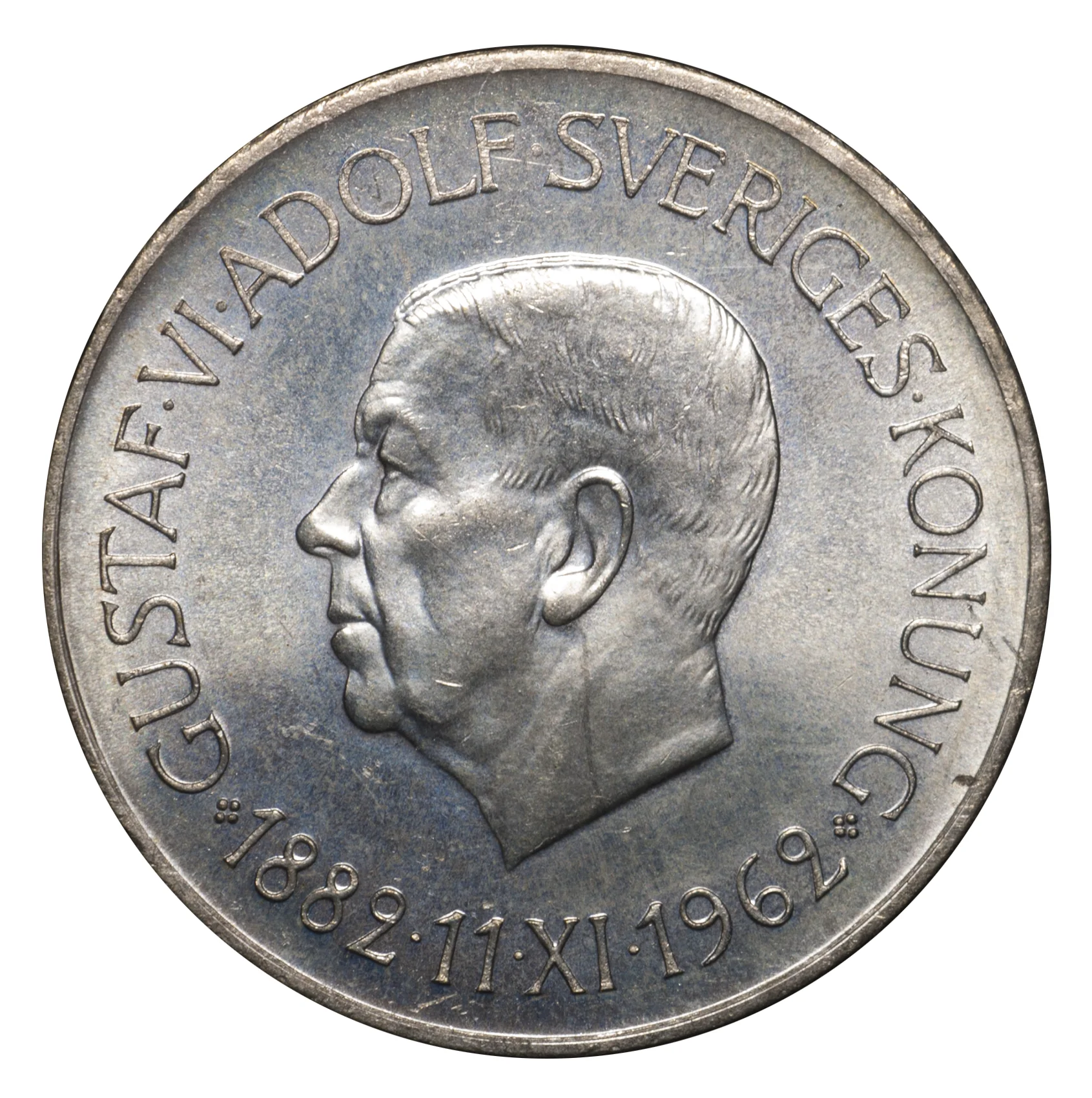
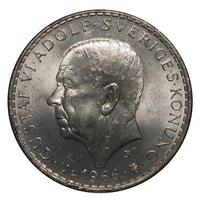
Portrait of King Gustav VI Adolf facing left, encircled by an inscription.
Inscription:
GUSTAF·VI·ADOLF·SVERIGES·KONUNG
+1882·11·XI·1962+
+1882·11·XI·1962+
Translation:
GUSTAF VI ADOLF SWEDEN'S KING
+1882 11 XI 1962+
+1882 11 XI 1962+
Script: Latin
Language: Swedish
Engraver: Léo Holmgren
Reverse
Description:
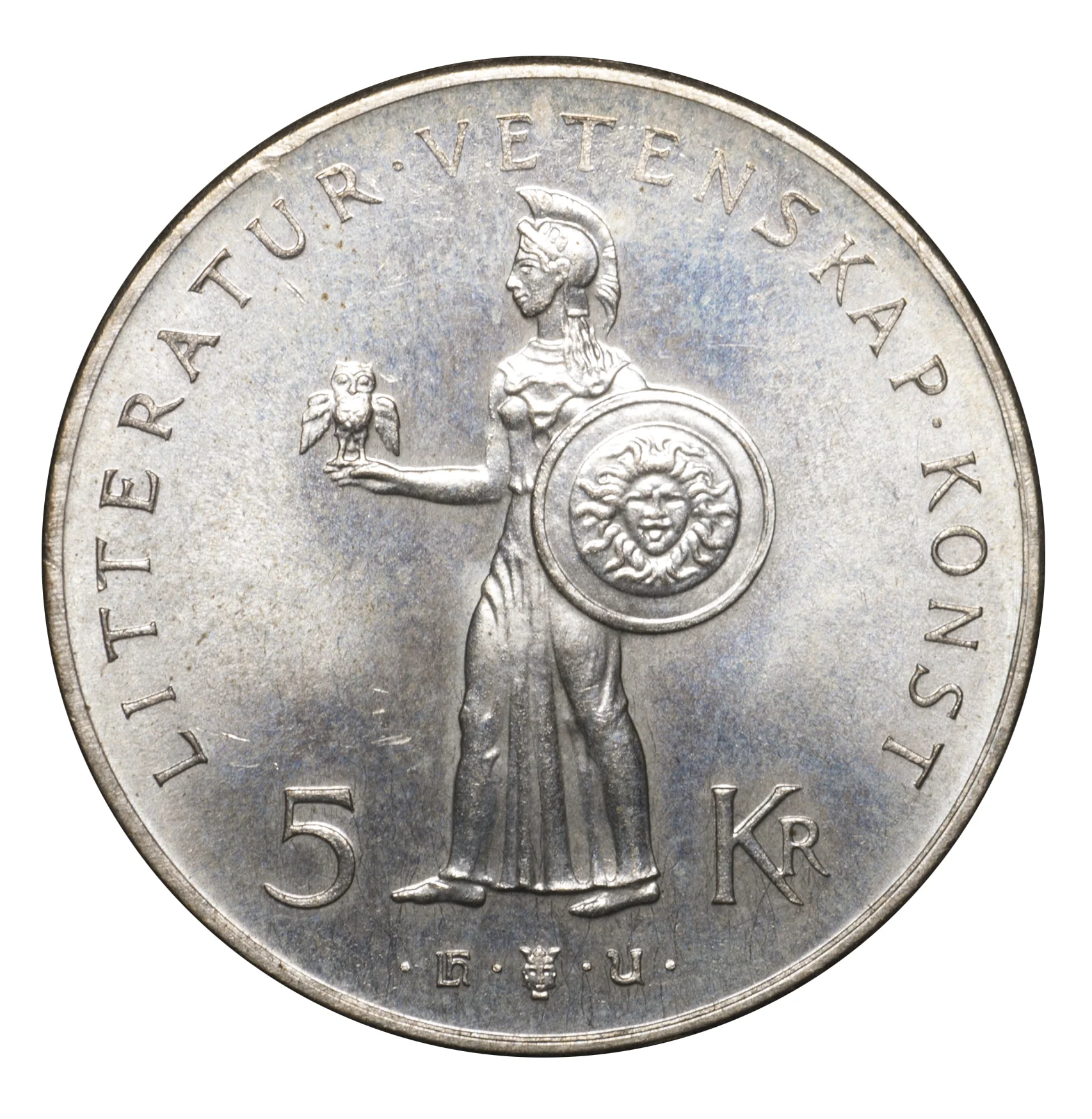
Athena standing with shield in left hand and owl on right forearm. Value at her feet, mintmark below, flanked by artist monogram and governor's initial.
Inscription:
LITTERATUR · VETENSKAP · KONST
5 KR
·Lh· ·u·
5 KR
·Lh· ·u·
Translation:
LITERATURE · SCIENCE · ART
5 KR
·Lh· ·u·
5 KR
·Lh· ·u·
Script: Latin
Language: Swedish
Engraver: Léo Holmgren
Edge
Uneven reeding.
Categories
| Event> Birth anniversary |
| Mythology |
Mints
| Name | Mark |
|---|---|
| Kungliga Myntet | — |
Mintings
| Year | Mint Mark | Mintage | Quality | Collection |
|---|---|---|---|---|
| 1962 | — | 159,575 |
Historical background
In 1962, Sweden operated under the Bretton Woods system of fixed exchange rates, with the Swedish krona pegged to the US dollar. This meant the Riksbank, Sweden's central bank, was obligated to maintain the krona's value within a narrow band, primarily by buying and selling foreign currency reserves. The period was characterized by a focus on maintaining internal economic stability—specifically full employment and steady growth—while managing the constraints of the external peg. This sometimes created tension, as domestic expansionary policies could lead to trade deficits and pressure on the fixed exchange rate.
The early 1960s were a time of strong economic performance and optimism in Sweden, part of the global "Golden Age" of capitalism. However, this prosperity also fostered rising wages and domestic demand, which increased imports. By 1962, Sweden began to experience a deteriorating current account balance. While not yet a crisis, this trend signaled the growing challenge of reconciling a booming domestic economy with the discipline required by a fixed exchange rate regime. Policymakers were increasingly attentive to the balance of payments, as persistent deficits could deplete currency reserves and force a devaluation.
Consequently, 1962 fell within a period of cautious monetary management, where the Riksbank had to carefully calibrate interest rates and credit policies. The goal was to cool domestic demand just enough to protect the external balance without triggering a recession. This delicate balancing act was the defining feature of Swedish currency policy at the time, setting the stage for the more pronounced economic and political debates over devaluation that would emerge later in the decade, ultimately leading to Sweden's departure from the dollar peg in 1971.
The early 1960s were a time of strong economic performance and optimism in Sweden, part of the global "Golden Age" of capitalism. However, this prosperity also fostered rising wages and domestic demand, which increased imports. By 1962, Sweden began to experience a deteriorating current account balance. While not yet a crisis, this trend signaled the growing challenge of reconciling a booming domestic economy with the discipline required by a fixed exchange rate regime. Policymakers were increasingly attentive to the balance of payments, as persistent deficits could deplete currency reserves and force a devaluation.
Consequently, 1962 fell within a period of cautious monetary management, where the Riksbank had to carefully calibrate interest rates and credit policies. The goal was to cool domestic demand just enough to protect the external balance without triggering a recession. This delicate balancing act was the defining feature of Swedish currency policy at the time, setting the stage for the more pronounced economic and political debates over devaluation that would emerge later in the decade, ultimately leading to Sweden's departure from the dollar peg in 1971.
🌱 Fairly Common