

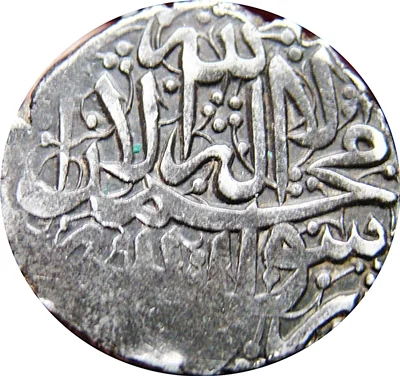
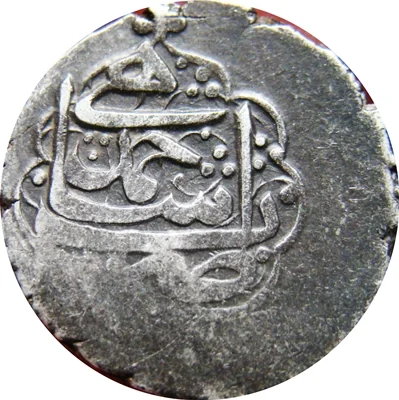
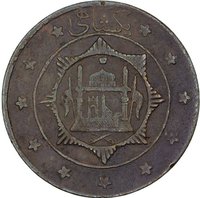
1 Rupee – Afghanistan
Afghanistan
Context
Material
Diameter: 24.13 mm
Weight: 9 g
Silver weight: 9.00 g
Shape: Irregular round
Composition: Silver
Magnetic: No
References
KM: #Click to copy to clipboard168
Numista: #104898
Value
Bullion value: $25.56
Mints
| Name | Mark |
|---|---|
| Ahmadshahi | — |
Mintings
| Year | Mint Mark | Mintage | Quality | Collection |
|---|---|---|---|---|
| 1827 | — | — | ||
| 1828 | — | — | ||
| 1829 | — | — | ||
| 1830 | — | — | ||
| 1831 | — | — | ||
| 1832 | — | — | ||
| 1833 | — | — | ||
| 1834 | — | — | ||
| 1835 | — | — | ||
| 1836 | — | — | ||
| 1837 | — | — | ||
| 1838 | — | — | ||
| 1838 | — | — |
Historical background
In 1827, Afghanistan existed not as a unified nation-state but as a decentralized confederation of rival principalities and tribal territories, most notably the Emirate of Kabul under Dost Mohammad Khan and the Durrani heartlands of Kandahar under his half-brothers. Consequently, there was no single, standardized national currency. The monetary system was a complex and fragmented mosaic, reflecting the region's political divisions and its historic role as a crossroads of trade. The primary circulating medium was the Kabuli rupee, a silver coin, but its weight, purity, and value could vary significantly between different mints and rulers, leading to chronic instability in exchange.
This period was one of intense internal power struggle following the collapse of the Durrani Empire, and coinage was a key instrument of sovereignty and propaganda. Local khans and emirs minted their own coins to assert authority and finance their militias. Alongside these local issues, a vast array of foreign coins circulated freely, a testament to Afghanistan's position on the Silk Road. Indian rupees (from Sikh Punjab and British-controlled territories), Persian krans, and even older Mughal mohurs and Bukharan tangas were all used in commerce, valued by their intrinsic silver or gold content rather than by a central banking authority.
The lack of a uniform currency posed significant challenges to trade and state-building. Merchants and money-changers (sarafs) were essential figures, arbitrating values between a bewildering variety of coins. For Dost Mohammad Khan, consolidating control over the minting of coins was as crucial a political objective as controlling territory or armies. The currency situation in 1827, therefore, was a direct reflection of the country's fractured polity—a tangible symbol of the economic disunity that would persist until a stronger central power could impose a standardized monetary system across the region.
This period was one of intense internal power struggle following the collapse of the Durrani Empire, and coinage was a key instrument of sovereignty and propaganda. Local khans and emirs minted their own coins to assert authority and finance their militias. Alongside these local issues, a vast array of foreign coins circulated freely, a testament to Afghanistan's position on the Silk Road. Indian rupees (from Sikh Punjab and British-controlled territories), Persian krans, and even older Mughal mohurs and Bukharan tangas were all used in commerce, valued by their intrinsic silver or gold content rather than by a central banking authority.
The lack of a uniform currency posed significant challenges to trade and state-building. Merchants and money-changers (sarafs) were essential figures, arbitrating values between a bewildering variety of coins. For Dost Mohammad Khan, consolidating control over the minting of coins was as crucial a political objective as controlling territory or armies. The currency situation in 1827, therefore, was a direct reflection of the country's fractured polity—a tangible symbol of the economic disunity that would persist until a stronger central power could impose a standardized monetary system across the region.

💎 Extremely Rare