

100 lire – Vatican City
Add to wishlist
Circulating commemorative coins
Commemoration: The Creation
Vatican City
Context
Year: 1983
Issuer: Vatican City
Ruler: John Paul II
Currency:
(1929—2001)
Demonetization: 1 March 2002
Total mintage: 358,500
Material
Diameter: 27.75 mm
Weight: 8 g
Thickness: 2 mm
Shape: Round
Composition: Stainless steel
Technique: Milled
Alignment: Coin alignment
flip
References
KM: #
Numista: #12939
Value
Exchange value: 100 VAL
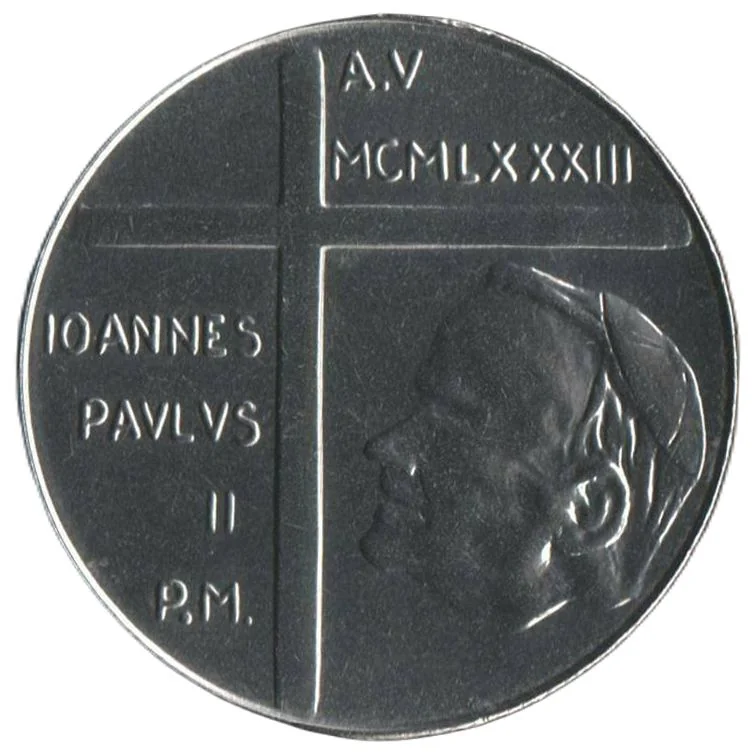
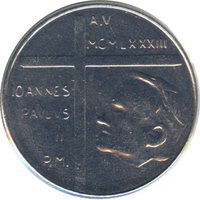
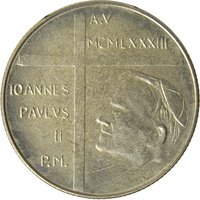
Obverse
Description:
Left to lower right of a cross.
Inscription:
A.V MCMLXXXIII
IONNAES PAVLVS II
P.M.
IONNAES PAVLVS II
P.M.
Translation:
Year of our Lord 1983
John Paul II
Supreme Pontiff
John Paul II
Supreme Pontiff
Script: Latin
Language: Latin
Engraver: Enrico Manfrini
Designer: Nicola Morelli
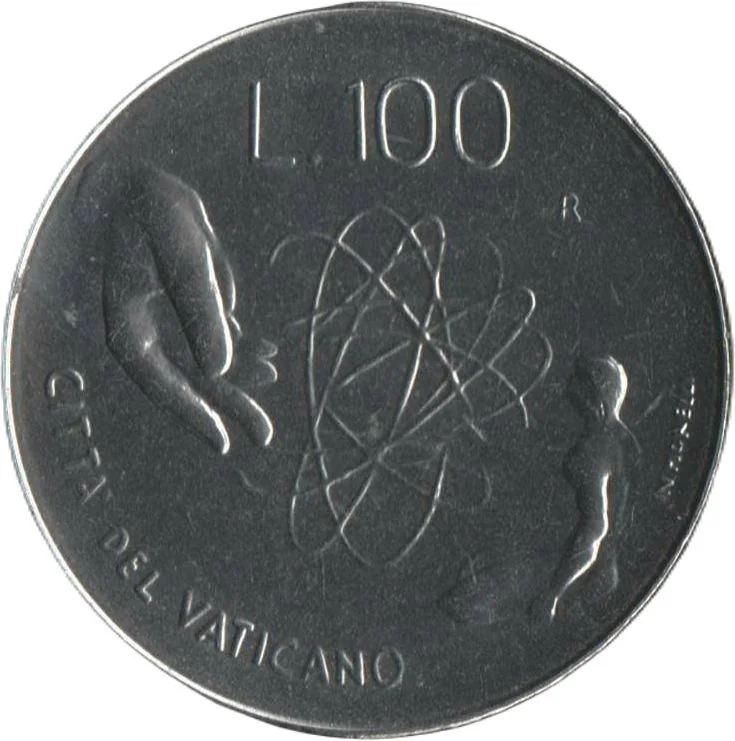
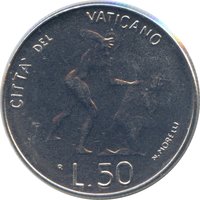
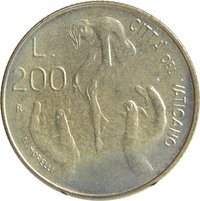
Reverse
Description:
The God hand offers humanity the atom’s circular design.
Inscription:
L. 100 R
CITTA' DEL VATICANO
CITTA' DEL VATICANO
Translation:
Vatican City State
L. 100 R
L. 100 R
Script: Latin
Language: Italian
Engraver: Enrico Manfrini
Designer: Nicola Morelli
Edge
Reeded
Categories
| Religion> Religious objects |
| Science |
| Symbol> Cross |
| Person> Religious figure |
| Symbol> Hand |
Mints
| Name | Mark |
|---|---|
| Rome | R |
Mintings
| Year | Mint Mark | Mintage | Quality | Collection |
|---|---|---|---|---|
| 1983 | — | 358,500 |
Historical background
In 1983, Vatican City's currency situation was fundamentally defined by two key international agreements: the Lateran Treaty of 1929 with Italy and a subsequent monetary convention with the Italian Republic. The Lateran Treaty granted the Holy See the right to issue its own coinage, a sovereign privilege exercised through the Vatican City State. However, for practical economic integration, a 1930 Monetary Convention established that Vatican lire were legal tender within Italy and the Republic of San Marino, and vice-versa. This created a fixed, one-to-one parity between the Vatican lira and the Italian lira, effectively making the Vatican's currency a nationally distinct but economically dependent subset of the Italian monetary system.
The practical issuance of currency in 1983 was governed by a revised monetary convention signed with Italy in 1979. This agreement strictly limited the annual minting of Vatican coinage based on the state's perceived numismatic and internal needs, capping the face value at a set number of billion lire per year. The coins, minted by Italy's Istituto Poligrafico e Zecca dello Stato, were primarily intended for collectors and tourists, serving as important sources of revenue and as vehicles of papal iconography. While legal tender, Vatican coins rarely circulated in everyday commerce within Italy; their value often exceeded their face value due to their collectible status, especially following the death of a pope or the start of a new pontificate.
Therefore, in 1983, the Vatican had no independent monetary policy or separate paper currency. It used Italian banknotes for all larger transactions, while its own minted coins held a dual identity as both functional currency (at par with the Italian lira) and sovereign commemorative objects. This arrangement ensured the Vatican's seamless participation in the Italian economy while symbolically upholding its sovereignty, a delicate balance maintained until the introduction of the Euro in 2002, which required a new set of agreements.
The practical issuance of currency in 1983 was governed by a revised monetary convention signed with Italy in 1979. This agreement strictly limited the annual minting of Vatican coinage based on the state's perceived numismatic and internal needs, capping the face value at a set number of billion lire per year. The coins, minted by Italy's Istituto Poligrafico e Zecca dello Stato, were primarily intended for collectors and tourists, serving as important sources of revenue and as vehicles of papal iconography. While legal tender, Vatican coins rarely circulated in everyday commerce within Italy; their value often exceeded their face value due to their collectible status, especially following the death of a pope or the start of a new pontificate.
Therefore, in 1983, the Vatican had no independent monetary policy or separate paper currency. It used Italian banknotes for all larger transactions, while its own minted coins held a dual identity as both functional currency (at par with the Italian lira) and sovereign commemorative objects. This arrangement ensured the Vatican's seamless participation in the Italian economy while symbolically upholding its sovereignty, a delicate balance maintained until the introduction of the Euro in 2002, which required a new set of agreements.
🌱 Common