

5 Francs (Treaty of Stans) – Switzerland
Non-circulating coins
Commemoration: 500th anniversary of the Treaty of Stans
Switzerland
Context

Material
References
KM: #Click to copy to clipboard60
Numista: #12910
Value
Exchange value: 5 CHF = $6.46
Inflation-adjusted value: 9.81 CHF
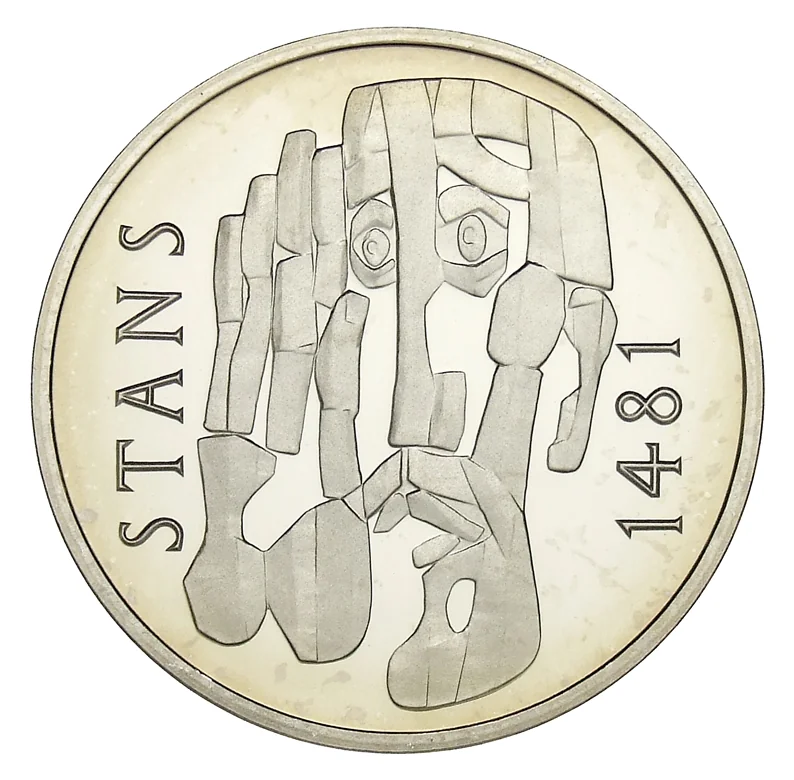
Obverse
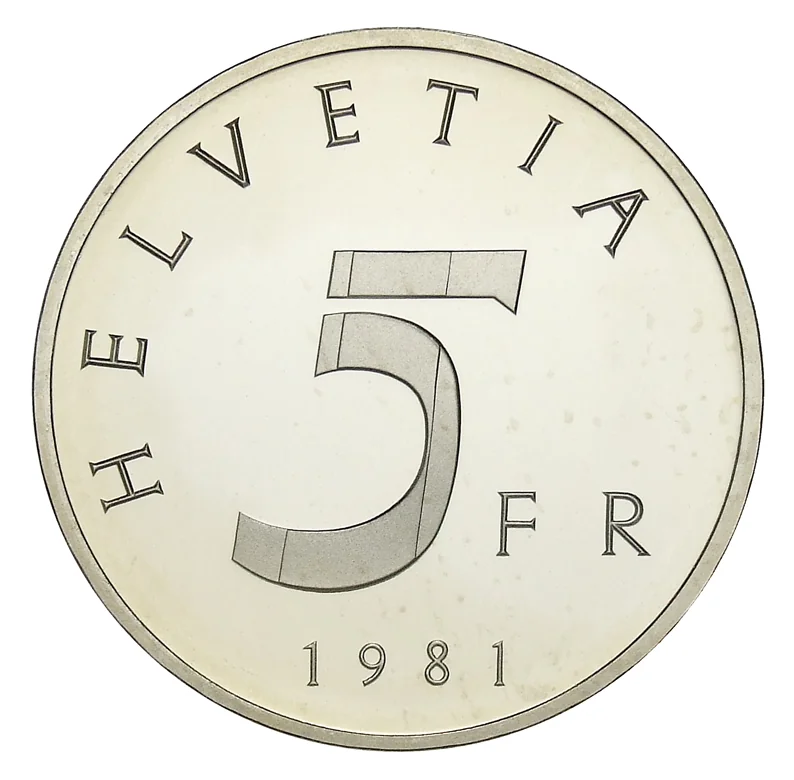
Reverse
Description:
Stylized male head, hand raised in oath.
Inscription:
STANS
1481
1481
Script: Latin
Designer: Kurt Wirth
Edge
Embossed inscription
Legend:
🟉🟉🟉 DOMINUS | PROVIDEBIT | 🟉🟉🟉🟉🟉🟉🟉🟉🟉🟉 |
Translation:
THE LORD WILL PROVIDE
Language: Latin
Mints
| Name | Mark |
|---|---|
| Bern | — |
Mintings
| Year | Mint Mark | Mintage | Quality | Collection |
|---|---|---|---|---|
| 1981 | — | 900,000 | ||
| 1981 | — | 50,260 | Proof |
Historical background
In 1981, Switzerland's currency situation was dominated by the persistent strength of the Swiss franc (CHF), a trend that had intensified throughout the 1970s. The franc was perceived globally as a premier "safe-haven" currency, attracting massive capital inflows due to Switzerland's political neutrality, low inflation, and renowned banking sector. This demand created significant upward pressure on the franc's value, which Swiss National Bank (SNB) officials viewed as problematic, as it hurt the competitiveness of the country's vital export and tourism sectors by making Swiss goods and services more expensive abroad.
The primary tool for managing this was the SNB's focus on controlling the growth of the monetary base (M0) to restrain inflation, which was relatively low by international standards but still a domestic concern. However, direct foreign exchange interventions to weaken the franc were used sparingly and seen as largely ineffective against market forces. Instead, the bank employed a policy of negative interest rates on foreign-held franc deposits—a highly unusual measure at the time—to deter speculative inflows. This period was also marked by the increasing influence of the Deutsche Mark, as the economic fortunes of Switzerland and West Germany were closely linked.
Consequently, Swiss monetary policy in 1981 was characterized by a difficult balancing act. The SNB aimed to maintain price stability and curb franc appreciation without resorting to measures that would spur domestic money supply growth and inflation. This environment of a "highly valued" franc created sustained challenges for Swiss industry and shaped a cautious, stability-oriented policy approach that would define the country's monetary framework for years to come.
The primary tool for managing this was the SNB's focus on controlling the growth of the monetary base (M0) to restrain inflation, which was relatively low by international standards but still a domestic concern. However, direct foreign exchange interventions to weaken the franc were used sparingly and seen as largely ineffective against market forces. Instead, the bank employed a policy of negative interest rates on foreign-held franc deposits—a highly unusual measure at the time—to deter speculative inflows. This period was also marked by the increasing influence of the Deutsche Mark, as the economic fortunes of Switzerland and West Germany were closely linked.
Consequently, Swiss monetary policy in 1981 was characterized by a difficult balancing act. The SNB aimed to maintain price stability and curb franc appreciation without resorting to measures that would spur domestic money supply growth and inflation. This environment of a "highly valued" franc created sustained challenges for Swiss industry and shaped a cautious, stability-oriented policy approach that would define the country's monetary framework for years to come.
🌱 Fairly Common