

5 Francs – Switzerland
Non-circulating coins
Commemoration: Zurich Exposition
Switzerland
Context
Year: 1939
Issuer: Switzerland 
Period:
(since 1848)
Currency:
(since 1850)
Demonetization: 30 November 1939
Total mintage: 60,250
Material
References
KM: #Click to copy to clipboard43
Numista: #12902
Value
Exchange value: 5 CHF = $6.46
Bullion value: $47.31
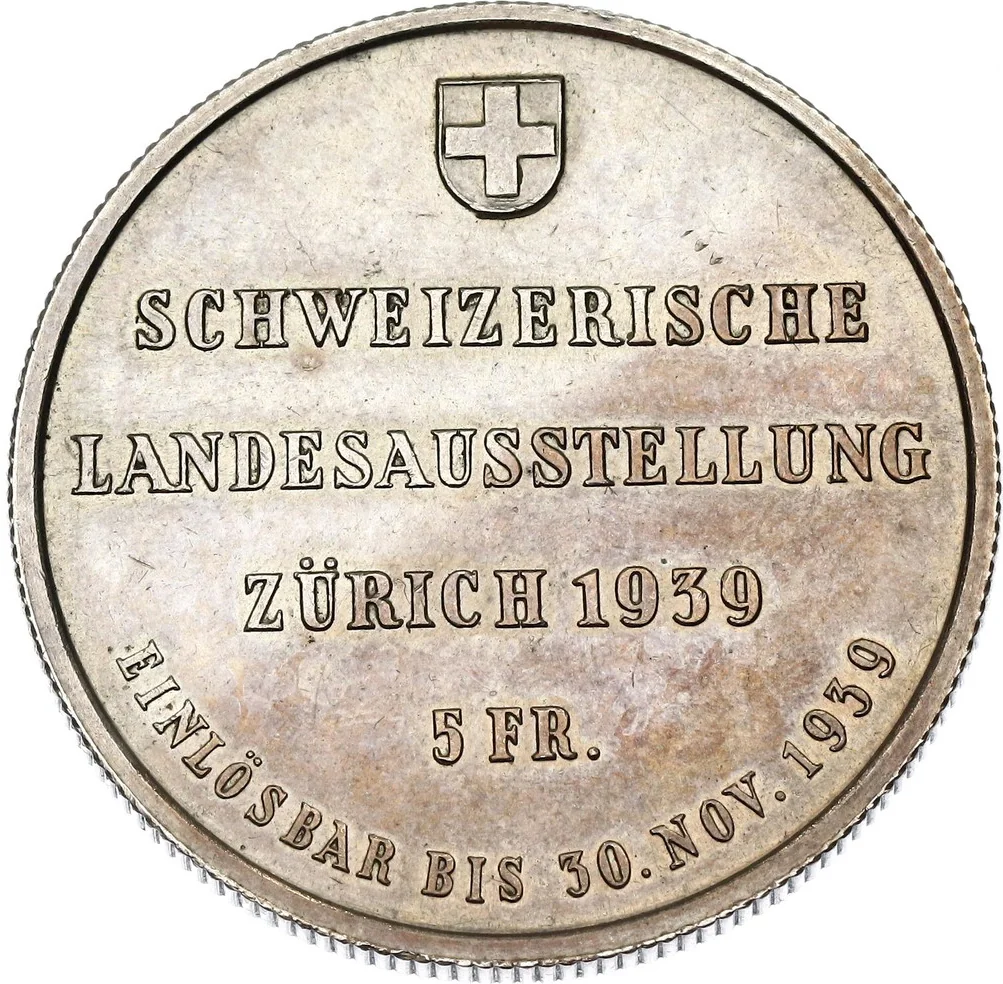
Obverse
Description:
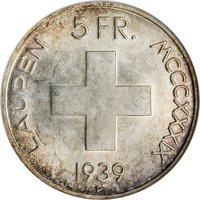
Swiss coat of arms on a square shield with a four-line legend below.
Inscription:
SCHWEIZERISCHE
LANDESAUSSTELLUNG
ZÜRICH 1939
5 FR .
EINLÖSBAR BIS 30 . NOV . 1939
LANDESAUSSTELLUNG
ZÜRICH 1939
5 FR .
EINLÖSBAR BIS 30 . NOV . 1939
Translation:
Swiss National Exhibition
Zurich 1939
5 Francs
Redeemable until 30 Nov. 1939
Zurich 1939
5 Francs
Redeemable until 30 Nov. 1939
Script: Latin
Language: German
Designer: Franz Fischer
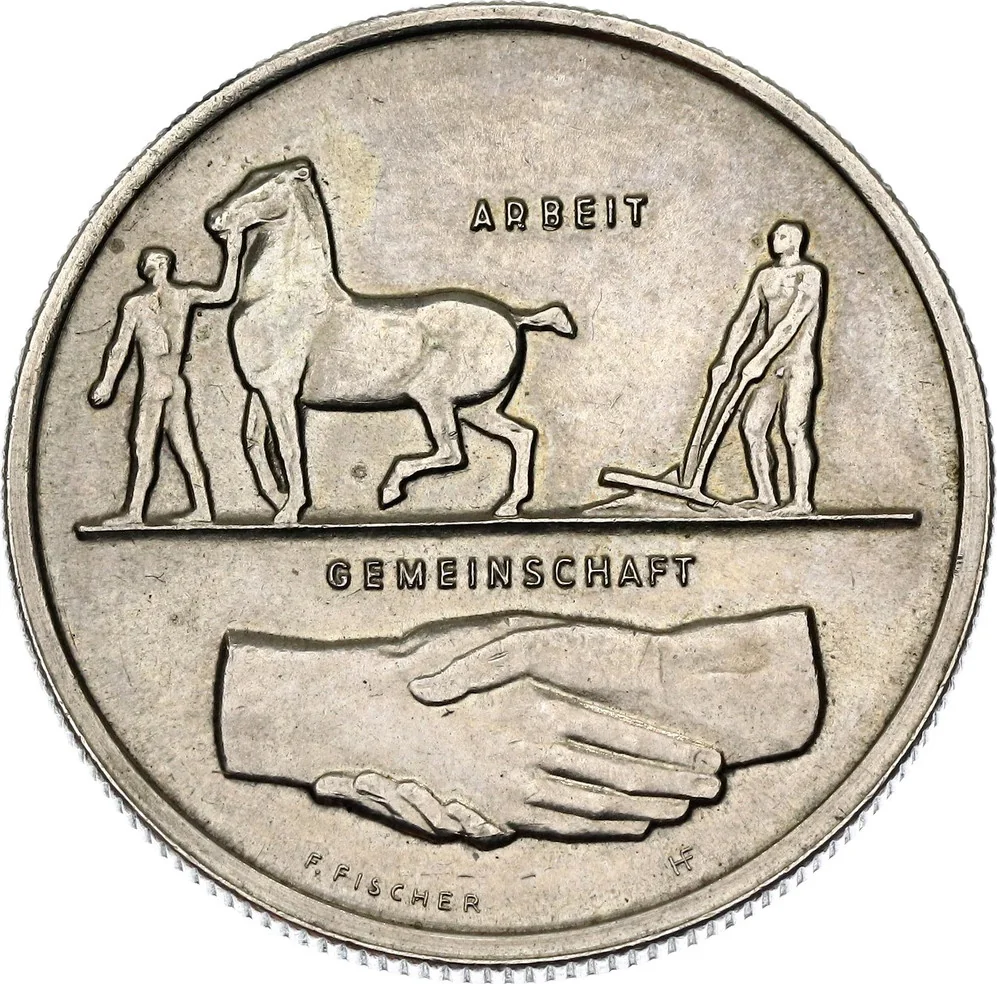
Reverse
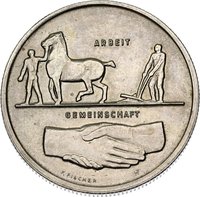
Description:
Horse and plough, two figures, facing left.
Inscription:
ARBEIT
GEMEINSCHAFT
F . FISCHER HF
GEMEINSCHAFT
F . FISCHER HF
Translation:
WORK
COMMUNITY
F. FISCHER HF
COMMUNITY
F. FISCHER HF
Script: Latin
Language: German
Designer: Franz Fischer
Edge
Categories
| Agriculture |
| Animal> Horse |
| Symbol> Hand |
Mints
| Name | Mark |
|---|---|
| Huguenin | HF |
Historical background
In 1939, Switzerland's currency situation was defined by its precarious neutrality at the outbreak of World War II. The Swiss franc (CHF) was, and remains, a key global safe-haven currency, but this status was under severe strain. The Swiss National Bank (SNB) had abandoned the gold standard in 1936, following other nations, and instead pegged the franc to the French franc. This link was abruptly severed in September 1939, as the SNB moved to insulate the country from the imminent currency instability of its belligerent neighbors. The primary fear was massive capital flight from warring nations into Switzerland, which would cause an uncontrollable appreciation of the franc and devastate the vital export sector.
To manage this crisis, the Swiss government and the SNB implemented a comprehensive system of capital controls and economic warfare legislation within days of the war's start. The most critical measure was the requirement that all foreign currency inflows be surrendered to the SNB. This created a dual-currency system: a "free" franc for internal use and a controlled, lower-valued "payment" franc for international transactions. This mechanism allowed the authorities to prevent hot money from distorting the domestic economy, accumulate crucial foreign reserves (especially gold), and control the exchange rate to support Swiss trade.
Thus, on the eve of war, the Swiss franc was not freely convertible. Its stability was artificially maintained by a strict regulatory framework designed as a defensive economic bulwark. The SNB's goal was not to set a strong franc, but to ensure a stable and competitively priced currency to secure essential imports like food and coal, while preventing the economy from being destabilized by the vast financial currents of a continent at war. This controlled system would define Switzerland's monetary policy throughout the conflict.
To manage this crisis, the Swiss government and the SNB implemented a comprehensive system of capital controls and economic warfare legislation within days of the war's start. The most critical measure was the requirement that all foreign currency inflows be surrendered to the SNB. This created a dual-currency system: a "free" franc for internal use and a controlled, lower-valued "payment" franc for international transactions. This mechanism allowed the authorities to prevent hot money from distorting the domestic economy, accumulate crucial foreign reserves (especially gold), and control the exchange rate to support Swiss trade.
Thus, on the eve of war, the Swiss franc was not freely convertible. Its stability was artificially maintained by a strict regulatory framework designed as a defensive economic bulwark. The SNB's goal was not to set a strong franc, but to ensure a stable and competitively priced currency to secure essential imports like food and coal, while preventing the economy from being destabilized by the vast financial currents of a continent at war. This controlled system would define Switzerland's monetary policy throughout the conflict.
🌟 Uncommon