

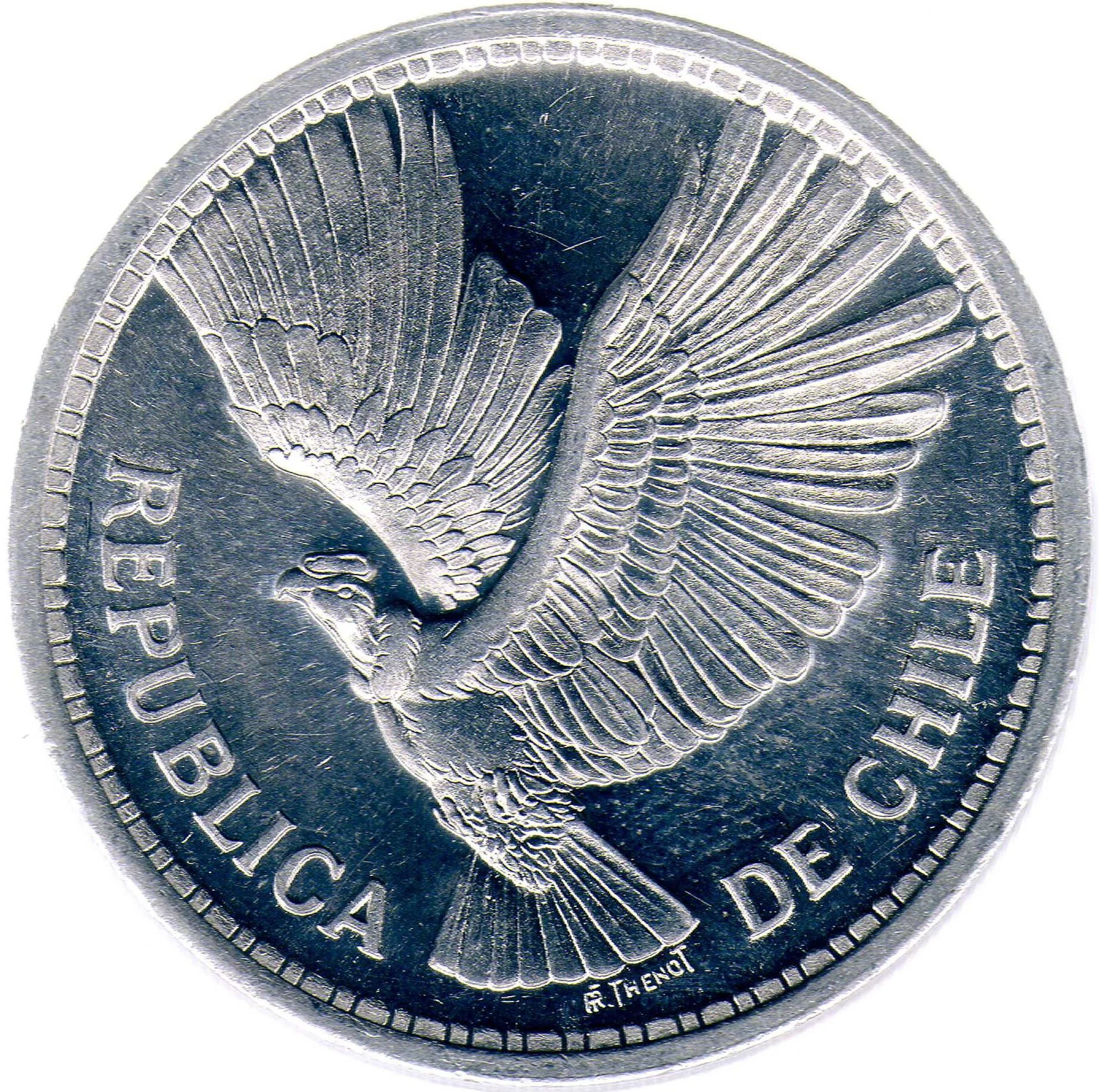
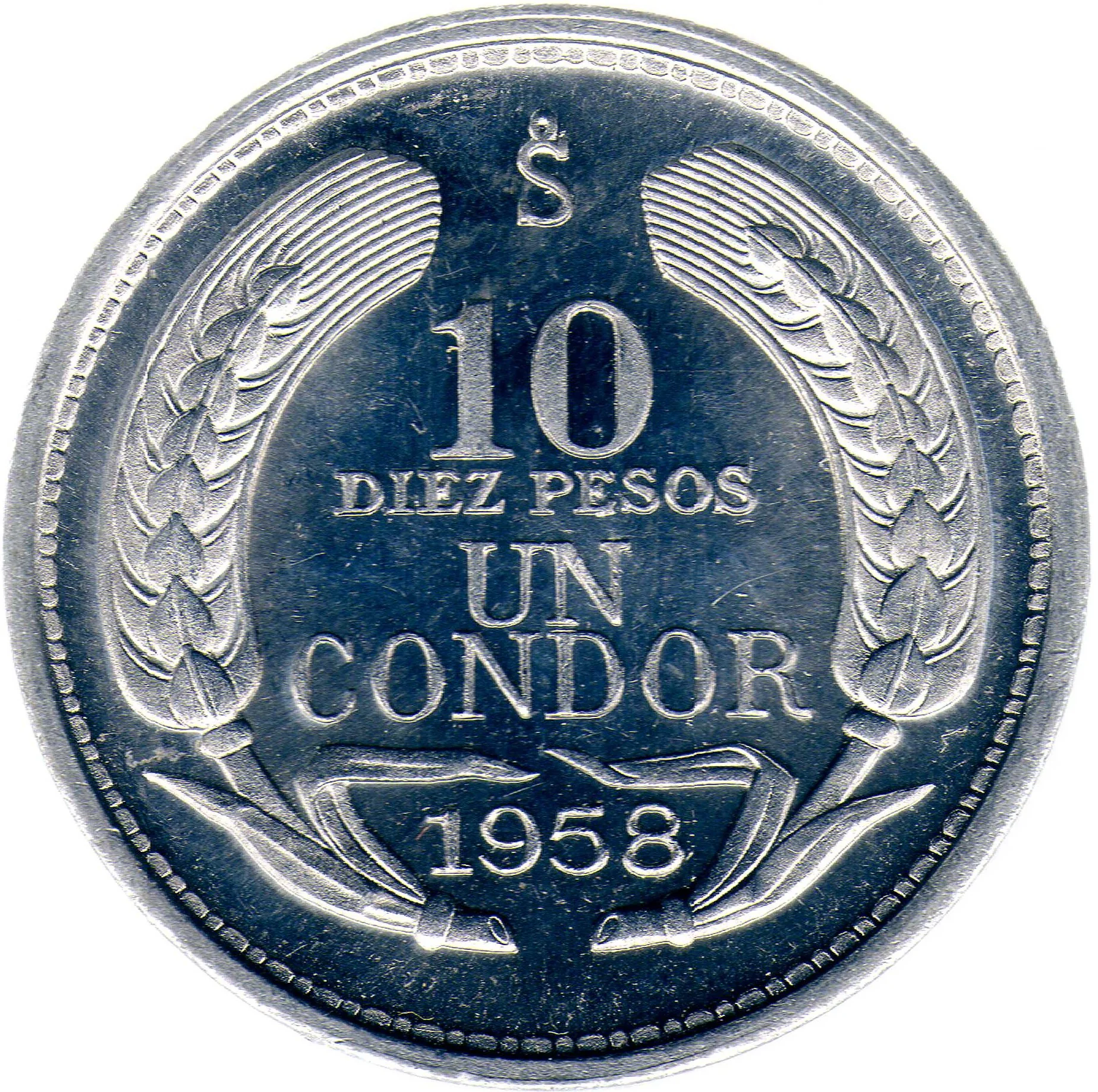

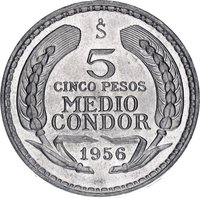
Obverse
Description:
Soaring Andean Condor
Inscription:
REPUBLICA DE CHILE
R.THENOT
R.THENOT
Translation:
REPUBLIC OF CHILE
R. THENOT
R. THENOT
Script: Latin
Language: Spanish
Engraver: René Thénot
Reverse
Edge
Plain
Mints
| Name | Mark |
|---|---|
| Casa de Moneda de Chile | (So) |
Mintings
| Year | Mint Mark | Mintage | Quality | Collection |
|---|---|---|---|---|
| 1956 | So | 13,100,000 | ||
| 1957 | So | 28,800,000 | ||
| 1958 | So | 44,500,000 | ||
| 1959 | So | 10,220,000 |
Historical background
By 1956, Chile was grappling with severe inflation and a currency crisis that had been building for over a decade. The Chilean peso, which had been relatively stable in the early 1940s, entered a period of rapid devaluation driven by expansive fiscal policies, heavy state intervention in the economy, and the financing of industrialization and social programs through money creation. This period, influenced by the policies of President Carlos Ibáñez del Campo (1952-1958), saw annual inflation soar to over 80% in 1955, eroding purchasing power and creating widespread economic instability. Multiple exchange rates and strict currency controls, managed by the Central Bank, led to a thriving black market for dollars, further distorting the economy and undermining confidence in the peso.
The situation reached a critical point, prompting the government to seek external assistance. In 1955, Chile secured a standby agreement with the International Monetary Fund (IMF), which demanded a stabilization plan to curb inflation and restore balance. The cornerstone of this plan was the "Klein-Saks Mission," a group of American economists hired to advise the government. Their recommendations, implemented in 1956, included sharp austerity measures: drastic cuts in public spending, the elimination of consumer subsidies (notably on bread and public transport), a unified and devalued exchange rate, and efforts to control the money supply. The goal was to halt hyperinflation and stabilize the currency through orthodox shock therapy.
The immediate social and political consequences of the 1956 stabilization plan were profound. The removal of subsidies triggered massive protests and strikes, as the cost of living skyrocketed for ordinary Chileans. While the plan succeeded in temporarily reducing inflation to around 17% by 1958, it was politically unpopular and only partially addressed deep-seated structural issues. The currency stabilization came at the cost of a sharp recession and rising unemployment, setting the stage for continued political debate over economic management. This crisis and its orthodox remedy marked a pivotal moment, highlighting the severe tensions between inflation control and social welfare in mid-20th century Chile.
The situation reached a critical point, prompting the government to seek external assistance. In 1955, Chile secured a standby agreement with the International Monetary Fund (IMF), which demanded a stabilization plan to curb inflation and restore balance. The cornerstone of this plan was the "Klein-Saks Mission," a group of American economists hired to advise the government. Their recommendations, implemented in 1956, included sharp austerity measures: drastic cuts in public spending, the elimination of consumer subsidies (notably on bread and public transport), a unified and devalued exchange rate, and efforts to control the money supply. The goal was to halt hyperinflation and stabilize the currency through orthodox shock therapy.
The immediate social and political consequences of the 1956 stabilization plan were profound. The removal of subsidies triggered massive protests and strikes, as the cost of living skyrocketed for ordinary Chileans. While the plan succeeded in temporarily reducing inflation to around 17% by 1958, it was politically unpopular and only partially addressed deep-seated structural issues. The currency stabilization came at the cost of a sharp recession and rising unemployment, setting the stage for continued political debate over economic management. This crisis and its orthodox remedy marked a pivotal moment, highlighting the severe tensions between inflation control and social welfare in mid-20th century Chile.

🌱 Very Common