

10 forint – Hungary
Add to wishlist
Circulating commemorative coins
Commemoration: F.A.O.
Hungary
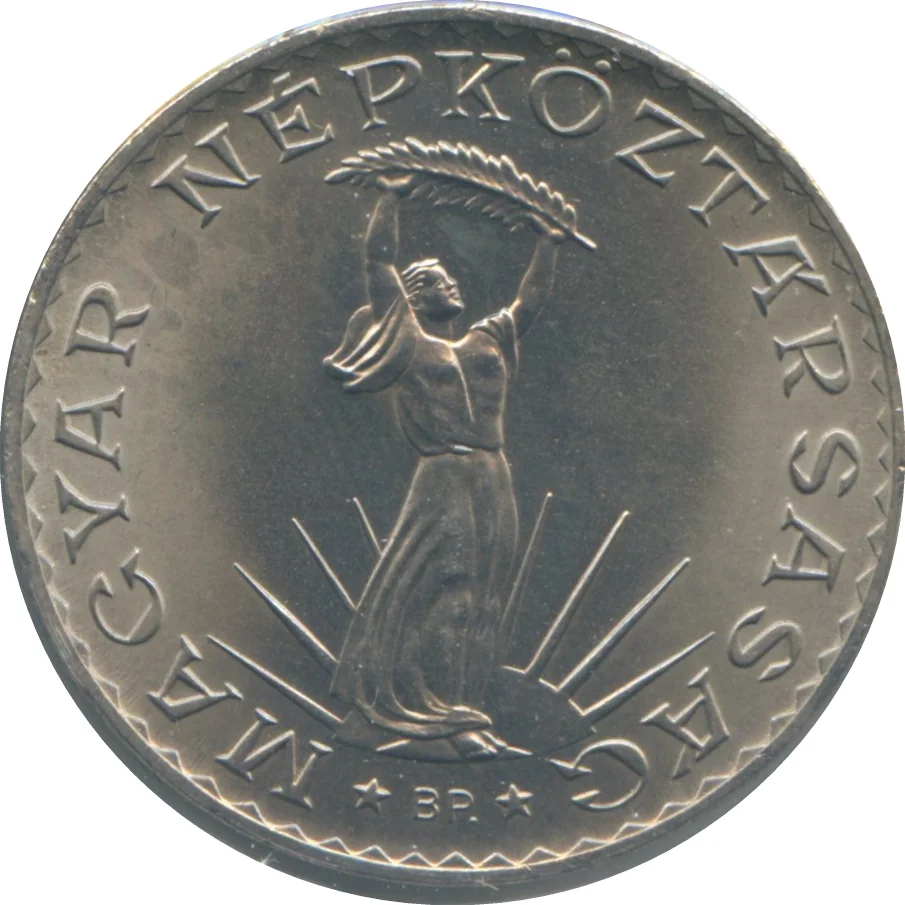
Obverse
Description:
Budapest's "Statue of Liberaty"
Inscription:
MAGYAR NÉPKÖZTÁRSASÁG
* BP. *
* BP. *
Translation:
HUNGARIAN PEOPLE'S REPUBLIC
* BUDAPEST *
* BUDAPEST *
Script: Latin
Language: Hungarian
Engraver: Dezső Kovács
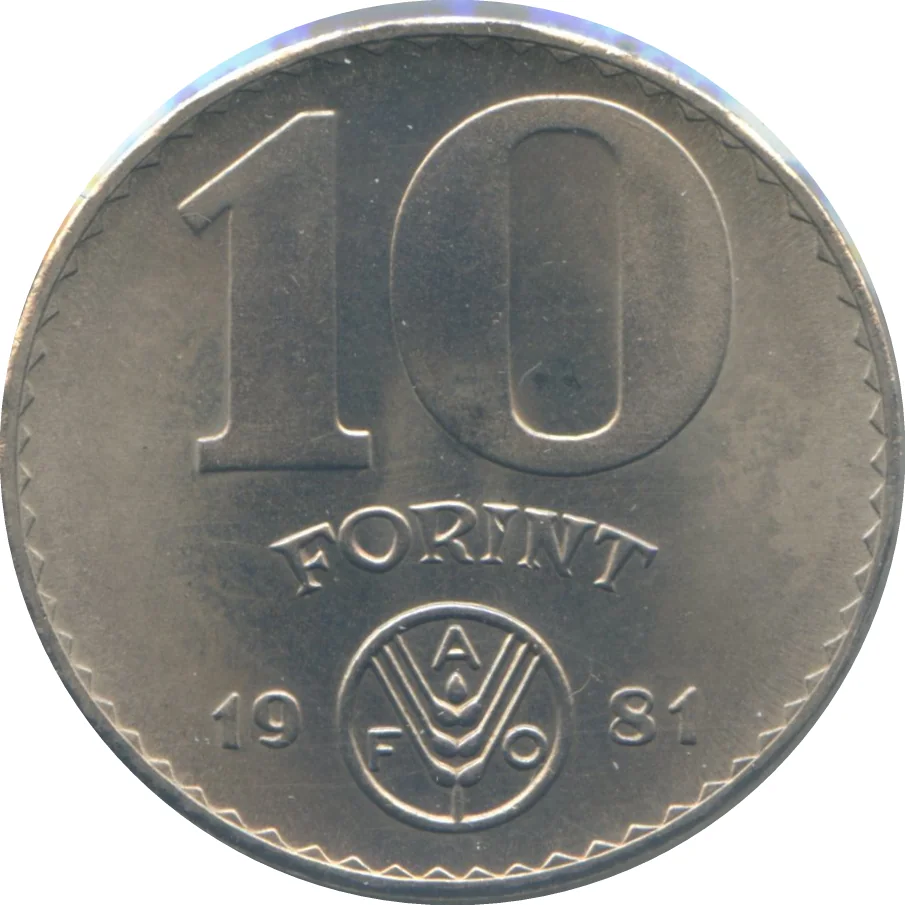
Reverse
Description:
Inscribed with FAO emblem
Inscription:
10
FORINT
19 81
FAO
FORINT
19 81
FAO
Translation:
Ten Forint, 1981, Food and Agriculture Organization of the United Nations.
Script: Latin
Engraver: Sándor Boldogfai Farkas
Edge
Plain with incuse pattern.
Categories
| Organization> FAO |
Mints
| Name | Mark |
|---|---|
| Hungarian mint | BP. |
Mintings
| Year | Mint Mark | Mintage | Quality | Collection |
|---|---|---|---|---|
| 1981 | BP. | 60,000 |
Historical background
By 1981, Hungary's currency situation was a critical symptom of its deepening economic crisis within the Soviet bloc. The country, which had pioneered "Goulash Communism" with limited market reforms in 1968, was now buckling under the weight of massive foreign debt, estimated at nearly $9 billion. This debt had been accrued during the 1970s to finance imports and maintain living standards, but global shocks like the oil crises exposed its fragility. The Hungarian Forint (HUF) was non-convertible and its official exchange rate, set by the state, bore little relation to its real value, creating a vast black market for hard currencies like the US dollar and Deutsche Mark.
Internally, the currency regime was complex and unsustainable. While the government maintained an artificial official rate, it operated a more realistic "non-commercial" tourist rate and tolerated a thriving black market where the forint traded at a fraction of its official value. This multi-tier system led to severe distortions, encouraging corruption and hoarding of hard currency. The National Bank of Hungary struggled to defend the forint as the country's trade deficit ballooned, driven by inefficient state industries and the need to import expensive energy. Inflation, though officially suppressed, was rampant in a repressed form, manifesting as widespread shortages of consumer goods.
The situation forced the government toward a pivotal and painful decision. In an attempt to stabilize finances and secure crucial loans from the International Monetary Fund (IMF) and Western banks, Budapest implemented a series of austerity measures. This included devaluing the forint, cutting subsidies, and allowing some prices to rise—a move that eroded living standards and marked a retreat from the social contract of "Goulash Communism." Thus, the currency turmoil of 1981 was a clear indicator that Hungary's reform model had reached its limits, setting the stage for the more radical economic transformations and mounting political pressures of the decade.
Internally, the currency regime was complex and unsustainable. While the government maintained an artificial official rate, it operated a more realistic "non-commercial" tourist rate and tolerated a thriving black market where the forint traded at a fraction of its official value. This multi-tier system led to severe distortions, encouraging corruption and hoarding of hard currency. The National Bank of Hungary struggled to defend the forint as the country's trade deficit ballooned, driven by inefficient state industries and the need to import expensive energy. Inflation, though officially suppressed, was rampant in a repressed form, manifesting as widespread shortages of consumer goods.
The situation forced the government toward a pivotal and painful decision. In an attempt to stabilize finances and secure crucial loans from the International Monetary Fund (IMF) and Western banks, Budapest implemented a series of austerity measures. This included devaluing the forint, cutting subsidies, and allowing some prices to rise—a move that eroded living standards and marked a retreat from the social contract of "Goulash Communism." Thus, the currency turmoil of 1981 was a clear indicator that Hungary's reform model had reached its limits, setting the stage for the more radical economic transformations and mounting political pressures of the decade.
🌱 Fairly Common